
It’s 9 a.m., the kids are already asking “what are we doing today,” and your list of ideas ran out sometime around Tuesday. If you’re searching for what to do with kids right now — whether it’s a free afternoon, a rainy weekend, or the entire stretch of summer break — you don’t need a Pinterest board. You need a short list that actually works, sorted by how much time, mess, and money you’ve got.
This guide breaks it down by setting: indoor, outdoor, rainy-day, and screen-time-smart options, plus a quick-reference table you can scan in ten seconds.
Quick-Pick Table: What to Do With Kids by Situation
| Situation | Best Option | Time Needed | Cost |
|---|---|---|---|
| 15 minutes, no prep | Scavenger hunt around the house | 15–20 min | Free |
| Rainy afternoon | Indoor obstacle course with couch cushions | 30–45 min | Free |
| Need them tired out | Backyard or park water balloon relay | 45–60 min | Low |
| Toddler + older sibling together | Sensory bin (rice, scoops, small toys) | 20–40 min | Low |
| Long car ride or waiting room | “I spy” or license plate bingo | Ongoing | Free |
| Group of friends over | Cardboard box building challenge | 1 hour+ | Low |
| Screen time, but make it count | Co-watched educational show + discussion | 30–60 min | Free |
Indoor Activities That Don’t Feel Like a Time-Killer
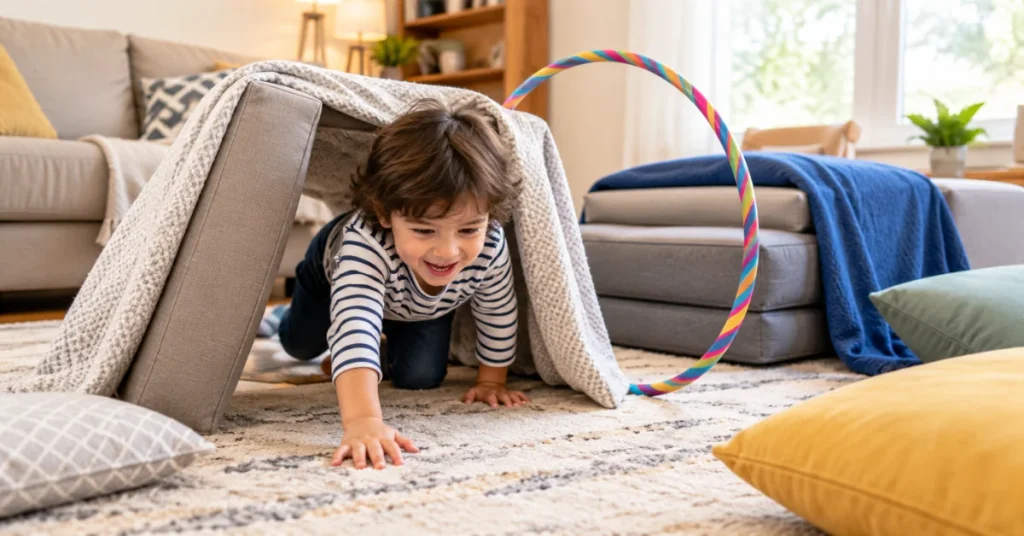
Anyone who has managed a full day home with kids knows the real challenge isn’t finding an activity — it’s finding one that buys you more than ten minutes of peace.
A few that consistently hold attention:
- Indoor camping. Blankets over chairs, flashlights, and a “campfire” made from an old phone playing crackling-fire sounds. Works for ages 3 and up.
- DIY obstacle course. Couch cushions, painter’s tape lines on the floor, a hula hoop to crawl through. Costs nothing, burns real energy.
- Kitchen science. Baking soda and vinegar volcanoes, or homemade slime, teach basic chemistry while doubling as sensory play.
- Box fort building. A leftover delivery box, some markers, and thirty minutes of unsupervised creativity.
The common thread across all four: kids do the building, not you. Activities that hand control to the child tend to run longer and need less adult refereeing than ones you have to run yourself.
A quick safety note: sensory bins and small-object play (rice, beads, small building pieces) are a choking hazard for children under 3, so keep those activities supervised and age-checked, and clear couch-cushion obstacle courses of anything breakable before letting kids loose on them.
Outdoor Ideas When You Need Them to Burn Energy
Parents dealing with a especially wound-up kid tend to reach for outdoor options first, and for good reason — the American Academy of Pediatrics has long linked regular outdoor play to better sleep and attention regulation in young children.
Reliable go-tos:
- Nature scavenger hunt. List five to ten items (a pinecone, something red, a bug) and let them lead the search.
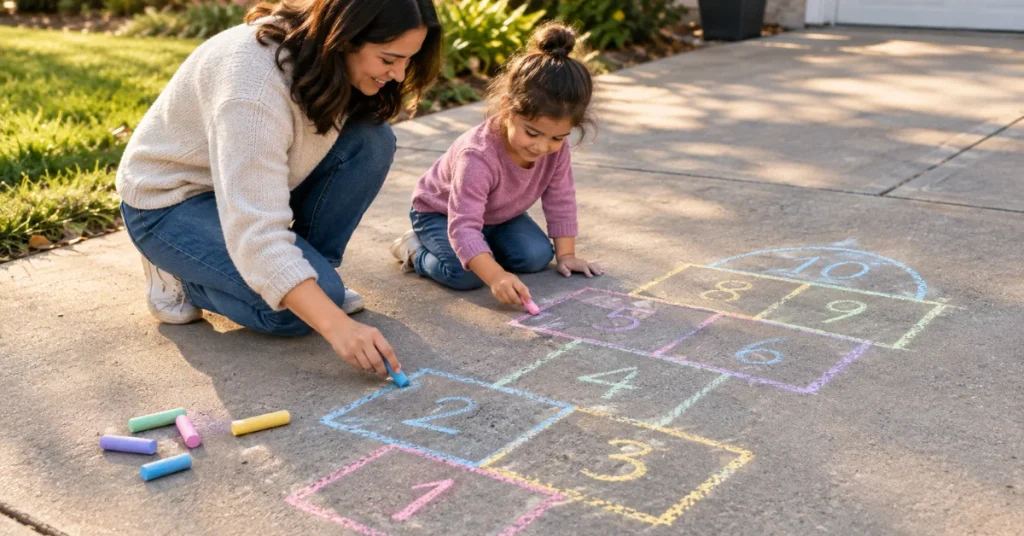
- Chalk obstacle course on the driveway — hopscotch squares, a balance beam line, a “lava” zone to jump over.
- Water play. Sprinklers, a kiddie pool, or a simple water balloon toss on hot days.
- Bike or scooter scavenger ride around the block, checking off landmarks on a list.
If you’re short on backyard space, a local park with a splash pad or trail loop covers most of the same ground. On hot days, keep water breaks and sunscreen part of the routine — the same energy-burning benefits apply whether it’s 15 minutes or an hour outside.
How Much Activity Do Kids Actually Need?
It’s a fair question to ask before picking activities: is any of this actually doing anything? The World Health Organization has a concrete answer, and it’s more specific than most “go play outside” advice.
| Age Group | WHO Daily Activity Guideline |
|---|---|
| Under 1 year | Multiple sessions of floor-based play throughout the day, including at least 30 minutes in tummy time |
| 1–2 years | At least 180 minutes of activity of any intensity, spread across the day |
| 3–4 years | At least 180 minutes total, including at least 60 minutes of moderate-to-vigorous activity |
| 5–17 years | At least 60 minutes of moderate-to-vigorous activity daily |
None of this needs to be a single scheduled block. A scavenger hunt, a chalk obstacle course, and a bike ride around the block can each cover a chunk of that daily total on their own, which is part of why outdoor ideas are worth prioritizing over indoor ones when the weather allows it.
Rainy-Day and Screen-Time-Smart Options
Rainy days are where most parents run out of ideas fastest, and it’s also where screens quietly take over by default. That’s worth pausing on for a second, because the guidance here actually shifted this year.
The American Academy of Pediatrics released updated media-use guidance in early 2026 — the first major update in a decade — and it moved away from a strict hours-per-day number toward what it calls the “5 Cs”: Child, Content, Calm, Crowding-out, and Communication. As a rough guide, the update still suggests under one hour a day for toddlers and preschoolers, and one to two hours of recreational screen time for school-aged kids and teens, though the bigger message is that content quality and context matter more than the clock.
That’s useful, practical news for a rainy day: a screen isn’t off-limits, but a co-watched, high-quality show followed by a short conversation about it does more for a child than the same thirty minutes spent scrolling alone. Some low-mess alternatives that fill the same gap:
- Puzzle or LEGO table set up in a corner they can return to all day.
- Indoor bowling with empty water bottles and a soft ball.
- Story chain game — one person starts a story, each person adds a sentence.
- Baking together, even something as simple as decorating pre-made cookies.
What to Do With Kids at Different Ages
A three-year-old and a ten-year-old don’t want the same afternoon, and pretending otherwise is how you end up with a bored kid and a meltdown.
Toddlers (1–3): Short, sensory-heavy activities — stacking cups, water play, simple sorting games. Attention spans run 10–15 minutes, so having three small activities ready beats planning one long one.
Preschoolers (3–5): Pretend play, simple crafts, and short outdoor games. This is the age where imaginative play (store, doctor, restaurant) does most of the heavy lifting.
School-age (6–12): Board games, building challenges, bike rides, and simple cooking tasks that give them real responsibility. Kids in this range also do well with a loose plan they help choose, rather than one handed to them.
Tweens and teens: Less about entertaining them and more about giving them a reason to be around you — cooking a meal together, a shared show, a drive with music they picked.
What Parents Actually Notice Works
Anyone who has spent a full week solo-parenting picks up on the same pattern fast: activities that involve a choice — picking between two options, choosing the color of the chalk, deciding the story’s next line — hold attention longer than ones handed down as instructions. And activities that don’t require your full participation, just your presence nearby, are the ones that actually give you a break.
Rotation matters too. Keeping a small box of “boredom activities” — a deck of cards, a few craft supplies, a puzzle — and only pulling it out when needed keeps novelty alive longer than leaving everything out all the time.
Conclusion
There’s no single right answer to what to do with kids — it depends on the day, the weather, the age, and honestly, how much energy you’ve got left. What holds up across ages and situations is simple: give kids some control over the activity, keep a short rotating list ready instead of starting from scratch each time, and don’t feel guilty reaching for a screen occasionally as long as it’s the kind you’re watching together. A short list you can actually use beats a long list you’ll never open.
The activity and screen-time figures above are general guidelines from the WHO and AAP, not individual medical advice — check with your child’s pediatrician for guidance specific to their needs.
FAQs
What can I do with kids when I’m too tired to plan anything?
Keep a “boredom box” pre-packed with cards, a puzzle, and simple craft supplies. Grab it and let them lead — you don’t need to plan or participate to make it work.
What to do with kids on a rainy day with no budget?
An indoor obstacle course with couch cushions, a blanket fort, or a story chain game cost nothing and can run 30–45 minutes.
How much screen time is okay if I need a break?
The AAP’s 2026 guidance points to roughly one hour a day for toddlers and one to two hours for school-age kids and teens, with quality and co-viewing mattering more than the exact number.
What to do with kids of very different ages at the same time?
Pick an activity with layered complexity — a sensory bin works for a toddler while an older sibling adds sorting or counting rules to the same materials.
What are good outdoor activities that don’t need special equipment?
A nature scavenger hunt, chalk hopscotch, or a simple game of tag cover most ages and need nothing but a driveway or small yard.
How much physical activity do kids actually need each day?
The WHO recommends at least 60 minutes of moderate-to-vigorous activity daily for ages 5–17, and at least 180 minutes of any-intensity activity for children aged 1–4, including 60 active minutes for 3–4 year-olds.