
“Mum, I’m bored” gets said about four times a day in most houses with a 12-year-old, and by the third week of any school break it starts to feel like a full-time job just answering it. If you’re searching for what to do when bored for 12 year-olds at home right now, in 2026, you’re nowhere near alone, and the fix doesn’t need a Pinterest board or a trip to the shop. Twelve sits at an odd age. Too old for the toy box, too young for a part-time job, and stuck at home more than they’d ever admit to a friend. This isn’t another “build a fort” list you’ve already tried. It’s activities that hold a 12-year-old’s attention, plus the actual research on why a stretch of boredom isn’t the disaster it looks like from the kitchen table.
Fast answer: solo ideas like stop-motion videos, baking, or journaling, group games like obstacle courses and cooking contests, and a pre-stocked “boredom kit” cover most situations in under ten minutes of setup. The full breakdown, including what the research actually says about not fixing boredom too quickly, is below.
Why 12-Year-Olds Get Bored Faster Than Everyone Else
Twelve is a strange in-between age. Too independent to want a parent picking the activity, too young to just leave the house for a few hours on their own terms. Clinicians at the Child Mind Institute point out that when a kid says “I’m bored,” it’s often code for something else entirely, hunger, restlessness, or a craving for more say over how their own time gets spent. That gap between what a 12-year-old actually wants (control) and what home life offers (rules, chores, waiting on an adult) shows up as boredom, fast.
Not every 12-year-old carries the same amount of independence, either. Some are ready to bake unsupervised or take apart an old gadget, others aren’t quite there yet. It’s worth judging each idea below against what already feels safe and doable for your particular kid, not just the age on a birth certificate.
Screens factor in here too. The American Academy of Pediatrics updated its guidance in 2026, shifting away from strict hour counts toward a framework built on quality, context, and what the screen time is replacing. In plain terms: the real question isn’t “how many hours,” it’s “what is this pushing out.” If a tablet is crowding out sleep or time outside, that’s the actual problem, not the device sitting on the table.
What to Do When Bored for 12 Year-Olds at Home: Solo Ideas
Some days there’s no sibling free, no friend online, and no adult with time to referee a board game. That’s when solo activities carry the whole afternoon. These work whether it’s a rainy Tuesday or a random Saturday with nothing on the calendar:
- Shoot a stop-motion short using an old phone and LEGO minifigures
- Learn one new skill off a free video tutorial, juggling, a card trick, a skateboard move
- Build a paper roller coaster from cardboard, tape, and marbles
- Write and illustrate a short comic starring the family pet
- Take apart an old gadget, with permission, just to see how it’s built
- Bake something using only pantry staples, like flatbread or a simple cookie dough
- Start a “someday” list of games or trips to save birthday money toward
- Teach the dog or cat one new trick using small treats
- Redesign a bedroom on paper before touching a single piece of furniture
- Keep a one-line-a-day journal for a month and see what patterns show up
- Reorganize the pantry or garage and negotiate a small “job rate” for it
One safety note: gadget teardown, baking, or anything involving tools or heat still needs an adult somewhere nearby, even if a 12-year-old insists they’ve got it handled.
Loud Ideas for When Siblings or Friends Are Around

Company changes the math completely. An indoor obstacle course built from couch cushions and painter’s tape works for almost any number of kids. A cooking competition judged by a parent, ingredients pulled from whatever’s already in the fridge, turns into a real contest fast. A scavenger hunt with riddles hidden around the house keeps younger siblings included without babysitting them directly.
When the sibling gap is wide, say a 12-year-old paired with a 5- or 6-year-old, the same game rarely suits both. Splitting one activity into two difficulty levels, a simpler scavenger hunt list for the younger one and a timed version for the older one, keeps both kids engaged without either one dragging the other down.
Anyone who’s hosted a group of tweens knows the winning formula: give them a loose structure, not a rigid one. A walkie-talkie spy mission between rooms, a backyard “Olympics” with three made-up events, or a bracket-style board game tournament all let kids self-organize the details, which is usually the part they enjoy most.
Rainy Day, Sick Day, No Wifi — Different Problems Need Different Fixes
Not every bored afternoon is the same problem. A sick day calls for low-energy options: audiobooks, a puzzle, drawing in bed. A wifi outage calls for genuinely offline fun: physical books, card games, journaling, or a building project that doesn’t need a single screen. A budget-tight week calls for zero-cost ideas using what’s already in a junk drawer or recycling bin.
A school night carries its own limits too. Homework’s usually still waiting and bedtime is close, so quick 15-to-20-minute solo ideas fit better there than an hour-long group game. Save the bigger projects for weekends or a longer break instead.
Only children and kids with siblings need different framing as well. A solo kid often does better with a project that has a clear finish line, like finishing a model or a drawing. A kid with built-in playmates usually just needs a nudge toward a shared goal before the arguing starts.
| Category | Best For | Time Needed | Cost | Energy Level |
|---|---|---|---|---|
| Quick Solo | Only child, quiet mood | 15–60 min | Free | Low–Medium |
| Group/Social | Siblings or friends over | 30–90 min | Free–$10 | High |
| Low Energy | Sick day, tired kid | 10–45 min | Free | Very Low |
| No-Wifi/Offline | Internet down, screen limits | 20–120 min | Free | Medium |
Some 12-year-olds, including many with ADHD or sensory sensitivities, do better with movement-heavy or fidget-friendly options than with sit-still crafts. Swapping a drawing project for something like an obstacle course or a hands-on building kit often holds their attention longer than a quieter activity would.
Money-Making Ideas for Bored (and Broke) 12-Year-Olds
Boredom and an empty wallet often show up together at this age, right as allowance stops covering what they actually want. A few low-key entrepreneurial ideas fill both gaps at once:
- Offer to be a “mother’s helper” for a neighbor with younger kids, one hour at a time
- Sell outgrown toys or games at a driveway table or through a family-run online listing
- Walk a neighbor’s dog for a small flat fee, with a parent’s okay and a nearby adult for the first few walks
- Take art commissions from cousins or classmates for birthday cards or small drawings
- Wash cars or pull weeds on the block for a set price per job
Anyone who’s managed a household of tweens knows these small jobs teach budgeting faster than a lecture ever does, and they solve the boredom problem as a side effect.
The Notepad Experiment: What Boredom Studies Reveal
Before rushing to fix boredom, it helps to know what’s actually happening in a bored brain. A 2013 study by psychologists Sandi Mann and Rebekah Cadman at the University of Central Lancashire found that people who sat through a genuinely dull task first came up with more creative ideas afterward than people who skipped straight to the creative task. Mann later told BBC Science Focus that handing a kid one plain object, like a notepad and pen, often keeps them occupied far longer than a whole bag of toys, since there’s nothing else competing for attention.
Mann’s research goes further than that general finding. In work she did for an airline testing how to keep kids entertained on long flights, giving over a whole bag of toys led to kids picking up each item for a few seconds before dropping it. Handing over one object at a time kept them occupied far longer. The same logic applies at home: offering two or three options instead of twenty, one at a time, tends to work better than dumping every toy box on the floor at once.
On timing, most child psychologists suggest giving a genuinely bored kid ten to fifteen minutes before stepping in with a suggestion. That’s usually enough time for a 12-year-old to land on something themselves, without the wait turning into real distress.
The Child Mind Institute frames the same idea from a different angle: boredom pushes kids to plan, organize, and troubleshoot on their own, skills that carry straight into schoolwork and group projects later on. None of this means a 12-year-old should sit staring at a wall all afternoon. It means the ten restless minutes before they find their next activity are doing more work than they look like from across the room.
Screens Aren’t the Enemy, But They’re Not the Whole Answer Either
A 12-year-old reaching for a phone the second boredom hits isn’t automatically a bad sign. Mayo Clinic’s guidance on children’s screen use points parents toward judging quality and context over raw minutes, plus building in a few device-free stretches during meals or a set evening block. Most families that land on something workable don’t ban screens outright. They just make the phone one option among several instead of the automatic default.
For the actual conversation, a specific ask usually works better than a flat rule. Something like, “try two things from this list before you pick up your phone,” gives a 12-year-old a clear, negotiable target instead of a blanket no, and it tends to cause far less pushback than confiscating the device outright. Moving the charger to a shared space instead of a bedroom does more than any rule printed on the fridge.
The Real Answer to What to Do When Bored for 12 Year-Olds at Home
Strip away the gadgets and the printable checklists, and the real answer to what to do when bored for 12 year-olds at home comes down to raw materials plus a little distance from adult supervision. A stack of cardboard, a deck of cards, an open afternoon. That’s closer to a sandbox than a script, and 12-year-olds tend to build something better out of a sandbox than out of someone else’s instructions.
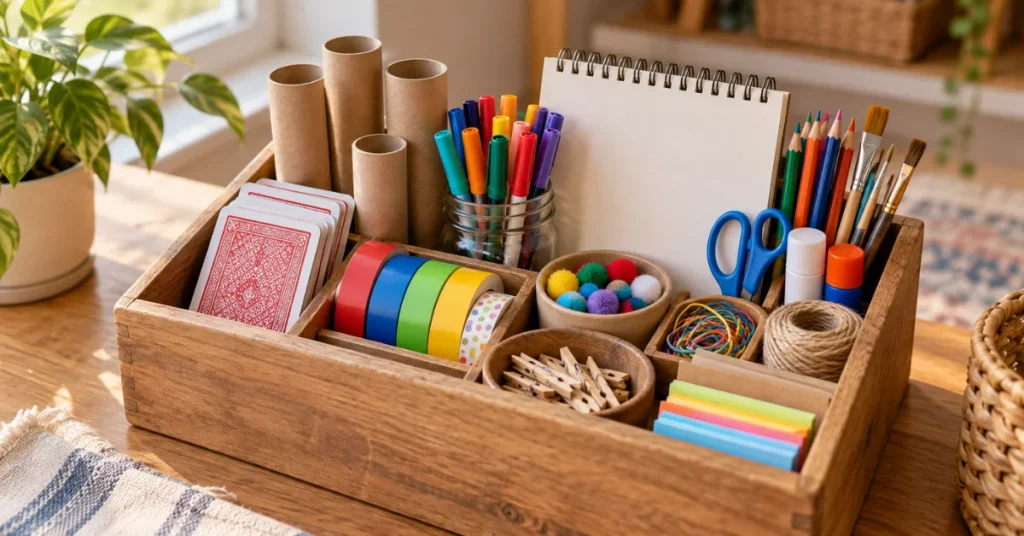
A little preparation heads off most of the daily “I’m bored” cycle before it even starts. A simple box stocked with cards, cardboard, tape, and a sketchpad, kept somewhere easy to grab, turns “I’m bored” into “let me check the box” without a parent doing anything in the moment.
It’s also worth knowing the difference between ordinary boredom and something that needs more attention. A kid who occasionally says they’re bored is normal. A kid who’s pulling away from friends, losing interest in things they used to enjoy, and seems flat rather than restless is showing something different, and that’s worth a conversation with a pediatrician rather than a new activity list.
Treat the ideas above as a starting point, not an order to follow.
Conclusion
Twelve-year-olds don’t need a packed schedule to stay entertained. They need a stocked junk drawer, a little unstructured time, and permission to figure the rest out themselves. Come back to this list next time the “I’m bored” chorus starts up, because knowing what to do when bored for 12 year-olds at home usually means having a handful of low-effort starting points ready, not a full day planned out in advance.
This article is for general informational purposes only. Activities involving tools, heat, gadgets, or outdoor jobs should be supervised by a parent or guardian based on the child’s individual maturity and safety awareness.
FAQs
What can a 12-year-old do alone at home for hours?
Projects with a clear finish line work best solo, a stop-motion video, a baking project, or a model build. These hold attention longer than open-ended play because there’s a visible end point to work toward.
Is it bad to let a 12-year-old be bored?
Not according to the research. Short stretches of boredom before finding the next activity are linked to stronger planning and problem-solving skills, according to child development specialists at the Child Mind Institute.
How much screen time is okay for a 12-year-old in 2026?
The AAP moved away from a fixed hour count in its 2026 update. The current advice weighs what the screen use is replacing, like sleep or outdoor time, over the raw number of minutes logged.
What are cheap boredom-busters for tweens?
Cardboard builds, card game tournaments, scavenger hunts, and small neighborhood jobs like dog walking cover both the boredom and the empty-wallet problem without spending anything upfront.
What if my 12-year-old rejects every idea I suggest?
Offer a couple of choices instead of one fixed suggestion, and hand them over one at a time rather than a long list. Kids this age often push back on anything that feels imposed, so framing it as “pick one” rather than “do this” usually gets further.
How do I get my 12-year-old off their phone without a fight?
Moving the charger out of the bedroom and offering a specific alternative activity, rather than just taking the phone away, tends to cause far less pushback than a blanket ban.