
A one-year-old who just found their feet and a nearly-three-year-old negotiating bedtime don’t look like they belong in the same category. Yet parents ask how old is a toddler more than almost any other question about early childhood, and the honest answer sits in a wider window than most people expect.
The short version: toddlerhood generally runs from a child’s first birthday to somewhere around age three. But that single sentence hides a surprising amount of disagreement among the experts who study it, and getting the range right actually matters for parents trying to make sense of milestones, sleep charts, and daycare enrollment forms.
How Old Is a Toddler, Officially?
The American Academy of Pediatrics puts the toddler stage at 12 to 36 months, and most pediatric guidance in the United States follows that lead. The World Health Organization uses a similar 12-to-36-month window when tracking global child growth and nutrition standards, so the range holds up internationally too.
Not everyone draws the line in exactly the same place, though. Some agencies split the period into two shorter chunks — one to two years and two to three years — because the skills a child has at 14 months barely resemble what they can do at 30 months. Anyone who has chased a wobbly one-year-old and then tried to keep up with a sprinting two-and-a-half-year-old knows exactly why that split exists.
A few sources stretch toddlerhood slightly earlier, starting around 18 months once walking is well established, or slightly later, letting it run until a child’s fourth birthday. None of these variations are wrong. They’re just built for different purposes, sleep guidance, milestone tracking, preschool cutoffs, and that’s worth remembering the next time two parenting books give you two different numbers.
Parents of children born early get an extra wrinkle here. For babies born before 37 weeks, doctors typically use “corrected age,” which subtracts the number of weeks premature from the child’s actual age when checking milestones. A premature toddler who looks a bit behind on the standard chart is very often right on track once corrected age is used instead.
Why the Toddler Age Range Isn’t One Fixed Number
Here’s the thing. “Toddler” was never a strict medical category to begin with — it’s a descriptive term that grew out of the word “toddle,” meaning to walk unsteadily. It was coined to describe behavior, not a birthday.
That’s exactly why answering how old is a toddler produces slightly different numbers depending on who’s asked. A pediatrician thinking about vaccination schedules draws the line differently than a childcare center building age-based classrooms, and a sleep specialist writing nap guidelines draws it differently again.
| Source Type | Toddler Age Range Given |
|---|---|
| American Academy of Pediatrics | 12–36 months |
| World Health Organization | 12–36 months |
| CDC milestone pages | Split into 1–2 years and 2–3 years |
| Sleep guidance organizations | 1–2 years (older toddlers grouped with preschoolers) |
| Common parenting usage | 1–3 years, sometimes extended to 4 |
The table isn’t a sign that anyone’s guessing. It reflects real differences in what each group actually needs the age bracket for.
What Actually Happens During the Toddler Years
Numbers aside, the toddler stretch is one of the busiest developmental windows a child will ever go through. Physical growth slows down compared to infancy, but nearly everything else speeds up.
Walking usually arrives first, somewhere between 12 and 15 months for most children, though plenty walk earlier or later without anything being wrong. Running, climbing, and eventually pedaling a tricycle follow in roughly that order by the time a child nears their third birthday.
Language explodes during this window too, and the range here is genuinely wide. Some toddlers combine words into short phrases by 18 months. Others say very little at that age and then catch up quickly a few months later — both patterns fall within what’s considered typical. Households raising bilingual toddlers often see a slightly different pattern too: total vocabulary across both languages tends to match single-language peers, even if each individual language looks a little behind on its own.
Emotionally, this is where independence starts showing teeth. Toddlers want to do things themselves, understand more than they can say, and get frustrated fast when the gap between wanting and doing feels too wide. It’s the root of most tantrums, and it’s completely expected rather than a sign of a problem.
Sleep needs shift as well. Toddlers between one and two years typically need somewhere around 11 to 14 hours across a 24-hour stretch, including naps, and that requirement stays fairly steady before easing slightly closer to age three.
It’s worth flagging a few genuine warning signs too, mainly so parents know when a check-in is worthwhile rather than something to lose sleep over. Not walking by 18 months, not saying any words by 16 months, or losing skills a child previously had are all reasons to bring it up at the next visit. On their own these signs don’t confirm a problem — they just signal that a closer look makes sense.
Pediatric guidance also recommends holding off on screen media, other than video chatting with family, until around 18 months, which lines up almost exactly with the toddler stage’s early half.
Toddler vs. Infant vs. Preschooler — Where the Lines Sit
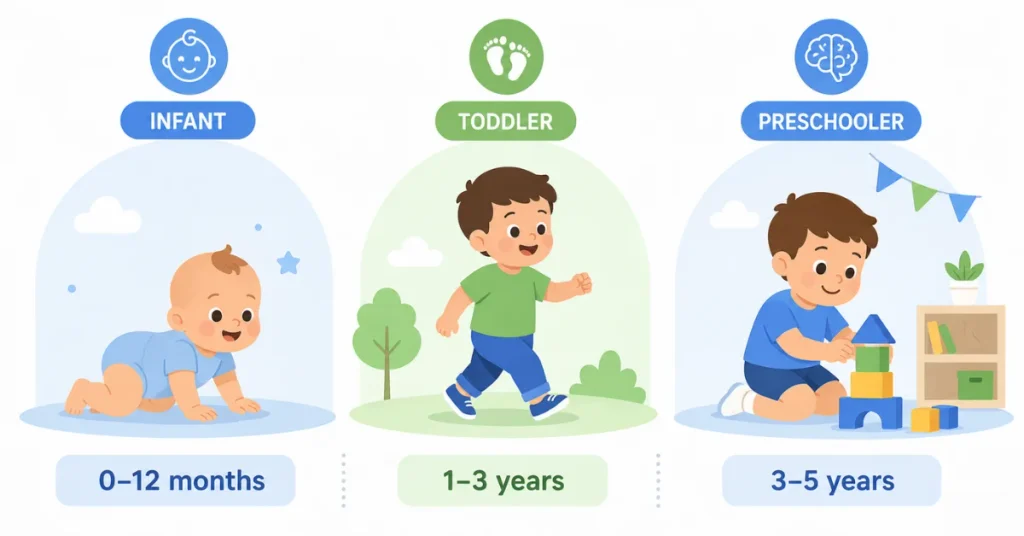
A quick comparison helps make the age question less abstract:
- Infant (0–12 months): Rapid physical growth, learning to sit, crawl, and eventually stand.
- Toddler (1–3 years): Walking, talking, and asserting independence take center stage.
- Preschooler (3–5 years): Vocabulary and social play expand fast, and formal early learning often begins.
Anyone who has moved a child through daycare classrooms recognizes these categories instantly — they’re the same age bands most centers use to group children for activities and staffing ratios. Many centers even split the toddler room further into a “young toddler” group for roughly 12 to 24 months and an “older toddler” group for 24 to 36 months, since the two halves need very different supervision and activities.
Practical Toddler Age Milestones Parents Search For
Beyond development charts, several everyday decisions hinge directly on a toddler’s age, and these are the practical questions parents type into search bars right after asking how old is a toddler.
| Milestone or Decision | Typical Toddler Age |
|---|---|
| Switch from formula/breast milk to whole milk | Around 12 months |
| Potty training readiness signs appear | 18 months–3 years (wide range) |
| Car seat stays rear-facing at minimum | Until 2 years, often longer |
| Well-child visits tied to vaccine schedule | 12, 15, 18, and 24 months |
| Retail “toddler” clothing/shoe sizing starts | Around 12 months |
| Screen media beyond video chat introduced | After 18 months |
Potty training is a good example of why rigid ages rarely help. Readiness signs, like staying dry for a couple of hours or showing interest in the bathroom, matter more than hitting a specific birthday, and plenty of toddlers aren’t ready until closer to three.
Who Actually Needs to Know the Toddler Age Range
Parents and caregivers checking milestones are the obvious audience, but they’re not the only ones. Childcare providers use the toddler bracket to set staff-to-child ratios and plan age-appropriate activities. Pediatric offices lean on it when scheduling wellness visits and screening questionnaires. Toy and product manufacturers rely on it for safety labeling, since a toy safe for a three-year-old can be a choking hazard for a one-year-old.
Grandparents and new caregivers stepping in for the first time also benefit from a clear picture. Knowing that a fifteen-month-old and a two-and-a-half-year-old are both technically toddlers, but need very different supervision, prevents a lot of unnecessary worry and a fair number of scraped knees.
What Pediatric Guidance Actually Agrees On
Detailed analysis of pediatric guidance over the past several years shows a consistent pattern: organizations agree on the broad 1-to-3-year window even when they disagree on the finer subdivisions. Developmental milestone tracking has also been revised recently, with updated benchmarks raising the bar for what percentage of children are expected to hit certain skills by a given age. That update reflects a broader push toward more precise, evidence-based milestone charts rather than a change in how toddlerhood itself is defined.
When examining this closely, the disagreement parents run into online usually isn’t a disagreement at all — it’s just different organizations optimizing the same age range for different jobs, from sleep charts to safety labels.
Common Questions Parents Get Wrong
A few myths keep circulating. No, a child doesn’t become a toddler the instant they turn one — the walking and talking that define the stage often arrive gradually, sometimes weeks before or after that birthday. And no, slower progress on one milestone doesn’t automatically mean something’s wrong; individual variation in this age group is wide and well documented.
It’s also worth knowing that the “terrible twos” label, often applied strictly to two-year-olds, actually describes behavior that can show up anywhere from 18 months to three years. The tantrums aren’t a phase that starts and stops on a birthday, they ease gradually as language and self-control improve.
Final Answer: How Old Is a Toddler?

So, how old is a toddler? Most reliable guidance lands on 1 to 3 years old, sometimes broken into finer one-year bands depending on why the age matters. That range covers one of the most dramatic stretches of development a person ever goes through, first steps, first words, and the first real flashes of independence, all packed into roughly 24 months.
Parents don’t need to memorize the exact cutoff used by every organization. What matters more is watching the child in front of them, tracking real progress rather than a strict number, and asking a pediatrician when something genuinely seems off — not because the calendar says so, but because the child’s own pattern suggests it.
This article is for informational purposes only. Always consult a qualified pediatrician for guidance specific to your child.
FAQs
At what exact age does a baby officially become a toddler?
Most pediatric guidance marks the shift around 12 months, though the walking and talking that define toddlerhood often show up gradually rather than exactly on a birthday.
How old is a toddler compared to a preschooler?
Toddlers are generally 1 to 3 years old, while preschoolers are typically 3 to 5. The transition is gradual rather than a hard cutoff.
Is it normal for toddler development to vary a lot between children?
Yes. Wide variation, especially in language and motor skills, is well documented and considered typical within the toddler age range.
Does a premature baby’s toddler age get calculated differently?
Often yes. Doctors typically use corrected age, subtracting the weeks born early, when checking whether a premature toddler is meeting milestones on schedule.
Why does the toddler stage get split into two age bands sometimes?
Because a one-year-old and a two-and-a-half-year-old have very different abilities. Splitting the range into 1–2 and 2–3 years lets guidance stay accurate for each half — it’s still the same broad answer to how old is a toddler, just viewed in finer detail.