
Parents usually notice it the same way: their toddler bends both knees, grunts a little, and then just stands there with two feet still flat on the carpet. So when do toddlers jump, exactly, and how long is it normal to wait before those feet actually leave the floor?
The short version: most toddlers attempt their first small hops between 18 and 24 months, and reach the real milestone, both feet off the ground at the same time, right around their second birthday. But that range stretches further than most parents expect, and knowing what’s typical can save a lot of unnecessary worry.
When Do Toddlers Jump for the First Time?
Jumping doesn’t show up out of nowhere. It’s built on top of skills a toddler already has, walking steadily, running without falling every few steps, and climbing on and off furniture.
Once those pieces are in place, usually around six months after a toddler starts walking independently, the earliest jumping attempts begin. This typically lands somewhere between 18 and 24 months.
Those first attempts rarely look like a real jump. A toddler might bend their knees, rise onto their toes, or lift one foot slightly while the other stays planted. It’s an important warm-up stage even though it doesn’t look like much yet.
Anyone who has watched a toddler try this for the first time knows the concentration on their face is almost comical. They’re working hard. Their brain is coordinating balance, muscle timing, and body position all at once, and that’s not a small task for a two-year-old.
What Jumping Actually Requires
It helps to understand why this skill takes as long as it does. Jumping isn’t one movement. It’s several systems working together.
Balance comes first. A toddler has to hold their weight steady while both feet leave the ground, something their body has never done before this point.
Leg strength matters just as much. The thighs, calves, and glutes all have to fire together to push the body upward, then absorb the landing without a tumble.
Motor planning ties it together. A toddler has to figure out how much power to use, where they’re aiming, and how to land safely, all in a fraction of a second.
Bone development plays a quieter role too. The repeated impact of small jumps and hops helps growing leg bones build density over time, which is one reason physical therapists encourage supervised jumping play rather than discouraging it.
Getting both feet off the ground is only step one, though. The ability to move both sides of the body with equal control, called bilateral coordination, keeps developing well past that first jump and typically isn’t fully in place until somewhere between 3 and 4 years old. That’s why a toddler’s early jumps often look lopsided even after they’ve technically “learned” to jump.
When Do Toddlers Jump Well Enough to Hit the Two-Feet Milestone?
This is the moment most parents are really asking about. National milestone checklists used by pediatricians place two-footed jumping, both feet leaving the ground at the same time, at 24 months. It’s listed alongside other physical skills expected around a child’s second birthday, like walking up a few stairs and kicking a ball forward.
A UK children’s health service that tracks toddler development lists the same skill for the same age window: jumping with both feet leaving the floor together, expected by roughly two years old.
That agreement between separate health resources matters. It means the two-year mark isn’t a rough guess, it’s a consistently observed benchmark. Still, plenty of toddlers land on either side of it and are developing completely normally.
A Month-by-Month Breakdown
Every child moves through these stages at their own pace, but here’s a general picture of how jumping tends to progress:
| Age Range | What’s Typical | What It Looks Like |
|---|---|---|
| 15–18 months | Pre-jump attempts | Knee bends, rising onto toes, feet stay on the ground |
| 18–24 months | Early jumping begins | Short hops in place, one foot may lift before the other |
| Around 24 months | Two-feet milestone | Both feet leave the ground together, brief and low |
| 2.5 years | Controlled jumping | Jumping down from a low step, better landing control |
| 3 years | Directional jumping | Jumping forward, jumping over a small object |
| 4–5 years | Advanced coordination | Jumping jacks, hopping on one foot, early jump-rope attempts |
This table is a general guide, not a strict checklist. A toddler who’s a few months behind one row isn’t automatically behind in development.
Why 24 Months Became the Benchmark
The national milestone checklist most U.S. pediatricians reference for toddler development was revised in 2022, and that revision moved two-footed jumping to the 24-month mark rather than listing it later. That change reflects updated observation data on when the majority of toddlers actually reach the skill, not just when some children happen to show it off first.
Pediatric physical therapists who work with toddlers report a consistent pattern too: kids who’ve been walking independently for at least six months are almost always the ones attempting real jumps, regardless of their exact age in months. Walking duration, more than age alone, tends to predict readiness.
Simple Activities That Build Jumping Skills

Toddlers don’t need formal coaching to learn to jump, but the right kind of play speeds things along.
- Blow bubbles and let your toddler chase and jump to pop them
- Practice jumping off the bottom stair with your hands ready to catch
- Bounce together on a padded mat or a low mattress on the floor
- Draw hopscotch-style circles with chalk and jump from one to the next
- Hold both hands and lift your toddler slightly as they squat and push off
- Try animal-themed jumps, frog hops work especially well for this age
Anyone who has run a toddler playgroup knows squats are the unsung hero here. A toddler who squats confidently to pick up toys is already building the exact leg strength jumping requires.
Trampoline Safety: A Warning Most Guides Skip
Trampolines often show up on jumping-practice lists, but pediatric orthopedic guidance says otherwise. Both the American Academy of Pediatrics and the American Academy of Orthopaedic Surgeons advise against trampoline use for children under 6, home or otherwise, because young bones and joints aren’t developed enough to absorb repeated bouncing safely. If a soft surface is what you’re after, a padded play mat or a low mattress on the floor gives the same bounce-and-land practice without that risk.
What About Premature Toddlers?
If your toddler was born premature, chronological age isn’t the right yardstick here. Doctors track physical milestones using corrected age, actual age minus how many weeks or months early they were born, and this is usually the standard used up until around age 2. A toddler born ten weeks early who isn’t jumping at 24 months by the calendar may be right on track once you account for that gap.
When to Check In With a Pediatrician
Most toddlers who aren’t jumping yet at 24 months simply need more time, and that’s completely normal. Clinical guidance generally suggests bringing it up with a pediatrician if a child shows no attempt at jumping by 2.5 to 3 years old.
A few other signs worth mentioning at a checkup:
- Jumping only ever uses one side of the body, with the other leg barely participating
- The knees bend to prepare for a jump but the feet never actually leave the floor
- Your toddler seems to avoid jumping entirely, even during play with other children
None of these signs mean something is seriously wrong. They’re simply worth flagging so a doctor or pediatric physiotherapist can take a closer look if needed.
If you do have a concern, don’t take a wait-and-see approach. You don’t need a doctor’s referral to get the ball rolling either, in most areas, parents can contact their local Early Intervention program directly and request a free evaluation, no pediatrician visit required first. Early intervention before age 3 tends to make the biggest difference, so acting on a concern early is always the safer choice over waiting for the next scheduled checkup.
Toddlers Who Are Ahead of Schedule
It’s worth mentioning the flip side too, since not every parent is watching a late jumper. Some toddlers start hopping around 15 or 16 months, well before the typical window. This is usually just individual variation, often tied to how much floor time and open space a toddler has had for practice. Early jumping isn’t a sign of advanced development on its own, and it doesn’t need any extra intervention either.
Jumping isn’t the only physical milestone worth tracking around this age. Skills like milestones like clapping and waving and other early gestures follow a similar individual timeline, and no two toddlers hit them in exactly the same order.
Conclusion
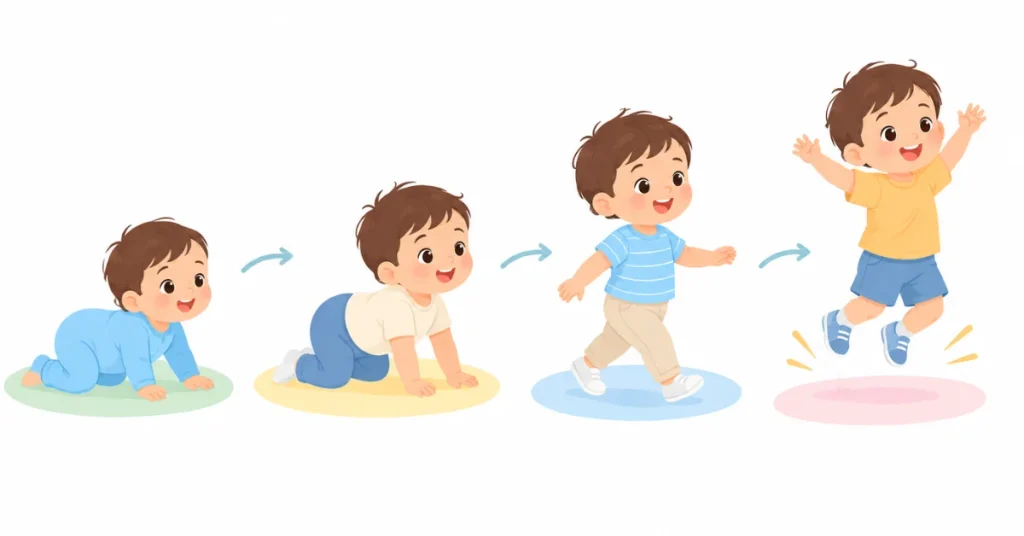
So, when do toddlers jump? For most kids, the honest answer is somewhere between 18 months and 3 years, with the real two-feet milestone landing right around age two. That’s a wide window, and it’s supposed to be. Jumping asks a toddler’s body to coordinate balance, strength, and timing all at once, and that takes the time it takes. If your toddler hasn’t jumped yet and they’re under 2.5, there’s usually nothing to worry about. Keep the squats and bubble-chasing going, and give it time.
This article is for informational purposes only. Always consult a qualified professional if you have concerns about your child’s development.
FAQs
When do toddlers jump for the first time?
Most toddlers make their first small jumping attempts between 18 and 24 months, usually a few knee bends and toe-rises before their feet fully leave the ground.
Is it normal if my 2-year-old still isn’t jumping?
Yes, it’s common. Some toddlers don’t reach the two-feet milestone until closer to 2.5 years. It only becomes worth checking on if there’s still no attempt at all by around 3 years old.
What’s the difference between hopping and jumping for toddlers?
Jumping means both feet leave the ground and land together. Hopping, which usually develops later, involves pushing off and landing on one foot.
Can I teach my toddler to jump, or does it happen on its own?
It largely develops on its own once leg strength and balance are ready, but games like bubble-chasing, squats, and jumping off a low step can speed the process along.
Should I be worried if my toddler only jumps off one leg?
A slight preference is common, but if one side barely participates at all by around 2.5 years, it’s a good detail to mention at a pediatric checkup.