
Two toddlers sit in the same sandbox. One is stacking blocks into a wobbly tower. The other is chewing on a plastic shovel and ignoring the blocks completely. Their parents sit nearby, sipping lukewarm coffee, and within thirty seconds the conversation drifts to a question that sums up what parents of toddlers might compare almost every time they meet: whose kid is doing what, and when.
That drift is not an accident. It’s basically the toddler-parent condition. What parents of toddlers might compare covers more ground than most people expect before they’re actually in it, sleep schedules, first words, potty training timelines, screen time rules, daycare versus staying home, even the brand of stroller parked by the door. Once you notice the pattern, you see it everywhere: at the pediatrician’s waiting room, in group chats, on the playground bench.
This isn’t really about competition, even though it can feel that way at 6am on four hours of sleep. It’s about parents trying to figure out whether they’re doing an impossible job reasonably well. Comparing is often just a stand-in for reassurance.
What Parents of Toddlers Might Compare First: Sleep
Sleep tends to top the list, and for good reason. A parent running on broken two-hour stretches doesn’t have much bandwidth left for anything else, so the first thing they ask another parent is usually some version of “is your kid sleeping through the night yet?”
The comparisons here get specific fast. Nap counts, bedtime routines, whether the toddler is still in a crib or has graduated to a toddler bed, whether anyone in the house is doing “cry it out” or something gentler. None of it is neutral information. A parent whose toddler sleeps twelve hours straight can say so cheerfully, without realizing it lands differently for the parent who’s been up every ninety minutes for a week.
Sleep consultants and pediatric nurses who work with this age group consistently point out that toddler sleep varies enormously and evens out over time. That doesn’t stop the comparing, though, because exhausted parents want a benchmark, even an unreliable one.
Developmental Milestones Get Weighed Constantly
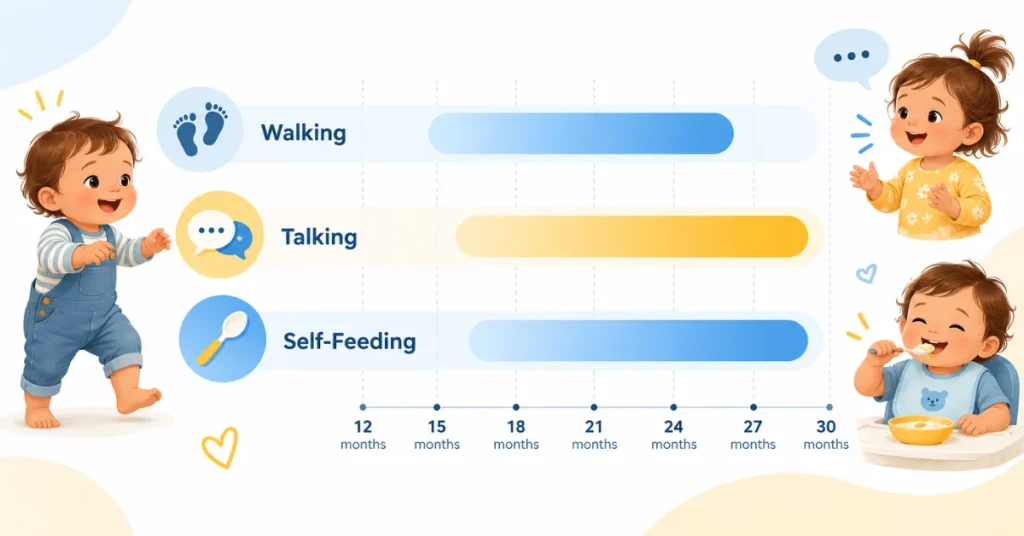
Walking, talking, and self-feeding sit near the top of what parents of toddlers might compare, mostly because these are the milestones that are easiest to observe in a five-minute playdate. The CDC’s own milestone guidance for toddlers covers exactly this stretch, from first independent steps to early social-emotional skills like showing affection or recognizing themselves in a mirror.
Worth knowing: CDC’s updated milestone checklists, revised in recent years, moved the benchmark for walking alone from 12 months to 15 months and pushed the 50-word vocabulary marker to 30 months. Pediatric providers made that change specifically because the older thresholds set an unrealistically early bar and fed unnecessary parental anxiety when a child hit milestones a bit later than a neighbor’s kid.
That detail matters here because it means a fair chunk of what parents have been quietly comparing for years was measured against numbers that were, frankly, too tight. A toddler walking at 16 months isn’t behind. A toddler still working on two-word phrases at 22 months isn’t necessarily behind either. Ranges are wide, and every pediatrician will say the same thing: watch the trajectory, not the single data point on a Tuesday afternoon.
Feeding, Eating Habits, and the Vegetable Question
Few topics generate more low-key parental one-upmanship than what a toddler will actually eat. One family’s toddler happily eats broccoli and lentils. Another survives mostly on crackers, cheese, and the occasional grape. Parents notice this, and they talk about it, usually with a mix of pride and quiet worry depending on which side of the comparison they land on.
Picky eating at this age is developmentally typical, not a parenting failure, and pediatric nutrition guidance treats it that way. Still, the comparing happens at birthday parties and daycare pickup lines constantly, because food is visible in a way that, say, emotional regulation isn’t.
Screen Time Rules Divide Households
Screen time might be the single most argued-about category on this list. The American Academy of Pediatrics recommends that children under 18 months avoid screen media beyond video chatting, and that guidance shapes a lot of household rules from there.
But actual practice varies wildly. Some parents ban screens almost entirely during the toddler years. Others use short shows strategically, during dinner prep or a rough car ride, and don’t apologize for it. Parents comparing screen time rules can get surprisingly judgmental, on both sides, which is part of why this topic tends to get avoided at group hangouts more than sleep or eating does.
A typical breakdown at playgroups looks like this: one parent quietly mentions their toddler “doesn’t really watch TV,” another parent changes the subject, and the group moves on without anyone saying what they’re actually thinking.
Childcare Choices: Daycare, Nanny, or Staying Home
This comparison carries more emotional weight than almost any other on the list, partly because it’s tangled up with money, career, and identity, not just parenting philosophy.
Daycare demand has been climbing steadily. Recent industry data puts the U.S. childcare and daycare sector at roughly $60.4 billion annually as of 2026, with center-based facilities making up close to 58% of that revenue, and about 60% of children under five in the U.S. now spending time in some regular childcare arrangement. Waitlists for toddler spots run shorter than infant waitlists but are still common in many cities.
Parents who choose to stay home full time compare notes with parents who work full time, and both sides sometimes wonder if the other has it easier. Neither does, really. It’s just a different set of trade-offs, and pretending otherwise doesn’t help anyone.
Gear, Strollers, and the Stuff of Toddlerhood
This is the lighter end of the spectrum, but it’s still real. Strollers, car seats, toddler beds, the “right” shoes for early walkers, whether a convertible car seat was worth the extra cost. Parents swap opinions on gear constantly, partly because it’s genuinely useful information and partly because gear is an easy, low-stakes way to compare notes without touching anything emotionally loaded.
Anyone who has shopped for toddler gear knows the research rabbit hole is real: weight limits, safety ratings, which stroller actually folds one-handed while holding a toddler on one hip. Compared to sleep or screen time, this category stays mostly friendly.
Why What Parents of Toddlers Might Compare Shifts by Age
The comparing doesn’t stay static. What parents of toddlers might compare at 15 months looks pretty different from what gets compared at 30 months, and knowing that shift ahead of time takes some of the sting out of it.
Early on, from about 12 to 18 months, the comparisons cluster around physical milestones: first steps, first words, whether a toddler is climbing furniture yet. Between 18 and 30 months, the focus moves toward language and social skills, two-word phrases, sharing (or refusing to share), tantrums and how a parent handles them in public. By the time a toddler is closer to three, comparisons shift again toward potty training timelines and early school or preschool readiness.
Anyone who has parented through this full stretch recognizes the pattern: the specific comparison changes, but the underlying need behind it, wanting to know whether things are on track, stays exactly the same the whole way through.
When Comparison Turns Inward: Comparing a Toddler to Their Own Sibling
Most of what parents of toddlers might compare happens with other families, but a good chunk of it happens quietly inside one household, when a toddler gets measured against their own older sibling.
A study led by BYU professor Alex Jensen and Penn State’s Susan McHale, published in the Journal of Family Psychology, looked at 388 two-child families and found that parents tended to believe their firstborn was the stronger performer, even when actual school achievement between siblings was nearly identical. The parents’ belief mattered on its own: the researchers found that a parent’s assumption about which child was “ahead” predicted the younger child’s future grades, independent of past performance.
That pattern starts earlier than school, and toddlerhood is where it often begins. “She wasn’t walking yet at this age either” or “her brother was already saying full sentences” are common lines, usually said without much thought. Family therapists who work with siblings generally recommend describing what a toddler is doing in the moment rather than measuring it against a sibling’s timeline, since toddlers pick up on these comparisons far earlier than parents expect.
Twins and Multiples: Comparison Without Leaving the House
For parents of twins or higher-order multiples, comparison isn’t something that happens occasionally at a playgroup. It happens daily, inside the same crib room, between two children born on the same day.
One twin walking before the other, one talking in longer sentences, one eating better at the table: parents of multiples describe this as a constant undertone rather than an occasional comment from a stranger. Pediatricians who specialize in multiples routinely remind parents that twins, especially non-identical pairs, can be developmentally weeks or months apart from each other and still both be entirely typical. Treating each twin’s chart as its own timeline, rather than as two data points on the same line, tends to reduce the pressure considerably.
Bilingual Households and the Milestone Chart
Families raising a toddler with more than one language at home run into a version of comparison that’s easy to miss if you’re not living it. A toddler hearing Urdu and English, or Spanish and English, from birth often has a smaller vocabulary in each individual language than a monolingual peer, even though their combined vocabulary across both languages is typically right in line with expectations.
Pediatric speech guidance is consistent on this point: bilingual exposure does not cause language delay on its own, and comparing a bilingual toddler’s single-language word count against a standard milestone chart, or against a monolingual cousin, tends to produce false alarms more often than real ones.
Comparison Pressure, By the Numbers
Parenting researchers who study comparison behavior describe a pattern that shows up consistently across surveys of parents with young children. A 2026 report from Nanit, based on responses from more than 1,600 U.S. parents of newborns, infants, and toddlers, found that about 33% of parents named comparison pressure specifically as something that drains their parenting confidence.
That figure lines up with a broader theme researchers keep flagging: parenting-focused social media use is linked to higher psychological distress specifically among parents already dealing with anxiety, according to a 2024 cross-sectional study published through JMIR. The effect wasn’t universal, it showed up most clearly for parents who were already stretched thin, which tracks with what pediatric mental health providers see in practice. Comparison itself isn’t automatically harmful. It becomes a problem when it lands on a parent who has no reserve left to shrug it off.
That same JMIR study found the pattern wasn’t identical across mothers and fathers. For mothers, social media use was tied to distress mainly when parenting anxiety was already high. For fathers, the same held true, and loneliness played an additional role that showed up less strongly among mothers, suggesting mothers and fathers may be pulled into comparison-driven distress through somewhat different paths.
When Comparison Signals Something Worth Checking
Most of what gets compared in the toddler years is noise, but not all of it. A small number of comparison points are worth raising with a pediatrician rather than shrugging off, because they line up with recognized early signs of developmental delay:
- No words at all by 18 months
- No two-word phrases by 24 months
- Loss of a skill the toddler previously had, such as words, gestures, or social smiling
- No response to their name, or limited eye contact and shared attention with a caregiver
- Little interest in pointing, showing, or sharing an experience with a parent
CDC’s “Learn the Signs. Act Early.” program is built specifically around these kinds of markers, and pediatricians generally treat any loss of a previously mastered skill as the single most important flag, more so than simply being a few months behind a chart.
This section is for general informational purposes only and isn’t a substitute for guidance from your child’s pediatrician or another qualified healthcare provider.
| Comparison Category | What Gets Compared | Why It Feels High-Stakes |
|---|---|---|
| Sleep | Night wakings, nap length, bedtime routine | Directly tied to parental exhaustion |
| Milestones | Walking, talking, self-feeding | Easiest to observe in short visits |
| Eating | Foods accepted, mealtime battles | Visible at every social gathering |
| Screen time | Daily minutes, show choices, rules | Tied to identity as a “type” of parent |
| Childcare | Daycare, nanny, stay-at-home | Wrapped up in money and career decisions |
| Gear | Strollers, car seats, shoes | Low emotional stakes, high research effort |
Who Should Actually Pay Attention to This Pattern
New parents heading into the toddler years benefit most from knowing this comparison habit exists before they’re in the middle of it. Grandparents and other caregivers can help by asking open questions instead of offering unsolicited rankings (“how’s she doing with talking?” lands very differently than “is she talking yet? my grandson was full sentences at this age”). Pediatric providers already factor this into how they present milestone charts, framing them as ranges rather than deadlines.
Parents who feel the pull to compare constantly, and feel worse after almost every comparison, might find it useful to mute a few accounts or skip a group chat for a week. That’s not avoidance. It’s just triage.
Conclusion
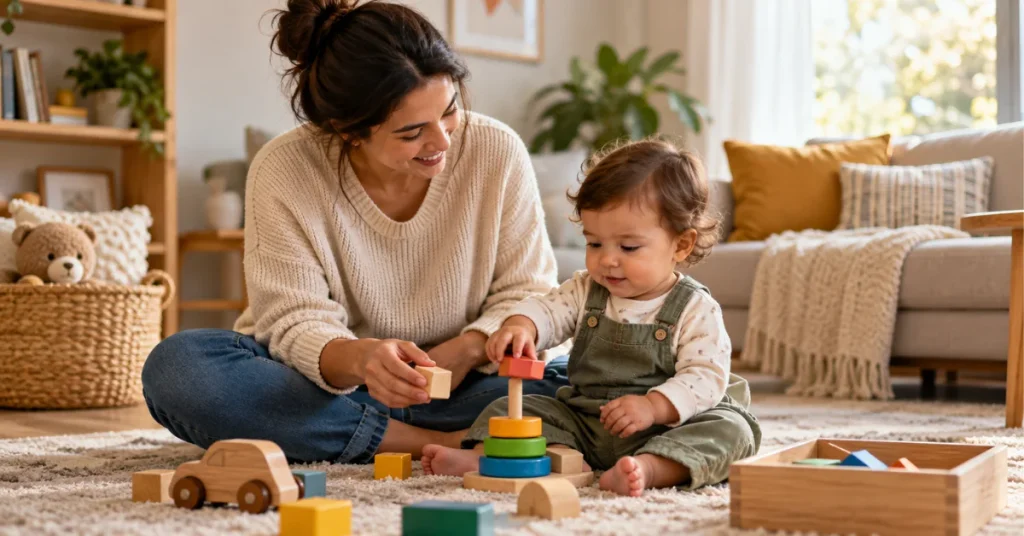
What parents of toddlers might compare turns out to be almost everything, sleep, food, milestones, screens, childcare, even stroller brands, because toddlerhood is a stretch of parenting where progress is visible daily and uncertainty is constant. None of that makes the comparing wrong. It usually comes from a genuine, understandable place: wanting reassurance that things are basically okay.
The healthier version of this habit treats another family’s toddler as one data point among thousands, not a scoreboard. Ranges are wide. Kids catch up in their own time, on their own schedule, and the parent obsessing over a milestone chart on a random Wednesday rarely remembers the worry a year later.
FAQs
Is it normal to compare my toddler to other kids their age?
Yes. Nearly every parent does it at some point, and researchers who study parenting stress describe it as a near-universal habit during the toddler years, especially around milestones and sleep.
Should I worry if my toddler is behind on a milestone?
A single missed milestone rarely means much on its own. Pediatric guidance treats milestones as ranges, not deadlines, and providers watch for patterns over time rather than one data point.
Why does screen time comparison feel more judgmental than other topics?
Screen time rules tend to reflect a parent’s broader philosophy, so comparisons there can feel more like a critique of values than a neutral fact swap, unlike, say, stroller brands.
Does social media make toddler comparison worse?
Research suggests it can, particularly for parents already experiencing anxiety or loneliness, though the effect isn’t the same for everyone.
What’s a healthier way to handle comparison as a toddler parent?
Treating other families’ updates as one example rather than a benchmark helps, along with stepping back from group chats or feeds that consistently leave you feeling worse instead of informed.
Is comparing a toddler to their older sibling different from comparing them to another family’s child?
It carries more weight, since it happens daily and the toddler often senses it directly. Research on siblings shows parental beliefs about which child is “ahead” can shape outcomes over time, even when the underlying skills are similar.
My bilingual toddler seems behind on the milestone chart. Should I worry?
Not automatically. A smaller vocabulary in one language is common in bilingual toddlers and doesn’t mean overall language development is delayed, since their combined vocabulary across both languages typically falls within the expected range.