
A lot of parents ask what age do babies clap the moment they notice their baby staring at their own hands like they’ve just discovered magic. It’s a fair question, because clapping isn’t just a cute party trick. It’s one of the clearer signals that a baby’s brain and body are starting to work together on purpose.
The short answer: most babies clap somewhere between 6 and 12 months, with 9 months being the point where it clicks for a large share of infants. But that range hides a lot of nuance worth understanding.
This isn’t a race, and there’s no single magic day when a switch flips. Still, knowing the pattern helps parents tell the difference between normal variation and something worth mentioning to a pediatrician.
What Age Do Babies Clap? The Typical Timeline
Here’s where things actually stand based on pediatric development research and hands-on observation from parents and clinicians alike.
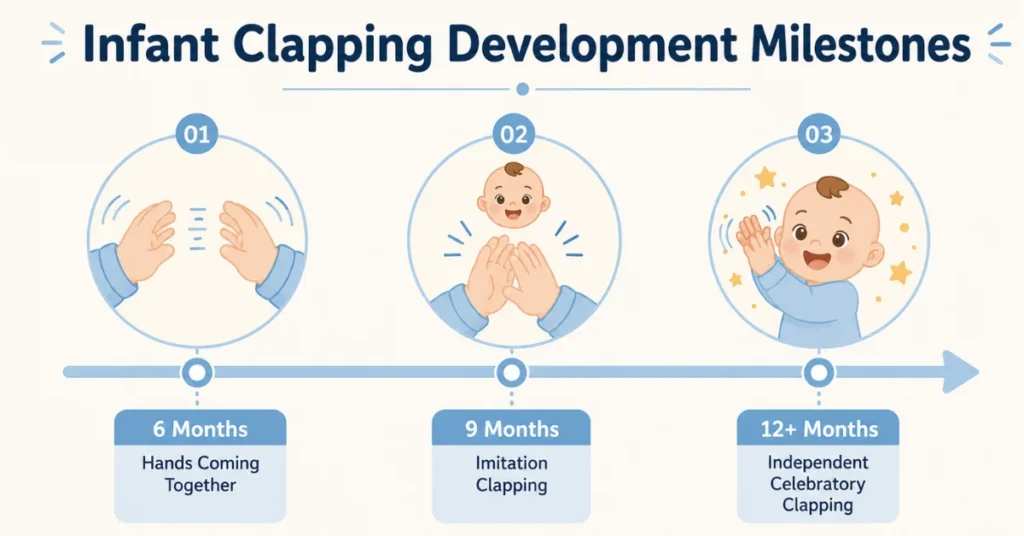
Between 6 and 8 months, babies usually start bringing their hands together in front of their body. It’s clumsy. It’s not really a “clap” yet, more like an accidental discovery that hands can meet in the middle.
By around 9 months, a large number of babies start producing something that looks and sounds like an actual clap, usually as imitation rather than celebration. Anyone who has spent time around infants this age knows the pattern: you clap, baby watches intently, and a beat later, a wobbly attempt follows.
Somewhere between 12 and 15 months is when clapping shifts from copycat behavior into genuine self-expression. This is the stage where a baby claps because they’re excited, not just because someone showed them how.
According to babies may begin showing signs of hand movement mastery by waving or bringing their hands close together as early as 7 months of age, with many able to clap by 9 months, though at that point it’s typically imitation rather than celebration. That lines up closely with what shows up across most credible parenting and pediatric resources.
Why the Age Range Is So Wide
Every baby’s nervous system develops on its own schedule, and clapping depends on several skills stacking up at once: shoulder and arm control, hand-eye tracking, and the cognitive leap of understanding cause and effect.
Parents who’ve raised more than one child often notice this firsthand. One baby claps at 7 months like it’s second nature. Another doesn’t get there until closer to 13 months, and both are completely normal.
Premature babies typically hit these milestones later when measured from their actual birth date rather than their adjusted age. Pediatricians usually recommend tracking a premature baby’s progress against their due date instead of their birth date for at least the first two years.
Babies who spend more tummy time developing shoulder strength sometimes clap earlier, since the muscles involved overlap with the ones used for crawling and reaching. It’s not a guarantee, but the connection shows up often enough that occupational therapists mention it regularly.
What Clapping Actually Signals About Development
Clapping isn’t just about hands meeting. It’s a window into three separate systems working together.
- Motor coordination: bringing both arms to the midline and controlling the timing of the movement
- Visual tracking: watching a caregiver’s hands and translating that into a matching motion
- Social cognition: understanding that a gesture can communicate joy, excitement, or approval
Those who study infant development often describe clapping as one of the first “intentional communication” gestures, right alongside waving and pointing. It sits at the intersection of physical skill and social understanding, which is exactly why pediatricians pay attention to it during checkups.
When Clapping Might Signal a Delay
Most babies who clap “late” are simply on their own timeline. But there are situations worth flagging to a doctor, and this is one part of the topic where being direct actually helps rather than causing unnecessary worry.
Pediatric guidance generally recommends a conversation with a doctor if a baby isn’t using any gestures, including clapping, waving, or reaching to be picked up, by their first birthday. The same applies if a baby who was clapping regularly suddenly stops doing it, since regression in a previously mastered skill is treated differently than a simple delay.
It’s worth remembering that clapping delays rarely show up alone. Pediatricians typically look at the whole picture: eye contact, babbling, response to their name, and overall muscle tone, rather than judging development off one milestone in isolation.
How to Encourage Clapping at Home
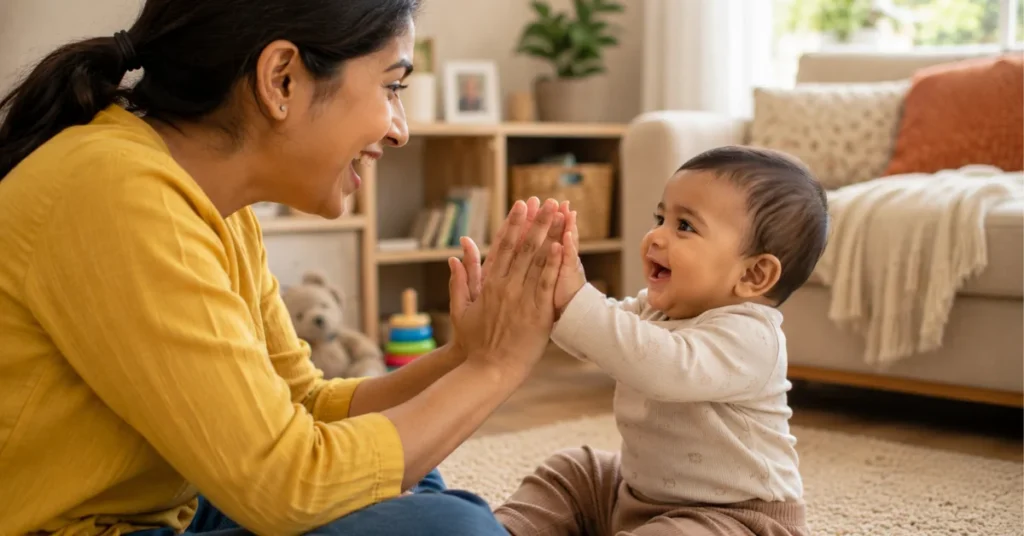
Encouraging clapping doesn’t require special equipment or elaborate routines. It mostly comes down to repetition, playfulness, and patience.
- Clap during daily routines, meals, bath time, diaper changes, so baby sees the motion repeatedly in relaxed contexts.
- Play simple hand-games like pat-a-cake, which pairs rhythm and language with the physical motion.
- Physically guide baby’s hands together gently a few times, then step back and let them try independently.
- Celebrate any attempt, even a lopsided one, with visible enthusiasm. Babies respond strongly to social reinforcement.
- Give tummy time daily, since shoulder and core strength feed directly into arm control.
None of this speeds up neurological readiness. What it does is give a baby more chances to practice once their body is actually capable of the motion.
What the Research Shows
Detailed analysis of pediatric developmental tracking consistently places clapping within the broader fine and gross motor milestone cluster that also includes waving, pointing, and transferring objects hand to hand. Clinicians generally treat these gestures as a group rather than isolated checkpoints, since a baby who is behind on one but on track for the others usually isn’t a cause for concern.
Detailed observation from parenting and pediatric sources shows a consistent pattern: imitation-based clapping tends to arrive first, somewhere in the 6 to 9 month window, while spontaneous, emotion-driven clapping tends to follow a few months later, closer to the 12 to 15 month mark. That two-stage pattern shows up again and again across different sources, which is part of why it’s considered a reliable developmental marker.
Clapping Across Different Baby Types
Not every baby follows the textbook path, and it helps to know where common variations show up.
Premature babies often reach clapping later when measured by birth date, but track normally against adjusted age.
Babies with low muscle tone sometimes take longer to bring both hands together with control, and may benefit from a physical therapy check-in if other milestones are also delayed.
Twins and multiples occasionally show slightly different timelines from each other, which is normal and not a sign that one twin is behind in any meaningful sense.
Babies raised in bilingual or multilingual homes show no meaningful difference in clapping timelines, since the milestone is motor and social rather than language-based.
Conclusion
So, what age do babies clap? Most babies land somewhere between 6 and 12 months, with imitation-based clapping showing up first and genuine, excited clapping following a few months later. The exact day matters far less than the overall pattern, and parents who track that pattern over weeks rather than days tend to worry less and enjoy the milestone more.
If a baby isn’t clapping, waving, or gesturing at all by their first birthday, that’s the point to bring it up with a pediatrician, not before. Everything else is just normal variation in a wide, well-documented window.
This article is for informational purposes only. Always consult a qualified professional if you have concerns about your baby’s development.
FAQs
Q: What age do babies clap on average?
A: Most babies start attempting a clap between 6 and 9 months, with spontaneous, excited clapping typically following by 12 to 15 months.
Q: Is it normal if my baby hasn’t clapped by 12 months?
A: It can still be normal, but this is the point where a pediatrician conversation is reasonable, especially if other gestures like waving or pointing are also absent.
Q: Does clapping mean my baby is smart?
A: No. Clapping reflects motor coordination and social development, not intelligence. Plenty of highly capable babies clap later than average.
Q: Can I teach my baby to clap faster?
A: You can encourage practice through games and modeling, but the underlying muscle control and coordination develop on their own biological schedule.
Q: Should premature babies be judged against their birth date or due date for clapping?
A: Pediatricians generally recommend using adjusted age, based on the due date, for at least the first two years.