
You hold a rattle a few inches from your newborn’s face, wiggle it, and… nothing. No eyes following it, no head turning. So you Google it at 2 a.m., half-worried, half-curious: when do babies start tracking?
The short answer is that most infants begin tracking moving objects somewhere between two and three months old, with the skill sharpening steadily through the first half of the year. But that single number skips over a lot of the story parents actually want. Newborn eyes don’t work like a finished camera lens. They’re more like a device still being assembled, one piece at a time, over months rather than days.
This guide walks through what’s actually happening behind those tiny eyes, month by month, and what pediatric eye specialists say is worth watching for.
When Do Babies Start Tracking Moving Objects?
According to the American Academy of Ophthalmology, most infants aren’t yet able to follow a moving object with their eyes at birth. A newborn baby can see something next to them with their peripheral vision, but their central vision is still developing, and for the first couple of months, a baby’s eyes often don’t work together very well. That’s why a lot of newborn photos catch one eye drifting slightly. It’s normal.
Things shift fast after that. By about two months old, babies usually manage to follow a moving object with their eyes as their coordination improves, and by three months, a baby’s eyes should work together to focus and track. Pediatricians describe this window as the real answer to when do babies start tracking, because it’s when the behavior becomes consistent rather than occasional.
Here’s a rough breakdown pediatric offices tend to use:
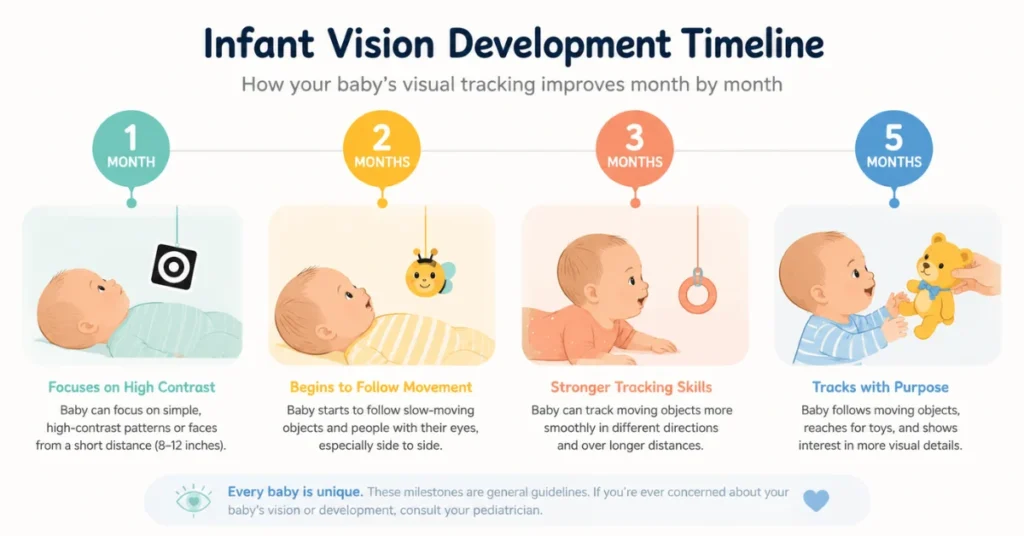
- Birth to 1 month: Focus is limited to about 8–12 inches, mostly faces during feeding.
- 2 months: Brief, sometimes jerky tracking of a moving object begins.
- 3 months: Smoother, more reliable tracking; eyes work as a team.
- 4–5 months: Tracking becomes fluid, and depth perception starts kicking in.
Anyone who has spent time with several babies at daycare or in a family notices this isn’t identical for every child. Some infants lock onto a moving toy at six weeks; others take until closer to three months. That spread is normal and doesn’t automatically signal a problem.
When Do Babies Start Tracking Faces and Recognizing People?
Faces get priority treatment in a baby’s visual world long before toys do. Newborns are drawn to high-contrast shapes, and a parent’s face — especially up close during feeding — is one of the first things that holds their attention.
By around two to three months, most babies aren’t just glancing at a face; they’re following it as it moves across the room, and they’ll often break into a social smile in response. This is a separate but related milestone from object tracking, and it’s one reason pediatricians ask about both during well-baby visits.
It’s worth noting that face tracking and object tracking tend to develop on a similar timeline in healthy infants, which is why doctors often check for both at once rather than treating them as unrelated skills.
Depth Perception and Eye Coordination
Tracking is only part of the picture. Around the four-to-five-month mark, depth perception starts to come online. This is the skill that lets a baby judge how far away a toy actually is, rather than just noticing that it’s moving.
Depth perception depends on both eyes working together and sending slightly different images to the brain, which then merges them into one 3D picture. Before this stage, a baby’s world is closer to flat. After it, reaching for objects becomes far more accurate — you’ll notice fewer wild swipes and more direct grabs.
Parents who’ve raised more than one child sometimes describe this as the moment a baby “starts actually aiming” for things instead of just batting in the general direction.
What the Research Shows
Clinical guidance from the American Academy of Ophthalmology treats three months as a meaningful checkpoint: if a baby’s eyes aren’t working together to focus and track objects by that age, it’s worth flagging to a pediatrician. That single benchmark is why so many parents search for exactly when do babies start tracking around the two- to three-month window — it lines up with what doctors themselves are watching for.
Eye-tracking research backs this up from a different angle. Studies on infant smooth pursuit and saccadic eye movement have found that tracking ability develops rapidly across a window rather than switching on overnight, with meaningful gains continuing well past the three-month mark and refinement stretching into later childhood.
Put together, the pattern is consistent across pediatric ophthalmology and behavioral research alike: tracking isn’t a single switch. It’s a skill that ramps up steadily, with two to three months as the period parents can reasonably expect to see it show up.
Activities That Support Visual Tracking
- Slowly moving a high-contrast toy (black-and-white patterns work well early on) about 8–12 inches from the baby’s face
- Rolling a ball back and forth once the baby can sit with support
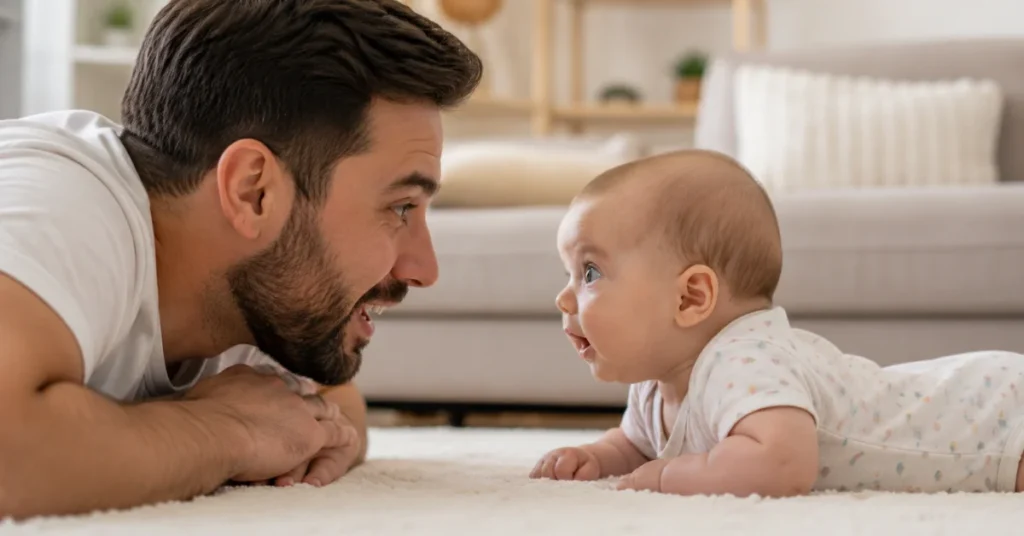
- Face-to-face play, since faces remain one of the strongest visual draws for infants
- Tummy time, which strengthens the neck and shoulder muscles a baby needs to actually turn and follow something
You can’t rush a baby’s neurological development, but you can give those developing eyes something worth practicing on. Pediatric offices commonly suggest simple, low-cost activities:
None of this needs to be elaborate. A parent moving their own face slowly side to side during a diaper change does more for tracking practice than most branded toys.
Warning Signs Worth Mentioning to a Pediatrician
Most babies hit these milestones without drama, but a few signs are worth flagging early rather than waiting it out:
- No tracking of any kind by three to four months
- One eye that consistently turns inward or outward, rather than occasionally
- No eye contact or visual response to a caregiver’s face by two months
- A white or cloudy reflection in a photo, which can indicate a more serious underlying issue
None of these automatically mean something is wrong. But pediatric eye specialists consistently say that early evaluation costs nothing and catches the small number of cases that do need intervention before they become harder to treat.
Premature Babies and Different Timelines
Not every baby is working from the same starting line. Infants born early are usually assessed based on their adjusted age — their due date, not their birth date — because visual development follows gestational timing rather than the calendar. A baby born six weeks early may reach a three-month tracking milestone six weeks later than a full-term peer, and that’s expected rather than concerning.
Parents of preemies often find this reassuring once a pediatrician walks them through adjusted-age milestones instead of standard ones. It’s a detail that gets left out of a lot of generic milestone charts, but it matters for a meaningful share of families searching this exact question.
The Bottom Line
If you’re wondering when do babies start tracking, the honest answer sits in a range, not a single date. Most infants begin following moving objects somewhere between two and three months, with faces often tracked even earlier. Depth perception and full coordination follow a few months after that.
Every baby moves through this at their own pace, and a week or two of variation rarely means anything. What matters more is the overall trend — steady improvement, not a stalled skill. If tracking hasn’t started by three to four months, or if something about a baby’s eyes seems off, a quick check-in with a pediatrician settles the question far better than another late-night search ever will.
This article is for informational purposes only. Always consult a qualified pediatrician or eye care professional regarding your child’s specific development.
Frequently Asked Questions
Is it normal if my one-month-old isn’t tracking objects yet?
Yes. Most newborns aren’t reliably tracking moving objects until closer to two months. At one month, brief focus on faces is a more realistic expectation than tracking a toy.
What’s the difference between tracking a face and tracking an object?
They’re closely related but not identical skills. Faces tend to get a baby’s attention earlier and more consistently because of the high contrast and movement involved, while tracking a toy requires slightly more coordinated eye control.
Should I worry if my baby’s eyes still look crossed at two months?
Mild, occasional crossing is common in the first couple of months as eye muscles mature. Constant crossing, or crossing that persists past three to four months, is worth mentioning to a pediatrician.
Can screen time affect when babies start tracking?
Pediatric guidance generally discourages screen exposure for infants under 18–24 months, favoring real-world interaction and face-to-face play, which offer richer visual stimulation than a flat screen.
Do premature babies track objects later than full-term babies?
Often, yes, but doctors typically measure this against adjusted age rather than birth date, so a “delay” based on the calendar is usually right on track once adjusted age is factored in.