
Most parents asking how many naps for a 9 month old already know the answer they’re hoping for. They want a number, a clean rule, something to pin on the fridge. The honest answer is two naps a day for most babies this age, though a few are still working through three.
This isn’t a guess. It’s the pattern that shows up again and again in current sleep research and in NHS guidance on infant sleep at this stage.
This article is for informational purposes only. Always consult a qualified pediatrician about your baby’s specific sleep needs.
What’s Actually Normal at 9 Months
By nine months, the third nap has usually dropped off. NHS guidance on baby sleep patterns notes that babies’ total sleep needs settle as they grow, and daytime naps gradually consolidate during the second half of the first year.
Two naps, roughly two to three hours combined, plus eleven to twelve hours overnight. That’s the shape of a typical day. One nap mid-morning, one in the early afternoon, both capped before they stretch past two hours.
Parents who’ve gone through this transition know it doesn’t happen on a fixed date. Some babies drop the third nap at eight months. Others hang onto it until ten. Both are within range.
How Many Naps for a 9 Month Old, Exactly?
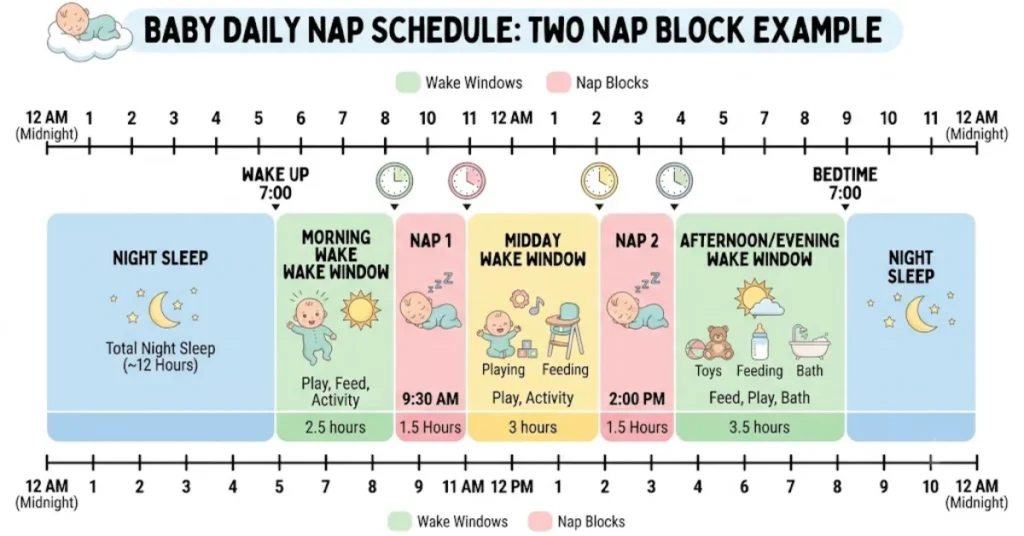
The question how many naps for a 9 month old needs deserves a direct answer: two, for the vast majority of babies at this point. A smaller group is still finishing the transition from three naps and may need a short catnap on rough days.
Wake windows widen at this age too — typically two and a half to three and a half hours between sleep periods. Shorter stretches in the morning, longer ones as the day goes on. That’s not arbitrary; it reflects how a baby’s circadian rhythm and sleep pressure mature over the first year.
If your baby is still fighting for three naps, it’s not a red flag on its own. It’s often just a sign the transition hasn’t fully landed yet.
Signs Your Baby Is Ready to Drop to Two Naps
A few patterns tend to show up right before the third nap disappears for good:
- The late-afternoon nap gets shorter or gets skipped outright
- Bedtime starts creeping later because that last nap is gone
- Morning wake-up time stays steady even without the third nap
- Your baby seems fine — not wired, not wrecked — on just two naps
Anyone who’s managed a baby through this stage knows it rarely happens cleanly. Some days look like the old schedule. Some days look like the new one. That back-and-forth can last a few weeks before it settles.
What the Research Shows
Detailed analysis of infant sleep across multiple pediatric sources points to a consistent total: most 9 month olds need around 14 hours of sleep in 24 hours, split between night sleep and daytime naps. NHS sleep guidance for infants in the 6 to 9 month bracket aligns with that figure, citing roughly 14 hours including naps.
Examining this closely, the variation between sources isn’t really about disagreement — it’s about how individual babies fall along a normal range. Some thrive on slightly less. Others need more. The 14-hour figure is a midpoint, not a mandate.
What If Your Baby Won’t Settle Into a Pattern
Not every 9 month old reads the textbook. Teething, developmental leaps like crawling or pulling to stand, and separation anxiety can all throw naps off course temporarily.
A typical disruption at this age looks less like a broken schedule and more like a few rough days strung together. The nap count doesn’t usually change — the consistency does. Babies who normally nap an hour might suddenly take 25 minutes, then bounce back the following week without anything being “fixed.”
If sleep problems persist for more than a couple of weeks, or you’re worried your baby isn’t getting close to that 14-hour range at all, it’s worth raising with your health visitor or pediatrician rather than guessing.
Nap Schedules Aren’t One-Size-Fits-All
Working parents, stay-at-home parents, and parents juggling daycare drop-offs all face this differently. Daycare-set schedules often force naps onto a fixed clock, which can actually help some babies settle into the two-nap rhythm faster than a flexible at-home routine.
Parents with babies in daycare should expect the provider’s nap timing to take precedence most days, with weekends sometimes looking looser. That mismatch is normal and rarely causes lasting sleep trouble.
Conclusion
So, how many naps for a 9 month old should you expect? Two, for most babies, totalling around two to three hours of daytime sleep, on top of roughly eleven to twelve hours overnight. A handful of babies are still finishing the move down from three naps, and that’s fine too.
What matters more than hitting an exact number is watching your own baby’s cues — tiredness, mood, how easily they fall asleep at night — rather than chasing someone else’s schedule.

FAQs
Is it normal for a 9 month old to still take three naps?
Yes, for some babies. The third nap typically disappears between 8 and 9 months, but the exact timing varies.
How long should each nap be at 9 months?
Most naps run between 45 minutes and two hours. Capping naps at two hours is generally recommended to protect nighttime sleep.
What if my 9 month old refuses the second nap?
Try shifting it slightly later, or shortening the wake window before it. Persistent refusal might mean an early transition toward one nap, though that’s uncommon this young.
Does daycare affect how many naps a baby takes?
It can. Daycare schedules often run on fixed nap times, which sometimes helps babies settle into a consistent two-nap rhythm faster than at home.
When should I talk to a doctor about my baby’s naps?
If sleep disruption lasts more than two to three weeks, or your baby seems consistently overtired or undertired, raise it with your pediatrician or health visitor.