
Rain hits the window at 8 a.m. and you already know how the next ten hours are going to feel. The bikes stay in the garage, the park stays empty, and three kids look at you like you’re supposed to have a plan. Figuring out what to do on a rainy day with kids doesn’t require a Pinterest board or a trip to the craft store. It usually just needs a little structure, a few supplies you already own, and permission to let the house get a bit messier than usual.
This isn’t a list of 50 vague suggestions you’ll skim and forget. It’s a working plan, broken down by age, energy level, and how much cleanup you’re willing to sign up for.
What to Do on a Rainy Day With Kids: Where to Start
Before picking an activity, it helps to read the room. A four-year-old bouncing off the walls needs something physical. A tired nine-year-old might just want to make something quietly for an hour. Sorting activities by energy level, rather than by age alone, saves you from picking something that fights against the mood already in the house.
Three questions tend to narrow things down fast:
- Does the child need to burn energy, or calm down?
- How much mess can you actually handle today?
- Is this a solo activity, or does it need a grown-up involved the whole time?
Answer those honestly and the right activity usually picks itself. A family stuck indoors for the third day in a row needs something different from a family facing a single wet afternoon, and treating every rainy day the same is where most plans fall apart by lunchtime.
High-Energy Options for Restless Kids
When the problem is pent-up energy rather than boredom, quiet crafts won’t cut it. An indoor obstacle course built from couch cushions, chairs, and a laundry basket can burn off a surprising amount of steam in twenty minutes. Painter’s tape on the hallway floor makes an instant hopscotch grid or a “the floor is lava” balance beam. Balloon volleyball over a string tied between two chairs works for almost any age and rarely damages anything, which counts for a lot on a day already full of compromises.
Anyone who has raised a toddler through a wet week knows the difference a laundry hamper and a pair of tongs can make. Put the child in the hamper, scatter some soft toys on the floor, and hand over a pair of salad tongs for “fishing.” It sounds too simple to work, and it works anyway.
Calm, Low-Mess Options for Quiet Time
Not every rainy hour needs to be loud. Building a blanket fort with cushions, chairs, and a string of fairy lights turns a corner of the living room into a reading nook that can occupy a child for an hour on its own. Storytelling games, where each person adds one sentence to a growing tale, cost nothing and travel well if you end up stuck somewhere without toys at all, like a waiting room or a relative’s house.
Board games and jigsaw puzzles remain reliable for a reason. They’re social without being loud, and a half-finished puzzle left on the table gives kids something to return to between other activities, which stretches a single purchase across an entire wet week.
An Age-by-Age Table for What to Do on a Rainy Day With Kids
Different ages need genuinely different approaches. A sensory bin that delights a toddler will bore a ten-year-old within ninety seconds. This table breaks activities down by age band, expected mess level, and roughly how long each one buys you.
| Age Group | Best Activity Type | Mess Level | Typical Time Bought |
|---|---|---|---|
| Toddlers (1–3) | Sensory bins, magic laundry hamper, simple sorting games | Medium | 20–30 minutes |
| Preschool (3–5) | Blanket forts, puppet shows, indoor scavenger hunts | Low–Medium | 30–45 minutes |
| Early school age (6–8) | Baking, obstacle courses, board games, science experiments | Medium–High | 45–60 minutes |
| Tweens (9–12) | Escape-room challenges, stop-motion videos, cooking projects | Low–Medium | 60–90 minutes |
| Teens | Movie or cooking marathons, DIY room projects, family tournaments | Low | 60+ minutes |
Use the table as a starting point rather than a strict rule. A seven-year-old having a rough day might genuinely need the sensory calm of a toddler activity, and a mature five-year-old might handle a scaled-down escape-room challenge just fine.
Kitchen and Craft Activities Worth the Cleanup

Baking together earns its spot on almost every rainy day list, and there’s a reason it keeps showing up. Measuring, pouring, and stirring strengthen fine motor skills while producing something the whole family gets to eat, which is more motivating for most kids than a worksheet ever will be. Simple cookies or muffins work well because the steps are forgiving of small mistakes.
Craft stations don’t need to be elaborate. Paper, glue, tape, and a pile of recycling scraps are enough for kids to put together a sculpture, a puppet, or a small cardboard city. Origami works particularly well for kids who like following precise steps, while process art, where the goal is exploring materials rather than producing a finished piece, suits younger children who lose interest in outcome-focused crafts fast.
A tea party with stuffed animals, a simple cooking activity turned into “playing restaurant,” or a full puppet show made from socks and paper bags all cost close to nothing and stretch far longer than the setup time suggests.
Screen Time, Balance, and Where It Fits
Screens are going to come up, especially on a multi-day wet spell, and pretending otherwise isn’t realistic. Current pediatric guidance for children ages two to five points to roughly one hour a day of high-quality, co-viewed content, with school-age kids and teens generally sitting somewhere in the one-to-two-hour range for recreational use, though the emphasis has shifted toward what kids watch and how they watch it rather than a strict clock. Parents who set a screen-free block before turning to a movie or game tend to report fewer battles over “just five more minutes,” largely because the screen becomes a planned part of the day instead of a default fallback.
A movie marathon paired with themed snacks, or a homemade “drive-in” built from cardboard boxes turned into cars, keeps screen time from feeling like the only option when boredom hits.
What the Research Shows
Detailed research from a 2018 pediatric clinical report found that preschoolers aged three to four who played with peers or a caregiver for just fifteen minutes showed roughly twice the drop in measured anxiety compared to children who instead listened to a teacher read a story for the same length of time. That single data point captures something worth remembering on a rainy afternoon: unstructured, hands-on play isn’t filler between “real” activities. It does measurable work on a child’s stress levels, language development, and problem-solving skills, and an indoor rainy day is often the only stretch of unscheduled time a busy week actually offers.
Common Challenges and How Families Work Around Them
Siblings of different ages rarely want the same thing at the same time, and that’s usually the first wall families hit. A workaround that holds up in practice: pick one shared activity, like a scavenger hunt with clues written at two difficulty levels, so everyone plays the same game at their own pace instead of running three separate activities at once.
Space is the second common problem, particularly in smaller homes or apartments. Obstacle courses and dance parties don’t need much room if you route them through a hallway instead of a living room, and vertical activities, like building the tallest tower from recycled materials, take up floor space instead of running space.
Cleanup fatigue is real by day three of a wet stretch. Rotating between low-mess and high-mess activities, rather than picking the messiest option every single day, keeps the whole week sustainable instead of front-loading all the effort into one exhausting afternoon.
Looking Ahead: Rainy Day Planning for 2026 and Beyond
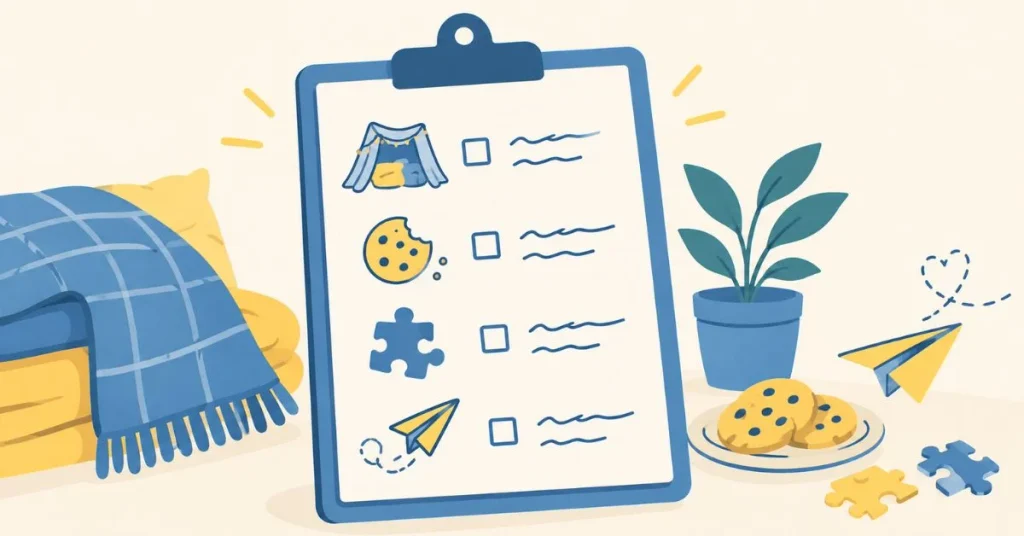
Families are increasingly treating rainy day planning the way they treat meal planning, with a running list of go-to activities sorted by age and mess level rather than a last-minute scramble. That difference matters because it turns a stressful morning into a five-minute decision: check the list, grab supplies, go. Heading into 2026, more households are also leaning on printable activity trackers and simple household inventories of craft supplies, kept stocked specifically for wet weeks, so the answer to what to do on a rainy day with kids is sitting in a drawer rather than requiring a store run in the rain.
Conclusion
A rainy day doesn’t have to mean a lost day. Whether it’s a blanket fort, a batch of cookies, or twenty minutes of balloon volleyball in the hallway, the real answer to what to do on a rainy day with kids usually comes down to matching the activity to the energy in the room and keeping a small stock of go-to ideas on hand before the clouds roll in. Put together a short list now, tape it inside a cupboard, and the next downpour becomes a lot less stressful for everyone under your roof.
FAQs
What can toddlers do on a rainy day that won’t create a huge mess?
Sensory bins made from dried rice or pasta, simple sorting games with household objects, and the “magic laundry hamper” game all keep toddlers busy with minimal cleanup afterward.
How much screen time is reasonable on a rainy day?
Guidance for preschoolers generally points to about an hour of high-quality, co-viewed content, while school-age kids and teens tend to fall in a one-to-two-hour range for recreational screen use, with content quality mattering as much as the total time.
What’s a good rainy day activity for siblings of different ages?
A two-level scavenger hunt, where clues are written at different difficulty tiers, lets kids of varying ages play the same game together instead of needing separate activities.
Do rainy day activities actually help child development, or is it just about passing time?
Unstructured play has been linked to measurable drops in stress and improvements in language and problem-solving skills, so a well-chosen rainy day activity does more than fill hours.
What if we’ve already done every indoor activity we can think of?
Rotate in a themed cooking project, a stop-motion video made on a phone, or a full cardboard-city project kept going across a weekend. New materials, even from the recycling bin, tend to spark interest faster than a brand-new toy would.