
You’ve tried this before. A fresh notebook, a color-coded schedule, maybe an app with a streak counter. Then week two happens, life gets messy, and the whole thing quietly falls apart. If you’re searching for how to start a new routine that survives past the honeymoon phase, you’re not broken and you’re not lazy. You just haven’t been given the real version of how habits actually form.
Most advice on this topic skips the boring, unglamorous middle part. It sells the fantasy of a perfect morning routine without explaining what happens on the days you’re tired, distracted, or just don’t feel like it. This piece covers that part.
Why Most New Routines Collapse Within Days
Here’s the pattern almost everyone falls into: excitement on day one, a rigid plan by day three, and quiet abandonment by day ten. It’s rarely about discipline. It’s about the plan being too big for the brain doing the work.
Anyone who has tried to overhaul five habits at once knows how this goes. You wake up early, exercise, meditate, journal, and eat clean, all starting on the same Monday. Your brain, which prefers small and familiar over big and new, pushes back. And it usually wins.
Behavioral researchers describe this as decision fatigue. Every new action you’re not used to costs mental energy, and that energy runs out fast when you’re stacking five unfamiliar tasks together. A single new behavior repeated daily asks far less of you than a full lifestyle reboot. That’s the real starting point if you want to figure out how to start a new routine that survives longer than a week.
There’s also a timing problem most people never notice. Routines usually collapse right after the first real disruption, a sick kid, a late meeting, a canceled flight, not because the person lacked willpower, but because the plan had no built-in flexibility for a bad day. A rigid all-or-nothing routine snaps the moment reality gets messy. A flexible one just bends and keeps going. If there’s one honest observation worth sharing here, it’s that the people who actually keep new routines aren’t the most disciplined ones. They’re the ones who built in enough slack to survive an ordinary rough week.
How to Start a New Routine Without Overhauling Your Whole Life
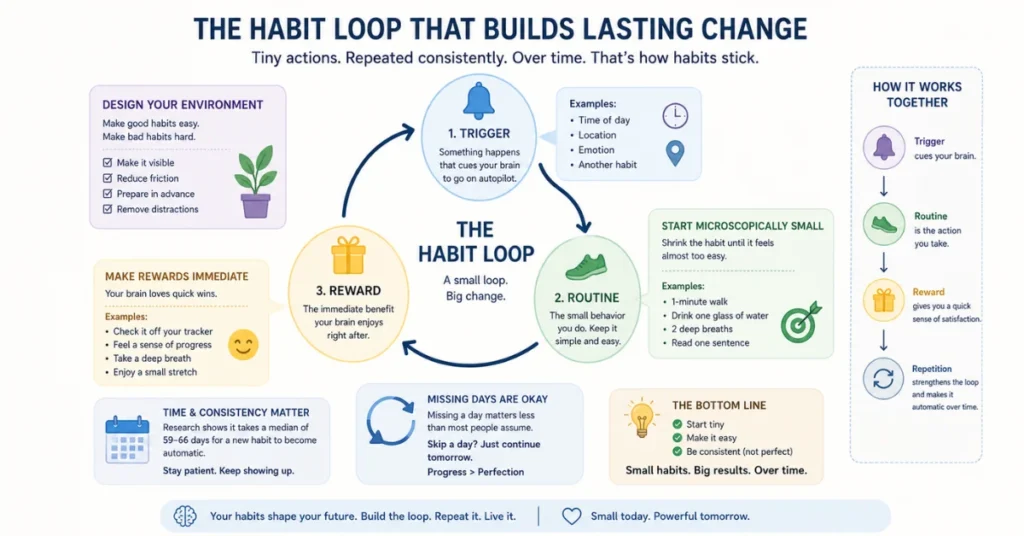
The fastest way to fail at how to start a new routine is treating it like a personality transplant. The better approach is smaller and, honestly, a little boring.
Pick one behavior. Not three, not five. One.
Choose a trigger you already do daily (coffee, brushing teeth, sitting at your desk).
Attach the new habit directly after that trigger.
Shrink the habit until it feels almost too easy.
For example, instead of “exercise for 45 minutes,” try “put on shoes and walk to the end of the block after breakfast.” That sounds small because it is small, and that’s exactly the point. Anyone managing a busy schedule knows that ambitious plans rarely survive contact with a bad night’s sleep or a packed inbox, but a two-minute version of the same habit usually does.
Once that tiny version feels automatic, and only then, you can build it up. Trying to skip this step is where most people quietly lose momentum without even realizing why.
What the Research Shows
Popular culture loves the idea that it takes 21 days to lock in a new habit. That number isn’t accurate, and recent research makes that clear.
A meta-analysis from the University of South Australia, covering 20 earlier studies and more than 2,600 participants, found that the median time to form a new healthy habit was 59 to 66 days, with some habits taking as long as 335 days to fully stick. That’s a massive range compared to the tidy three-week myth most people grew up hearing.
An earlier, frequently cited 2009 study backs this up. Researchers found habits developed across a range of 18 to 254 days, with participants taking an average of about 66 days to reliably build one new daily behavior, whether that was eating fruit with lunch or running before dinner.
The pattern that shows up again and again: simple habits with a clear, consistent trigger form faster than complex ones, and morning habits tend to take hold more successfully than evening ones, while habits people choose for themselves stick better than habits assigned by someone else. None of this means you’re failing if week three rolls around and the habit still feels effortful. It means you’re right on schedule. These numbers matter because they set honest expectations for anyone trying to work out how to start a new routine without giving up too early.
How to Start a New Routine When Motivation Runs Out
Motivation is unreliable. It shows up strong on a Sunday night and vanishes by Wednesday afternoon. Anyone who has tried to build a routine around feeling inspired every day eventually hits a wall, because feelings aren’t a stable foundation for repetition.
What actually works is designing your environment so the habit needs less willpower to happen.
Lay out your workout clothes the night before instead of deciding in the morning.
Keep a book on your pillow if you want to read before bed instead of scrolling.
Put your phone charger in another room if late-night scrolling is the habit you’re replacing.
This is sometimes called reducing friction, and it works because it removes the small decisions that quietly drain your energy before the habit even starts. Anyone who has managed a demanding job and still kept a routine intact usually credits this kind of environment design over sheer willpower.
Missing a day matters less than most people assume, too. One skipped session doesn’t erase progress. What actually derails routines is missing two days in a row, since that’s when the old default behavior starts sliding back in.
Tools That Make Tracking Easier
You don’t need a complicated system to track a new habit, but some structure genuinely helps. A simple paper calendar with an X marked on each successful day works just as well as any app, and for some people it works better, since there’s no notification fatigue to fight against.
Phone-based habit trackers can help if you’re someone who responds well to streaks and visual progress. The key is picking one method and sticking with it instead of switching tools every few weeks looking for the perfect app. That switching itself becomes a distraction from the actual habit.
For habits tied to a specific time of day, a simple phone alarm labeled with the habit name tends to outperform generic reminders. Seeing “walk after lunch” pop up carries more weight than a plain buzz with no context attached. Tracking isn’t the whole answer, but it’s a useful piece of how to start a new routine you can actually watch take shape.
Building a Routine Around an Unpredictable Schedule
Not everyone works a standard nine-to-five, and most routine advice quietly assumes they do. Shift workers, freelancers, and new parents often can’t anchor a habit to a fixed clock time, since their days shift constantly.
The fix is anchoring the habit to an event instead of a time. Instead of “meditate at 7 a.m.,” try “meditate right after my first cup of coffee, whenever that happens.” Instead of “exercise at 6 p.m.,” try “exercise as soon as my shift ends.” Event-based triggers travel with an irregular schedule in a way that clock-based triggers simply can’t. This is often the missing piece for anyone trying to figure out how to start a new routine while working nights, freelancing, or caring for a newborn.
Anyone who has worked rotating shifts knows how disorienting a fixed-time routine becomes when your mornings and evenings keep swapping places. Building around events rather than hours solves that problem directly, and it works whether the disruption is a newborn’s sleep schedule or a job with rotating hours.
Old Habits vs. New Routines: What’s Actually Different
It helps to see the contrast plainly. Think of an old habit as a well-worn path through grass, and a new routine as a fresh trail you’re carving through the same field.
| Old Habit | New Routine (Early Stage) |
|---|---|
| Automatic, no thought required | Requires conscious effort |
| Triggered instantly by context | Needs a deliberate cue |
| Feels effortless | Feels slightly uncomfortable |
| Rarely skipped | Easy to skip without a plan |
That discomfort in the second column isn’t a warning sign. It’s just what an unfinished trail feels like before enough footsteps have worn it smooth.
Who Actually Needs to Rethink Their Routine Right Now
This isn’t only a New Year’s resolution topic, even though that’s when most people search for it. A few groups tend to need this more than others:
Parents adjusting to a new school schedule often need a completely rebuilt morning sequence within days, not months. Remote workers who lost the structure of a commute frequently drift into inconsistent sleep and work hours without realizing it. People recovering from illness or burnout usually need to rebuild basic routines from a much smaller starting point than they’re used to, and that’s normal, not a setback. Each of these groups needs a slightly different entry point into how to start a new routine, even though the underlying method stays the same.
Each of these situations calls for the same underlying approach: one small behavior, tied to an existing cue, repeated daily, with patience for the two-month timeline research actually supports.
Bringing It All Together

Figuring out how to start a new routine isn’t about finding the perfect plan or the right burst of motivation. It’s about picking one small, specific action, attaching it to something you already do, and giving it two months instead of three weeks. The discomfort in the early days is expected, not a sign that something’s wrong.
Start smaller than feels necessary. Track it if that keeps you honest. And when you slip for a day, just pick the thread back up tomorrow instead of restarting from scratch. That’s genuinely how lasting routines get built, one unremarkable repetition at a time.
This article is for general informational purposes only and reflects patterns drawn from published research on habit formation. It isn’t personalized coaching, medical, or psychological advice. If you’re rebuilding routines after illness, burnout, or a major life change, consider checking in with a doctor or qualified professional for guidance suited to your situation.
FAQs
How long does it really take to build a new routine?
Research points to a median of 59 to 66 days for a habit to feel automatic, though it can range from about 18 days to nearly a year depending on the behavior and the person.
Is it better to build multia day?
Just continue the next day. Missing one session rarely undoes progress, but missing two in a row is when old defaults tend to creep back in.
Do morning routines really work better than evening ones?
Research suggests morning habits tend to stick more successfully than evening ones, likely because there’s less competition from fatigue and unplanned interruptions later in the day.
What’s the single biggest mistake people make when starting a new routine?
Making the habit too big, too fast. A tiny, almost-too-easy version of the habit is far more sustainable than an ambitious version you can’t maintain past the first week.