
When your agent calls and tells you that you’ve got a callback, your heart starts racing. You’ve passed the initial round. Now comes the real test — backroom casting. But what exactly happens when you step into that private audition room? And why does this stage of the casting process feel so different?
Backroom casting isn’t some mysterious black box. It’s simply the private evaluation space where casting directors, producers, and sometimes directors assess selected actors in more depth. These aren’t the open cattle calls with fifty other hopefuls in the waiting room. This is where decisions get made. Understanding how it works removes the anxiety and helps you perform your best.
What Exactly Is Backroom Casting?
The term backroom casting refers to the secondary audition phase that happens after an initial screening. If you made it here, congratulations — you’ve already impressed someone. Now you’re being invited for a more detailed evaluation.
Think of it this way: the first audition is the filter. The backroom casting is the close inspection. In the first round, casting directors are looking for potential, chemistry, the right look. In the callback room, they’re assessing your range, your ability to take direction, how you handle pressure, and how you interact with other actors.
These rooms aren’t literally always in the back of a building — they’re just private spaces removed from public auditions. They could be a small studio, a conference room, or even conducted virtually through Zoom. The location matters less than what happens inside: genuine, focused evaluation.
In 2026, the entertainment industry has evolved significantly. The International Casting Directors Association recognizes that auditions are based on power imbalance, and performers can feel obligated to agree to uncomfortable requests to get a job. This awareness has led to clearer protocols and ethical standards that professional organizations now enforce.
How Modern Backroom Casting Works
The structure of backroom casting varies depending on the production size and type. For major studio films and streaming productions, the process is fairly standardized. For independent projects, it can be more informal — but increasingly, even smaller productions follow professional guidelines.
Here’s what typically happens: You arrive at the designated time. You’re checked in by an assistant. You wait briefly (sometimes they’re running late — this is normal). You’re called into the room. Usually, three to five people are present: a casting director, a producer, possibly an assistant, and sometimes the director themselves.
You’ll perform your prepared monologue or scene. They might ask you to read the sides differently — faster, slower, with different emotional choices. This is where you prove you can take direction. Some callbacks include chemistry reads, where you perform scenes with another actor who’s also being considered. This shows how you collaborate and whether there’s natural rapport.
The entire process usually takes five to twenty minutes. Then you’re thanked and you leave. No one tells you what they thought. No feedback. This silence is the hardest part for most actors, but it’s standard practice.
Virtual backroom casting has become common since 2025. You’ll audition from home via video call. The same people observe, the same evaluation happens, but without the physical presence. Some actors actually prefer this because the pressure feels slightly lower.
The Evolution of Callback Auditions
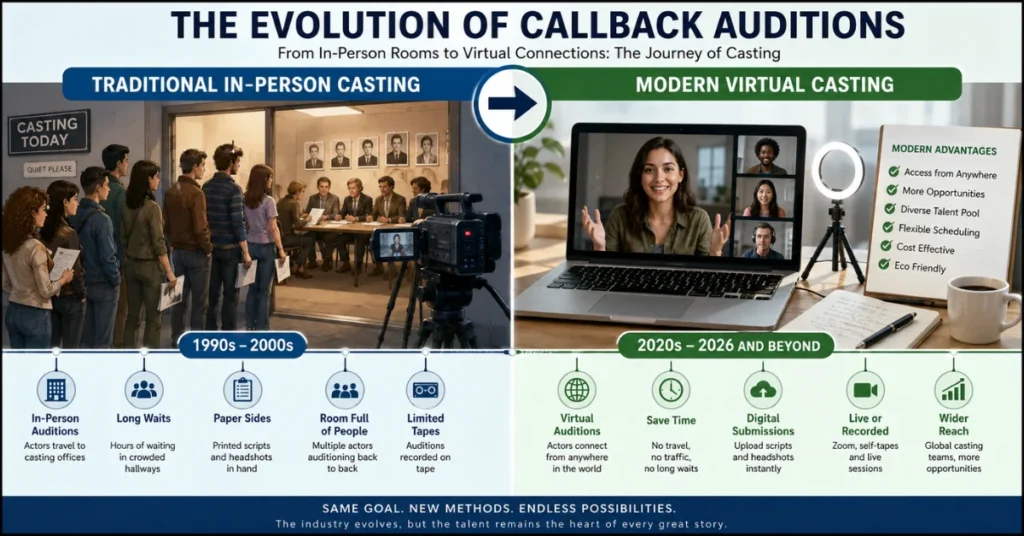
The entertainment industry didn’t wake up one day and establish formal callback procedures. This evolved over decades. In the 1980s and 90s, callbacks were often chaotic — actors would drive across cities, wait hours, perform for distracted executives. There were no clear standards, and that’s where many problems occurred.
Today, professional organizations have changed the landscape. The International Casting Directors Association launched AI Guidelines for Casting Platforms at the Cannes Film Festival in May 2026, addressing ethical, creative, and professional challenges and ensuring technology supports rather than replaces human creative expertise.
These aren’t just guidelines for technology — they reflect a broader commitment to professionalism. The industry now expects clear communication about audition times, what to prepare, how long the session will last, and who will be present. Professional casting directors provide written confirmation of appointments. They respect actors’ time.
The shift accelerated during the pandemic, when virtual auditions became necessary. Something unexpected happened: actors started asking why callbacks had to be in-person at all. Why travel hundreds of miles? Why wait in person? Now hybrid models are standard — you can often choose video auditions for initial rounds and only come in person if you’re seriously being considered.
Who Actually Controls Backroom Casting Decisions?
Here’s something aspiring actors often misunderstand: backroom casting isn’t controlled by a single person. It’s collaborative.
The casting director runs the room and conducts the audition. Their job is to evaluate talent objectively and present strong options to decision-makers. They’re the professionals — this is their expertise.
The producer is watching, forming opinions about whether you fit the project’s needs and budget. They’re thinking about bankability and practical concerns.
The director — if present — is imagining you in the actual role. They’re asking themselves: can this person bring this character to life the way I’m envisioning?
All three might have different opinions. The casting director might love you. The director might see someone else. The producer might worry about scheduling conflicts with your other projects. That’s how real decisions happen.
Safety Standards in Modern Casting
One reason backroom casting felt risky to actors historically was the lack of oversight. Private rooms, power imbalances, no witnesses. To help ensure a professional environment and enable the director to believe that a performer’s ‘yes’ is genuine, casting directors are rightly concerned about performer safety and issues of consent.
Professional casting societies now enforce codes of conduct. Casting directors must treat all performers with respect. They cannot require anything inappropriate. They cannot pressure performers into uncomfortable situations. Violations get reported to unions like SAG-AFTRA, which has real enforcement power.
For actors, this means:
You have the right to bring someone with you (always ask first).
You should receive clear information about what the audition entails before you go.
If you feel unsafe or uncomfortable, you can leave.
You can report unprofessional behavior to your union or to organizations like ICDA.
These standards exist because the industry acknowledged that backroom casting only works fairly when both parties operate with respect and transparency.
What the Research Shows
The entertainment industry continues studying audition outcomes and casting practices. One consistent finding: callbacks that follow structured processes produce better creative matches. When casting directors use clear rubrics, evaluate multiple candidates in similar conditions, and involve multiple decision-makers, the final cast typically performs better.
The emotional toll of backroom casting on performers has drawn increased attention. Early adoption of wellness support programs in major studios shows that actors performing better callbacks correlate with access to coaching and mental health support. Professionals working in this field consistently report that clarity and professionalism in the callback process reduce stress significantly.
Backroom Casting: Film vs. Television vs. Modeling
The process differs slightly depending on medium.
Film: Usually one to three callbacks. Once you’re cast, you’re done auditioning for that role. The stakes feel highest because film contracts are significant.
Television: Often multiple callbacks across several episodes before final casting. TV productions need faster turnaround, so virtual callbacks are more common. Some shows hold group callbacks to test ensemble chemistry immediately.
Modeling: Callbacks are often go-sees where photographers test you with actual outfits and lighting. It’s less about performance, more about how you photograph.
Theater: Academic institutions and regional theaters often have final callback sessions where they combine auditions with workshops. Yale’s Acting program, for example, holds Final Acting Callback Sessions in late February for finalists, where they meet faculty and take classes.
The fundamentals remain the same across all mediums — backroom casting is simply the deeper evaluation phase.
Red Flags vs. Legitimate Casting
Not all callbacks are legitimate. Protecting yourself means knowing the difference.
Legitimate backroom casting:
- Comes through your agent or a verified casting call
- Takes place at established studios, production offices, or professional facilities
- Involves known casting directors, producers, directors
- Happens during reasonable hours
- Asks for performance, not personal favors
- Provides clear written confirmation
Suspicious situations:
- Private residences for professional film/TV auditions
- Requests to remove clothing for “dramatic roles” without clear context
- Vague about who will be present
- No written confirmation
- Asking for personal information beyond what’s necessary
- Pressure to rush decisions
Trust your instincts. If something feels off, it probably is.
How to Prepare for Your Backroom Casting
Preparation is your power. When you know exactly what to expect, you perform better.
Research the project: Know the script, the character, the director’s previous work. Know what story you’re trying to tell.
Prepare multiple versions: Have your audition piece ready in different tempos and emotional approaches. Casting directors will direct you — show you’re flexible.
Dress appropriately: Match the character or dress neatly in neutral colors. This isn’t about fashion — it’s about not distracting from your performance.
Arrive early: Being calm matters more than being first. Arrive with time to breathe.
Look them in the eye: When you start, make brief eye contact with the casting director. This builds connection. During your piece, perform for the character, not the casting director.
Take direction gracefully: When they ask for adjustments, implement them immediately without debate. This is the entire point of callbacks — showing you can take notes.
Leave everything in the room: Give the strongest performance you can. Then let it go. You can’t control their decision.
The Waiting Game After Backroom Casting
Here’s the reality: After your callback, you probably won’t hear anything for days or weeks. Sometimes longer.
This doesn’t mean you didn’t book the role. It means decisions take time. Final callbacks happen, contracts negotiate, producers argue about choices. Three actors might have tied auditions and the decision comes down to scheduling or a director’s intuition.
The professional world isn’t designed to make closure easy. But that’s actually good news — it means your audition isn’t forgotten. You’re still in consideration.
The Future of Backroom Casting
By 2026, technology is reshaping how callbacks happen. AI isn’t replacing casting directors — but it is helping with organization. Platforms now store audition videos, making it easy for producers to review callbacks weeks later. Virtual auditions mean less travel. International collaborations mean time zone management.
What’s not changing: the human judgment of casting directors. Technology serves their expertise. It doesn’t replace it.
The industry is also getting better at transparency. More productions publish their casting processes, their diversity goals, their timeline expectations. This benefits everyone.
FAQs
Q: What’s the difference between a callback and backroom casting?
A: They’re often used interchangeably. A callback is when you’re invited back. Backroom casting describes the private setting where that callback happens. Same thing, different terminology.
Q: Can I bring my agent to the backroom casting?
A: Typically no — it’s you and the industry professionals. Your agent stays in the waiting room. But you can ask if you’re under 18 or have specific access needs.
Q: How many callbacks are normal before booking?
A: It varies wildly. Sometimes one callback leads to a booking. Sometimes four or five callbacks precede a rejection. There’s no standard.
Q: What if I freeze during my backroom casting?
A: Acknowledge it. “I got nervous, can I start again?” Casting directors respect honesty. They want to see you at your best.
Q: Is backroom casting only for major productions?
A: No. Student films, indie productions, theater, commercial casting — all use callback processes. The scale changes, not the fundamental structure.