
“I’m bored” has a way of landing at the worst possible moment, usually while dinner’s on the stove or a work call just started. A boredom jar printable is the low-effort fix a lot of parents reach for: a jar of pre-written activity slips a kid can grab on their own, no negotiating required. It sounds almost too simple, but that’s kind of the point.
The idea has been floating around parenting blogs and Pinterest boards for well over a decade now, and it keeps resurfacing every summer and school break because it actually works. A recent nationally representative survey of US parents found that most parents strive to manage their kids’ screens, yet 42% say they could do better, which explains why a low-tech, screen-free tool like this one still gets reached for so often. Here’s what it is, how to set one up properly, what child development research says about letting kids sit with boredom, and a stack of activity ideas you can print today.
What a Boredom Jar Printable Actually Is
A boredom jar printable is a downloadable, printable set of activity slips designed to be cut apart and dropped into a jar or container. When a child announces they’ve got nothing to do, they reach in, pull one, and follow through. No screens involved, unless the activity happens to call for one.
Most printable sets include somewhere between 20 and 60 activities, a label to stick on the jar itself, and a handful of blank slips so families can add their own ideas. Anyone who has managed a household with restless kids during a long weekend knows the appeal instantly: it hands the decision-making back to the child instead of leaving a parent to invent something on the spot for the fifth time that day.
The format works because it’s tactile. Pulling a slip out of a jar feels like a small game, which makes kids more willing to actually do the activity than if a parent just listed off suggestions verbally. Most families find it clicks best from around age four or five onward, once a child can read a short phrase or at least follow a simple picture prompt. Younger toddlers usually need an adult to read the slip aloud and guide the activity anyway, so the independence benefit doesn’t fully kick in until a bit later.
Building One in Four Simple Steps
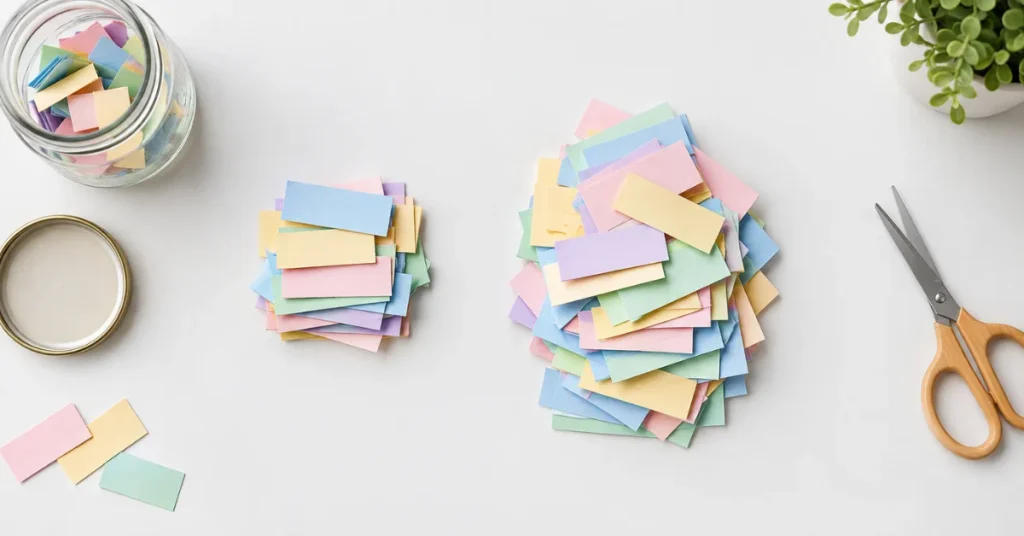
Setting one up doesn’t take long, and most of the work happens once.
- Print the slips. Use a printable set (plenty are free online, cardstock works best) or type up your own list in a document and print it on regular paper. If you’re outside the US, remember most templates default to US Letter size, so switch your printer settings to A4 before printing or the edges may get cut off.
- Cut the strips apart. A paper cutter speeds this up, but scissors do the job fine for a smaller batch.
- Prep the jar. A standard quart-size mason jar, roughly 32 ounces, holds about 30 to 40 folded slips comfortably. A smaller jam jar works fine for a shorter list. Tape or glue a printed label to the front if the set includes one.
- Sort activities by effort level. Split them into “quick and easy” and “needs a bit of planning” piles before dropping them in, so a five-minute wait before dinner doesn’t turn into a half-finished art project on the kitchen table.
A few extras are worth doing at this stage, even though they’re easy to skip. Running the cut slips through a laminating pouch or covering them with clear contact paper makes them last through months of handling instead of tearing after a few weeks. Marking each slip with a small symbol (a paintbrush icon for craft supplies, a shoe icon for outdoor gear) lets a child see at a glance what they’ll need before they commit to an activity. And on cost: a printable set is usually free, a secondhand jar costs next to nothing, and a laminating pouch or roll of contact paper runs a few dollars, so the whole project typically comes in under five dollars total. If you’d rather design your own from scratch, free tools like Canva let you build and edit a fully custom slip template before printing, which is handy if you want activities tailored to a specific child instead of a generic list.
What the Research Shows About Boredom and Kids
Letting a child sit in boredom for a bit isn’t neglect, according to researchers who study this. A 2014 study published in the journal Creativity Research Journal found that boredom pushes people toward generating more of their own ideas, essentially forcing the brain to fill the gap itself instead of waiting for outside entertainment.
Penn State researchers Karen Gasper and Brianna Middlewood found that people who handle boredom well actively seek out satisfying activities, much the way happy people do, rather than simply waiting to be entertained. That framing matters here. A boredom jar printable doesn’t remove the discomfort of boredom, it gives a child a structured way to move through it toward something engaging.
One UK-based education researcher who spent years studying the topic has said publicly that boredom can lead to more creativity in both children and adults, based on interviews with authors and artists about their own childhoods. A separate study out of a UK university, meanwhile, found that people were measurably more creative after sitting through a very boring, passive task, and the more tedious the task, the stronger the effect afterward.
None of this means unlimited free time is the goal. It means a bit of unstructured boredom, followed by a nudge toward action, tends to produce more independent, creative kids than constant scheduled entertainment does.
50+ Ideas to Put Inside a Boredom Jar Printable
A good boredom jar printable mixes activity types so a kid isn’t stuck doing the same category of thing every time they reach in. Here’s a breakdown that works well across most age ranges.
| Age Group | Sample Activities | Prep Time Needed |
|---|---|---|
| Toddlers (2-4) | Stack cups, color with chunky crayons, sort laundry by color, stack pillows into a “mountain” | Under 2 minutes |
| Young kids (5-8) | Draw a comic strip, build a pillow fort, do a scavenger hunt, write a silly story | 5-10 minutes |
| Tweens (9-12) | Learn a magic trick from a book, plan a mini obstacle course, start a journal, teach the dog a new trick | 10-20 minutes |
| Teens | Cook a snack from scratch, redesign a bedroom corner, write a letter to future self, learn three chords on guitar | 15-30 minutes |
| Whole family | Board game tournament, backyard scavenger hunt, family movie pitch night, build something from cardboard | 20+ minutes |
A few of these need a quick supervision note. Anything involving the stove, sharp scissors, or leaving the yard (a bike ride, a solo walk) should stay flagged as adult-supervised for kids under roughly eight, even though the slip itself doesn’t say so. Marking those slips with a small dot of colored tape before they go in the jar is an easy way to flag them without cluttering the printable design.
For a genuinely copy-and-cut boredom jar printable, here’s a ready-to-use set. Copy this into a document, print it on cardstock, and cut along each row.
| # | Activity Slip (cut along this row) |
|---|---|
| 1 | Build a blanket fort and read inside it |
| 2 | Draw your own comic strip, three panels minimum |
| 3 | Make up a secret handshake |
| 4 | Write a letter to your future self |
| 5 | Do 20 jumping jacks, then freeze-dance to one song |
| 6 | Create a scavenger hunt for a sibling or parent |
| 7 | Build the tallest tower you can from household objects |
| 8 | Teach a pet (or a stuffed animal) a new trick |
| 9 | Make a paper airplane and test three different designs |
| 10 | Write and perform a two-minute puppet show |
Common Mistakes That Make a Bored Jar Fail
A boredom jar printable that gets ignored after the first week almost always has one of these problems.
Too many activities require a parent’s help. If half the slips say “ask mom to help you bake” or “have dad set up the sprinkler,” the jar stops being a solo tool and becomes another request queue. Aim for at least 70 percent of the activities a child can start without adult involvement.
The activities don’t match the child’s actual interests. A printable pulled straight off the internet won’t know that a particular eight-year-old hates drawing but loves building things. Swap in a few custom slips using the blank templates most sets include.
The jar sits somewhere inaccessible. If it’s on a high shelf or in a closet, a kid will default to asking for a screen instead of walking across the house to dig through a jar. Keep it somewhere they can reach without asking permission first.
There’s no system for more than one child. Two siblings reaching into the same jar tends to end in an argument over who goes first or who got the better slip. A simple fix: give each child their own color-coded jar, or let each child draw two slips and choose one, so it feels like a decision rather than a lottery.
There’s no refresh cycle. Activities get pulled and used once, then the jar quietly empties out over a month. A quick monthly top-up keeps it from going stale.
Boredom Jar Printable for Classrooms, Road Trips, and Homeschool Days
Parents aren’t the only ones using this. Teachers running early-finisher stations in a classroom often keep a version at a desk corner, with slips built around quiet, low-mess activities that don’t disrupt other students mid-lesson: silent reading challenges, vocabulary doodles, or a five-minute mindfulness prompt.
Homeschool families frequently build a boredom jar printable around subject-specific prompts, turning “I’m bored” into a chance to squeeze in extra practice without it feeling like a worksheet. A math-focused slip might ask a kid to find five things around the house shaped like a specific geometric figure.
For road trips, the format shifts again. Car-friendly slips skip anything involving glue, paint, or wide-open floor space and lean into travel bingo, license plate games, or story-building where each passenger adds one sentence. A small tin works better than a glass jar for this one, given the bumps.
For neurodivergent kids, including those with ADHD or sensory sensitivities, a scaled-down jar tends to work better than a full 50-slip version. Keeping the jar to 8 to 10 slips at a time reduces decision fatigue, pairing each phrase with a simple icon helps kids who find reading under stress harder, and sticking to one activity category per week (all movement-based, then all quiet-based) can prevent the kind of overwhelm that makes a bigger jar backfire.
Non-technical parents and grandparents tend to appreciate this format specifically because it needs no app, no login, and no charging. Print it, cut it, done.
Boredom Jar Printable vs. Screen Time: A Quick Comparison
Handing over a tablet solves boredom faster in the moment, no argument there. But the trade-offs look different once you compare them side by side.
| Factor | Boredom Jar Printable | Screen Time |
|---|---|---|
| Setup effort | One-time, 20-30 minutes | Instant |
| Independence built | High, kid chooses and executes | Low, passive consumption |
| Creativity involved | Usually active | Usually minimal |
| Repeat cost | Free after printing | None, but usage adds up |
| Parent involvement needed | Occasional | Often none until it’s time to stop |
Neither one is a villain here. A reasonable household usually lands somewhere in between, leaning on the jar for the bulk of “I have nothing to do” moments and saving screens for genuine downtime or travel days.
Conclusion
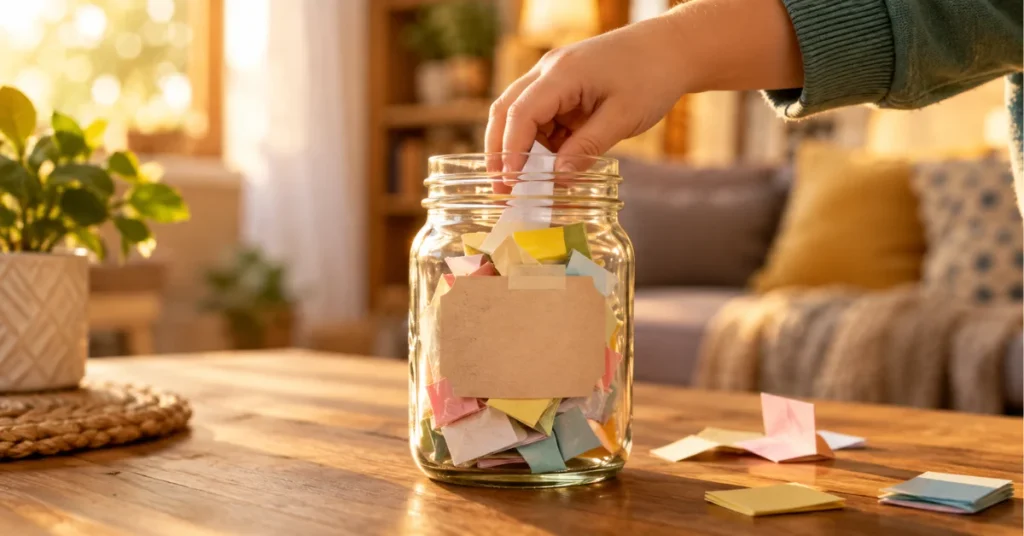
A boredom jar printable isn’t a magic fix, but it’s a genuinely useful one. It hands kids a structured way to move through boredom on their own, backs up what researchers keep finding about unstructured time and creativity, and costs next to nothing to set up. Print a set on the right paper size, laminate the slips if you want them to last, sort by effort level, keep it somewhere reachable, and refresh it once a month. That’s really the whole system, and it tends to outlast most other quick parenting fixes precisely because it’s this simple.
FAQs
Do boredom jars actually work for teenagers, or just younger kids?
They work for teens too, as long as the activities match their age. A jar full of toddler crafts won’t land with a 14-year-old, but slips built around cooking, music, or independent projects usually do.
How many activities should go in a boredom jar printable?
Somewhere between 25 and 40 tends to be the sweet spot. Fewer than that and it feels repetitive fast; more than that and kids spend too long picking instead of doing.
What age should a child be before starting a boredom jar?
Around four or five is the usual starting point, once a child can read a short phrase or follow a simple picture. Younger toddlers can still use one, but they’ll need an adult to read the slip and get them started.
What size jar do I actually need?
A quart-size mason jar, about 32 ounces, comfortably holds 30 to 40 folded slips. For a smaller list of 15 to 20, a jam jar or small tin works just as well.
Can I make my own instead of downloading a printable set?
Absolutely. A blank sheet, a pen, and ten minutes of brainstorming works just as well as a downloaded template, especially if it’s built around what your specific kids actually enjoy.
What if my child keeps picking the same easy activity over and over?
Remove duplicate slips once they’ve been used, or set a rule where a pulled slip goes into a “used” pile until the jar gets refreshed. That forces some variety back in.
Is a boredom jar printable appropriate for a classroom setting?
Yes, many teachers use a scaled-down version for early finishers or transition times. Keep classroom slips quiet, low-mess, and short enough to complete in five minutes or less.