
“I’m bored” is the phrase every parent dreads, and a boredom jar is one of the simplest fixes that actually works. The idea is straightforward: write activities on slips of paper, drop them in a jar, and let your kid pull one out whenever the complaining starts. Below are 101 boredom jar ideas for kids, sorted so you can build a jar that fits your household — whether that’s a rainy Tuesday indoors or a free Saturday afternoon outside.
Quick Reference: What’s in This Jar
| Category | Idea Range | Typical Time | Best For |
|---|---|---|---|
| Indoor (No Screens) | 1–30 | 10–45 min | Any day, any weather |
| Creative & Craft | 31–50 | 20–60 min | Rainy days, quiet afternoons |
| Outdoor | 51–70 | 15–45 min | Warm weather, energy to burn |
| Quiet Time & Rainy Day | 71–85 | 10–30 min | Winding down, sick days |
| Learning & Brain Games | 86–101 | 5–20 min | Car rides, waiting rooms |
Why a Boredom Jar Works Better Than a List on the Fridge
A list gets ignored. A jar gets picked. There’s something about pulling a random slip of paper that turns “go find something to do” into a tiny game, and kids are far more likely to commit to an activity they chose (even randomly) than one they were told to do.
Anyone who’s tried both approaches with siblings knows the jar also cuts down on arguing — each kid pulls their own slip, so nobody feels like they got stuck with the “boring” option someone else picked for them.
Pediatric researchers back the bigger idea behind this, too. A clinical report from the American Academy of Pediatrics found that children’s play isn’t frivolous, and the importance of playful learning for children can’t be overstated, with unstructured, child-led play specifically linked to executive function, stress reduction, and stronger parent-child bonds.
How to Actually Make the Jar
This is the step most lists skip. Here’s the quick version:
- Pick a container. Any jar, box, tin, or empty container works — it doesn’t need to be a mason jar with ribbon on it.
- Cut slips of paper. Roughly 1×3 inches is enough to write one activity per slip.
- Write or print the activities. Handwritten is fine for older kids; younger kids do better with a simple picture or icon glued on instead of text.
- Fold each slip so the activity isn’t visible until it’s pulled.
- Color-code by category (see below) using colored paper, dots, or colored pens, so kids can steer toward what fits the moment — indoor vs outdoor, quiet vs active.
- Drop them all in and shake. Done.
No supplies on hand? An empty cereal box, a repurposed candle jar, or even a sandwich bag works just as well as anything store-bought. Paper doesn’t need to be fancy — torn notebook paper folded in half does the exact same job.
A Quick Safety Note
A few activities on this list need a bit of supervision. Slime-making involves mixing agents that shouldn’t touch skin for long or go anywhere near eyes or mouths. Water balloon games should stay away from roads and driveways. And for kids under 3, keep an eye on small craft items — buttons, beads, small blocks — since anything that fits inside a toilet-paper tube is considered a choking risk by product safety regulators. If in doubt, swap the activity for one of the paper-only or verbal alternatives below.
Indoor Activities (No Screens)
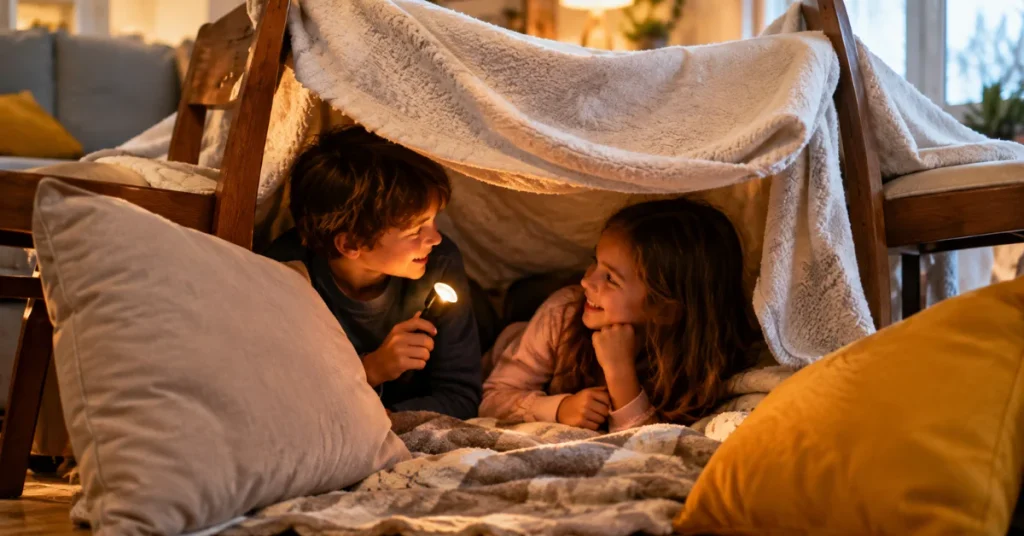
- Build a blanket fort and read inside it with a flashlight
- Make up a secret handshake
- Do a puzzle (time yourself and try to beat it next time)
- Write and illustrate a short comic strip
- Play hide and seek with stuffed animals
- Set up an indoor obstacle course using pillows and furniture
- Make paper airplanes and hold a distance contest
- Learn 5 words in a new language
- Build the tallest tower possible out of cups or blocks
- Write a letter to your future self
- Draw a self-portrait using only shapes
- Play “the floor is lava” through the whole house
- Make a scrapbook page about your favorite day this year
- Do a magic trick and perform it for someone
- Invent a new board game with rules you make up
- Practice cartwheels or handstands (with a soft landing spot)
- Make a time capsule to open in a year
- Write a short story starting with “The door creaked open…”
- Build a card tower
- Do 20 jumping jacks, then draw what you’re thinking about
- Play charades solo — act out movies for a stuffed animal audience
- Fold 10 origami shapes
- Make a playlist of your top 10 songs
- Practice juggling with socks
- Create a treasure map of your house
- Do a “silent minute” and write down everything you hear
- Make shadow puppets on the wall
- Reorganize your bookshelf by color
- Write a joke and test it on a family member
- Build a marble run out of cardboard tubes
Creative and Craft-Based
- Draw your dream bedroom
- Make friendship bracelets
- Design a superhero and give them a backstory
- Paint rocks to hide around the yard later
- Make a collage from old magazines
- Sculpt something out of clay or playdough
- Design a flag for an imaginary country
- Decorate a plain t-shirt with fabric markers
- Make homemade slime (with supervision)
- Create a comic about your pet (real or imaginary)
- Design and build a mini cardboard house
- Press flowers or leaves from the yard
- Make a friendship card for someone unexpected
- Draw a map of an imaginary island
- Create a stop-motion video with toys and a phone
- Paint with cotton swabs instead of brushes
- Make paper snowflakes, no matter the season
- Build a diorama in a shoebox
- Design your own board game box art
- Make bookmarks for every book on your shelf
Outdoor Activities
- Go on a bug hunt and count how many kinds you find
- Have a chalk-drawing contest on the driveway
- Build a fort out of sticks
- Do a nature scavenger hunt (find something red, something round, something soft)
- Water balloon toss with a partner
- Ride bikes to a spot you’ve never been before
- Have a picnic in the backyard
- Plant something in a pot or garden bed
- Fly a kite
- Skip rocks at a pond or lake
- Play hopscotch
- Set up a lemonade stand
- Do a cloud-watching session and describe the shapes
- Make mud pies
- Have a bubble-blowing contest
- Go on a walk and collect 10 different leaves
- Build a fairy house out of natural materials
- Play tag with a twist (like “freeze tag” or “shadow tag”)
- Wash the family bike or car
- Try to identify 5 different bird calls
A quick note on this section: water balloons, bubbles, and kite-flying depend on decent weather, while chalk drawing, bug hunts, and stick forts work fine on a cool or overcast day. Swap accordingly by season.
Quiet Time and Rainy Day Options
- Listen to an audiobook or podcast made for kids
- Do a word search or crossword puzzle
- Write in a journal about your day
- Learn a magic trick from a book or video
- Practice a musical instrument for 15 minutes
- Sort and organize a drawer or closet
- Read a book in a different room than usual
- Make a list of 20 things you’re grateful for
- Draw a comic strip with no words, just pictures
- Do a guided breathing or stretching exercise
- Write a letter to a grandparent or relative
- Make a family tree with drawings instead of names
- Practice handwriting in cursive
- Do a coloring page and try to stay perfectly in the lines
- Build a pillow nest and just relax for 10 minutes
Learning and Brain Games
- Try a math riddle or logic puzzle
- Look up one interesting fact about an animal you like
- Do a memory game with playing cards
- Practice spelling with sidewalk chalk
- Learn how to tie 3 different knots
- Try mental math — add up numbers you see around the house
- Research a country you’ve never heard of
- Learn a fun fact about the day’s date in history
- Practice telling time with an analog clock
- Do a science experiment with household items (with supervision)
- Try a tongue twister challenge
- Learn the sign language alphabet
- Play 20 Questions with a family member
- Write down 5 questions you’d ask an astronaut
- Try to name all 50 states (or all the countries you know)
- Teach a trick to the family pet (or a stuffed one, if you don’t have a pet)
A Paper-Free Version for the Car or Waiting Room
Not every boredom jar moment happens at home. For car rides, waiting rooms, or restaurants, build a small verbal-only version using ideas from the list above that need nothing but talking — 20 Questions (98), mental math (91), naming states or countries (100), tongue twisters (96), and storytelling starting with a set line (“The door creaked open…” from idea 18, told aloud instead of written). Keep 8–10 of these memorized or on a small card in the glove box.
Making It Work for Every Kid
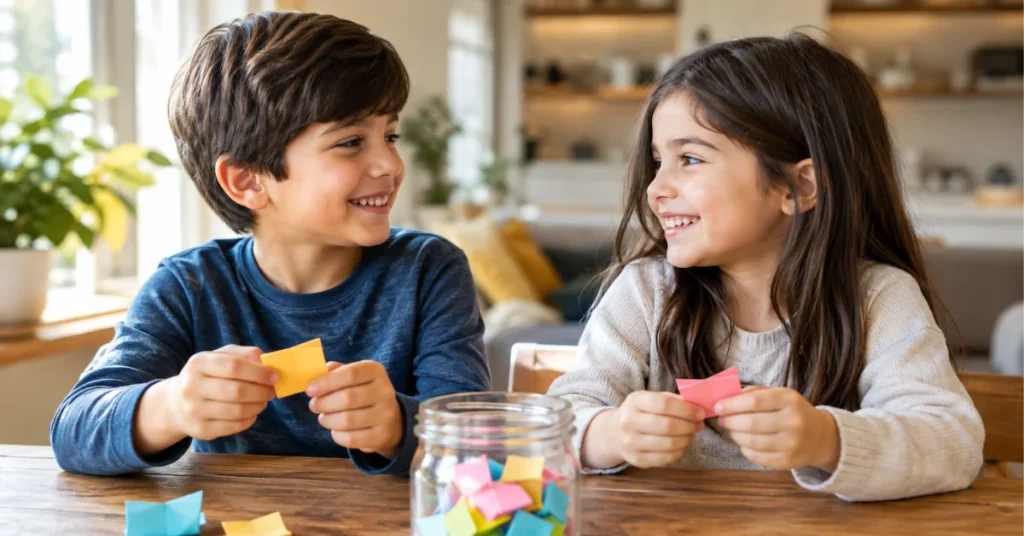
Boredom jars aren’t one-size-fits-all, and a few small adjustments make a big difference depending on who’s using it.
By age. Kids around 4–6 do better with picture-based slips and shorter activities (5) and (20). Ages 7–9 can handle most of the list as written. Kids 10 and up tend to gravitate toward the more independent, longer activities like (18), (45), and (92).
For sensory-sensitive or neurodivergent kids. Some children do better with predictable, low-stimulation options rather than open-ended ones. Slips like the pillow nest (85), sorting a drawer (76), or the silent minute (26) work well for kids who need to wind down rather than rev up. A dedicated “quiet corner” slip category, kept separate from the high-energy ones, can help these kids self-select without feeling singled out.
For siblings sharing one jar. Give each child their own color of slip so nobody feels like they got someone else’s pick, or use a “draw two, keep one” rule so there’s a small element of choice built in. This one adjustment resolves most of the fighting that comes with a shared jar.
Tips for Building the Jar
A few things make a boredom jar hold up over time:
- Mix easy and involved activities so kids can pick based on how much energy or time they have.
- Color-code slips by category (indoor, outdoor, quiet, craft) using colored paper or dots, so kids can steer toward what fits the moment.
- Refresh it seasonally — swap in outdoor ideas for summer, quiet indoor ones for winter.
- Let kids add their own ideas to the jar. It keeps them invested and often surfaces activities they actually want to do.
FAQs
How many ideas should go in a boredom jar?
Anywhere from 20 to 50 is manageable to start. You don’t need all 101 at once — build it out over time as ideas come up.
What age is a boredom jar good for?
It works well for roughly ages 4 through 12. For younger kids, use simple picture cards instead of written slips.
Should the jar include screen-time options?
Most parents keep boredom jars screen-free on purpose, since the goal is usually to offer an alternative to screens rather than another way back to one.
How do I keep kids from picking the same easy slip every time?
Some families set a rule that a slip can’t be picked again until it’s drawn once from every category, or they let kids draw two and pick one.
What if my kid says every idea is boring?
That’s common at first. Let them add a few of their own ideas to the jar — buy-in usually goes up once it’s not just a parent’s list.