
Dinner’s half-made, someone needs help with homework, and the baby’s crying in the next room. Somewhere in that noise, one on one time with each child can feel like the first thing that gets cut. But parents who’ve stuck with it, even for fifteen minutes a week, describe a shift in how their kids behave and open up that’s hard to get any other way.
This isn’t about grand gestures or expensive outings. It’s about carving out small, undivided windows where one parent and one child are simply together, without a sibling competing for airtime.
What One on One Time With Each Child Actually Looks Like
At its core, one on one time with each child means exactly what it sounds like: a stretch of time, however short, where a parent gives full attention to a single child. No referee duties. No dividing attention three ways at the dinner table.
Family time and one on one time aren’t the same thing, and mixing them up is where a lot of parents lose the benefit. Group activities are great for teaching kids to share and cooperate. But a child rarely gets to steer the conversation or feel like the center of the room when siblings are around. One on one time flips that. The child picks the game, the topic, the pace.
Parenting researchers sometimes call this practice “Special Time,” a term built around a simple idea: kids who get regular, focused attention from a parent tend to act out less the rest of the week, not more. The logic tracks with how attachment develops in early childhood. When a child trusts that connection is available, they don’t have to fight for it.
What Researchers Found When They Looked Closer
A national survey of American families with children aged one to five found something worth paying attention to. Parents who read, sang, or told stories with their young kids daily were far more likely to describe those children as flourishing, including having a close, affectionate bond with the parent. Kids who got little individual interaction showed lower overall well-being and a weaker connection to their parent, even within the same household.
A Yale-based child psychiatry researcher who has studied parent-child bonding for decades makes a distinction that sticks: time alone with mom and time alone with dad tend to feel different to a child, and both matter in their own way. He also notes that this time doesn’t need a plan. Unstructured time, just sitting together with no phones in sight, often does more work than a scheduled activity.
There’s harder data too. A team of Swedish economists studied what happened after a nationwide childcare reform freed up more one on one time between parents and infants, by moving older siblings into part-time care during parental leave. They didn’t find a blanket boost in test scores years later. But they did find measurable gains for specific groups, including sons of mothers without a university degree and daughters of highly educated mothers, and the effect showed up even though total parenting time didn’t change. What changed was the quality of interaction once competition for attention dropped.
Pediatric health organizations echo this from a developmental angle. Consistent one-on-one interaction in early childhood supports social-emotional growth, language development, and self-regulation, the kind of skills that show up later as a kid who can calm down after a bad day instead of melting down.
How Much One on One Time With Each Child Do Kids Actually Need
Here’s the good news: this isn’t a multi-hour weekly commitment. One well-known family program built from clinical research on bereaved and high-stress households recommends just fifteen minutes per child, per week, protected on the calendar like any other appointment. Other researchers point to roughly one hour weekly, split however fits your family’s rhythm, as enough to see a real shift in behavior and connection.
What matters more than the total minutes is consistency. A single two-hour outing once a season doesn’t build the same trust as fifteen predictable minutes every week. Kids track patterns. A regular slot on the calendar tells a child, without you saying a word, that they matter enough to be planned for.
Making It Work When You Have More Than One Kid
Anyone raising more than one child knows the math gets harder fast. Three kids at fifteen minutes each is forty-five minutes a week just in dedicated time, on top of everything else already competing for the clock. Families who’ve made this stick usually rely on rotation, not simultaneous effort.
| Family Size | Suggested Approach | Weekly Time Commitment |
|---|---|---|
| 1 child | Daily short check-in or one longer weekend slot | 15–30 min/day or 1–2 hrs/week |
| 2 children | Alternate evenings, one child per night | ~15–20 min per child, 3x/week |
| 3–4 children | Rotate one child per day, repeat weekly | 15 min per child, once weekly |
| 5+ children | Assign fixed days per child on a visible calendar | 10–15 min per child, once weekly |
Errands turn out to be an underused resource here. A grocery run or a school pickup with just one kid in the car often produces more honest conversation than a sit-down chat ever does, since there’s no eye contact pressure and no audience.
Age-by-Age Ideas That Actually Work
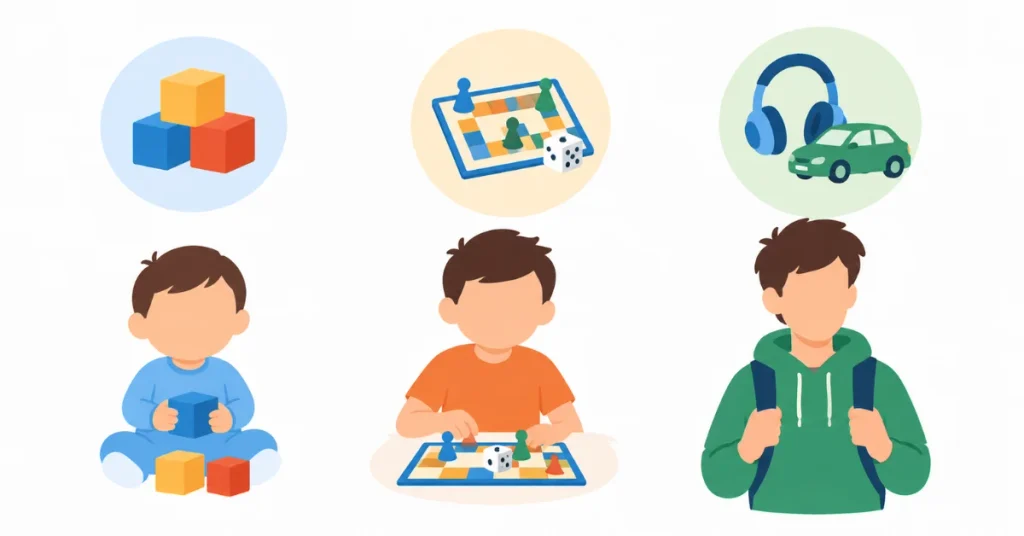
Telling a parent to “let the child pick” only helps if they know what’s actually age-appropriate to offer. What works for a toddler falls flat with a twelve-year-old, and forcing a teen into a toddler-style activity usually backfires.
| Age Group | What Tends to Work | What to Avoid |
|---|---|---|
| Toddlers (1–3) | Simple sensory play, reading the same book on repeat, naming objects on a walk | Long sit-down activities, anything requiring patience they don’t have yet |
| Preschool (4–5) | Pretend play led entirely by the child, baking, drawing together | Correcting their “rules” of the game mid-play |
| Elementary (6–10) | Board games, bike rides, cooking a simple recipe together, a hobby they’re into | Turning it into a lesson or quiz session |
| Tweens (11–13) | Shared errands, a shared show or podcast, teaching them a skill you have | Asking too many direct questions about feelings |
| Teens (14–18) | Driving somewhere together, a shared meal out, working on something practical like a car or a project | Scheduling it as a formal “talk,” bringing up grades or curfew |
The pattern across every age group is the same: activities with low eye-contact pressure, like driving, cooking, or walking, tend to get kids talking more freely than sitting face to face ever does.
Different Families, Different Realities

Not every household runs the same playbook, and one on one time with each child needs to flex depending on who’s doing the parenting.
Single parents juggling this alone often find it easier to fold individual time into existing routines, like bedtime or the morning school drop-off, rather than adding a new block to an already stretched day.
Blended families carry an extra layer. Stepparents building trust with a non-biological child usually need more repetitions of small, low-pressure time before a child opens up, and biological parents sometimes need to protect that space intentionally so it doesn’t get absorbed by the whole group.
Working parents with limited evening hours tend to do better with short, frequent contact over long, rare sessions. Ten minutes before bed, four nights a week, beats one exhausted Saturday afternoon.
Parents of teenagers face a different challenge: teens often resist anything that looks like a scheduled “talk.” What tends to work better is shared activity with low eye contact, driving somewhere, cooking together, shooting hoops, where conversation happens as a byproduct instead of the point.
Only children already get more individual attention by default, but even here, dedicated time distinct from general household interaction still matters, since day-to-day logistics conversations aren’t the same as time set aside purely for connection.
Why Birth Order Makes This Matter More for Some Kids
Not every child in the same house gets the same amount of unplanned individual attention, and that’s where birth order quietly enters the picture. Firstborns get several years of undivided focus before a sibling arrives. Youngest kids often stay the “baby” of the family well into their teens, picking up leftover doting long after older siblings have moved on. Middle children tend to get squeezed between both.
This isn’t just an old wives’ tale. Alfred Adler’s birth order theory, developed in the early 1900s, first proposed that a child’s position among siblings shapes how much parental attention they receive by default, and researchers studying family dynamics still reference the pattern today. A sociologist who has written on the topic notes that middle children, left without deliberate one on one time, can end up at a real developmental disadvantage compared to their siblings, not because parents love them less, but because attention naturally drifts toward whoever just arrived or whoever arrived first.
The practical takeaway for parents managing more than two kids: don’t split one on one time evenly by default and assume it’s fair. A middle child who rarely asks for attention often needs it scheduled for them precisely because they won’t ask. Watching who in the family tends to go quiet at the dinner table is usually a better guide than the calendar alone.
Common Mistakes That Undo the Trust
A few habits quietly wreck the benefit of this practice, even when parents show up for it every week.
- Turning it into a reward or punishment, like “you’ll get your time with me if you behave,” which teaches a child the connection is conditional instead of guaranteed.
- Using the time to bring up grades, chores, or discipline, which makes the child associate the slot with being evaluated instead of enjoyed.
- Letting it get bumped for minor scheduling conflicts, which quietly signals it wasn’t a real priority to begin with.
- Checking a phone during the time, even briefly, which a child notices far more than parents assume.
- Steering the activity toward what the parent enjoys instead of what the child picked.
None of these are dramatic failures. They’re small habits that build up and hollow out the whole point of the time.
When Your Child Says They Don’t Want To
Resistance shows up more often than most articles admit, especially with tweens and teens who find a labeled “special time” awkward or babyish. A flat refusal usually isn’t rejection of the parent. It’s discomfort with the format.
Dropping the label often helps more than pushing the schedule. Instead of announcing “it’s your one on one time now,” folding the same undivided attention into something the child already does, a drive, a shared errand, watching something they picked, keeps the connection without the pressure of a formal invitation. For younger kids who resist sitting still, shortening the window to five or ten minutes and building back up tends to work better than forcing a full session.
If refusal is constant and paired with pulling away from the family generally, that’s usually less about the practice itself and more worth a quiet, separate conversation about what’s actually going on.
The Bigger Picture Going Into 2026
Screen time and packed extracurricular schedules keep shrinking the windows families have for unstructured connection, which is part of why one on one time with each child has resurfaced as a topic parents are actively searching for guidance on. As remote work and flexible schedules reshape how much time parents physically share a roof with their kids, the quality of the minutes available matters more than it used to. Families who treat individual time as non-negotiable, rather than a nice-to-have, tend to report fewer behavior flare-ups and a clearer read on what each child is actually dealing with day to day.
FAQs
How is one on one time with each child different from regular family time?
Family time includes the whole household and teaches group skills like sharing. One on one time gives a single child full attention without a sibling present, which tends to surface things a child wouldn’t say in front of the group.
What if I only have fifteen minutes a week to give?
That’s enough to start. Consistency matters more than duration. Fifteen protected minutes weekly, repeated over months, builds trust more reliably than one long outing that happens once.
Does this still work with teenagers, or is it just for younger kids?
It works differently, not less. Teens usually respond better to shared activity with low pressure, like driving somewhere together, rather than a sit-down conversation labeled as special time.
Does birth order affect how much one on one time a child needs?
Yes. Firstborns and youngest children tend to pick up more incidental individual attention naturally, while middle children are more likely to be overlooked, so they often benefit from having dedicated time scheduled deliberately rather than left to happen on its own.
What should I do if my child refuses this time?
Drop the formal label and fold the same attention into something they already enjoy, like a car ride or an errand. Constant refusal paired with general withdrawal is worth a separate, calmer conversation.