
Parents asking about daytime sleep for 9 month old babies are usually staring at a nap that ended fifteen minutes too soon. It’s one of the most searched sleep questions of this age, right up there with night waking. And the honest answer is: it varies more than most charts admit, but there’s a real range worth knowing.
Most nine-month-olds land somewhere between 12 and 16 hours of total sleep across a full day, once naps and nighttime hours are combined. That figure comes from general pediatric sleep guidelines rather than a single fixed number, so don’t panic if your baby sits at either end of it.
What Counts as Normal Daytime Sleep for 9 Month Old Babies?
By nine months, most babies have settled into a two-nap rhythm. One nap sits mid-morning, the other early afternoon, and together they typically add up to somewhere in the range of two to three hours of daytime rest.
That’s not a hard rule. Some babies nap shorter and sleep longer at night. Others do the reverse. Pediatric sleep guidance treats the 24-hour total as the number that actually matters, not the day-night split on its own.
Anyone who has tracked a baby’s sleep log for a few weeks knows the pattern rarely looks identical two days running. A short nap on Tuesday often gets balanced out by an earlier bedtime that same evening.
Nighttime Sleep vs Daytime Sleep for 9 Month Old Schedules
Night sleep usually makes up the bigger share at this age, often 10 to 12 hours, with daytime naps filling in the rest. This is the point where a lot of the third nap disappears for good.
Babies who were still squeezing in a brief late-afternoon nap at seven or eight months tend to drop it around now. Cutting that catnap is a normal part of the shift toward a more toddler-like schedule, not a sign anything’s gone wrong.
A Quick Reference Table
Here’s a simple breakdown that’s specific to nine-month-olds rather than the whole first year:
| Sleep Component | Typical Range at 9 Months |
|---|---|
| Total sleep (24 hrs) | 12–16 hours |
| Number of naps | 2 (sometimes transitioning from 3) |
| Daytime nap sleep | Roughly 2–3 hours combined |
| Nighttime sleep | Roughly 10–12 hours |
| Wake window between naps | About 2.5–3.5 hours |
| Wake window before bedtime | Often the longest of the day |
Treat this as a starting point, not a target to hit exactly. Babies who run a little under or over these numbers, but seem alert and content, usually aren’t dealing with a sleep problem at all.
Signs Your Baby’s Daytime Sleep Is Off Track
A few patterns are worth paying attention to, without jumping to conclusions.
- Naps consistently under 30 minutes, most days of the week
- Extreme fussiness in the hour before a nap “should” happen
- Night sleep becoming more broken as naps shrink
- A baby who seems wiped out even after what looks like enough sleep
None of these alone mean something’s wrong. Teething, a growth spurt, or a new skill like crawling or pulling up can all shake up a previously solid schedule for a week or two.
What Pediatric Sleep Guidelines Say for 9-Month-Olds
Sleep guidelines published through Mayo Clinic’s pediatric network put infants aged 4 to 12 months at 12 to 16 hours of sleep in a 24-hour period, including naps — a figure that lines up closely with UK health guidance covering the same age band. That range is wide on purpose, since babies genuinely differ in how much rest they need.
Clinical nap guidance also points to nine months as roughly when the third nap tends to disappear, once a baby is sleeping well at night and taking two solid daytime naps instead. Parents who’ve gone through this transition often describe it as bumpy for about a week, then surprisingly smooth once bedtime moves earlier to compensate.
Wake Windows and Why They Matter
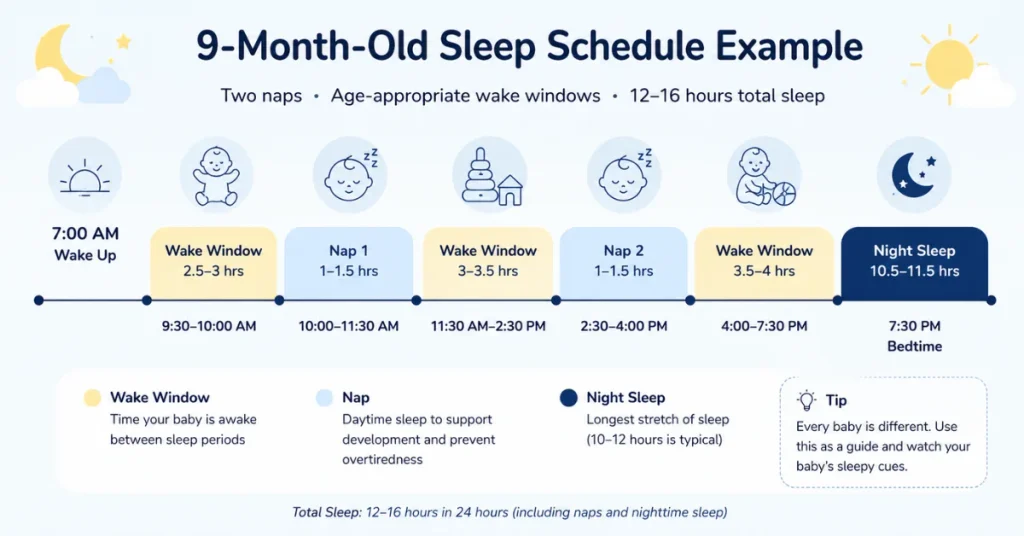
Wake windows, the stretches of awake time between sleep periods, tend to run about two and a half to three and a half hours at this age. Push much past that and overtiredness can make falling asleep harder, not easier.
That’s a bit counterintuitive for new parents. Keeping a baby up longer doesn’t usually produce a longer nap. More often it produces a shorter, choppier one.
Different Babies, Different Patterns
Not every nine-month-old fits the two-nap mold neatly.
Babies still on three naps. Some are mid-transition and doing a short third nap a few times a week. That’s fine as long as it isn’t pushing bedtime too late.
Early one-nappers. A small number of babies drop to a single nap earlier than average. This is less common at nine months but not alarming if night sleep stays solid.
Daycare schedules. Babies in group childcare often nap on a fixed schedule set by staff rather than by their own cues, which can look different from a home routine without being worse.
Breastfed vs formula-fed babies. Feeding method doesn’t reliably predict nap length, though frequent night feeds can sometimes shorten how long a baby sleeps before their first nap starts.
When to Check In With a Doctor
Most nap struggles resolve on their own within a couple of weeks. That said, it’s worth mentioning to a pediatrician if a baby is sleeping far outside the 12–16 hour range consistently, seems unusually lethargic during the day, or if snoring and pauses in breathing show up during sleep.
Bringing It All Together

Daytime sleep for 9 month old babies isn’t a single fixed number so much as a workable range, with two naps and roughly two to three hours of combined nap time being the most common pattern. What matters more than hitting an exact figure is whether your baby wakes up rested, feeds well, and stays reasonably content between sleep stretches. Watch the whole day, not just the clock.
This article is for informational purposes only. Always consult a qualified professional for guidance specific to your child.
FAQs
Is it normal for a 9 month old to only take one nap?
It happens, though it’s earlier than the typical one-nap transition, which usually lands closer to 14–18 months. If night sleep stays strong and your baby seems well-rested, one nap alone isn’t automatically a concern.
How long is too long for a daytime nap at this age?
A single nap running past two and a half hours can sometimes eat into nighttime sleep readiness. It’s not universally a problem, but it’s worth watching if bedtime keeps slipping later.
Why did my baby’s naps suddenly get shorter around 9 months?
Developmental leaps like crawling, pulling to stand, or separation anxiety commonly disrupt naps for a stretch. Most babies settle back into their previous pattern within one to three weeks.
Should I wake my baby from a nap so it doesn’t affect bedtime?
Capping the last nap of the day, generally by mid-to-late afternoon, is a common approach parents use to protect bedtime. There’s no strict universal cutoff time since routines vary household to household.
Does daytime sleep affect how well a baby sleeps at night?
Yes, though not always in the direction people expect. Skipping naps to “tire a baby out” tends to backfire, since an overtired baby often fights sleep harder rather than falling asleep faster.