
There’s a question that keeps audiences buzzing long after the credits roll: who does she choose in eternity? A24’s 2025 fantasy rom-com Eternity forces Joan to decide between her first love and her lifelong husband, setting up the film’s central moral dilemma — and the answer is genuinely earned.
Spoilers ahead. All of them. Read on only if you’re ready.
The Setup That Makes Who Does She Choose in Eternity So Hard to Answer
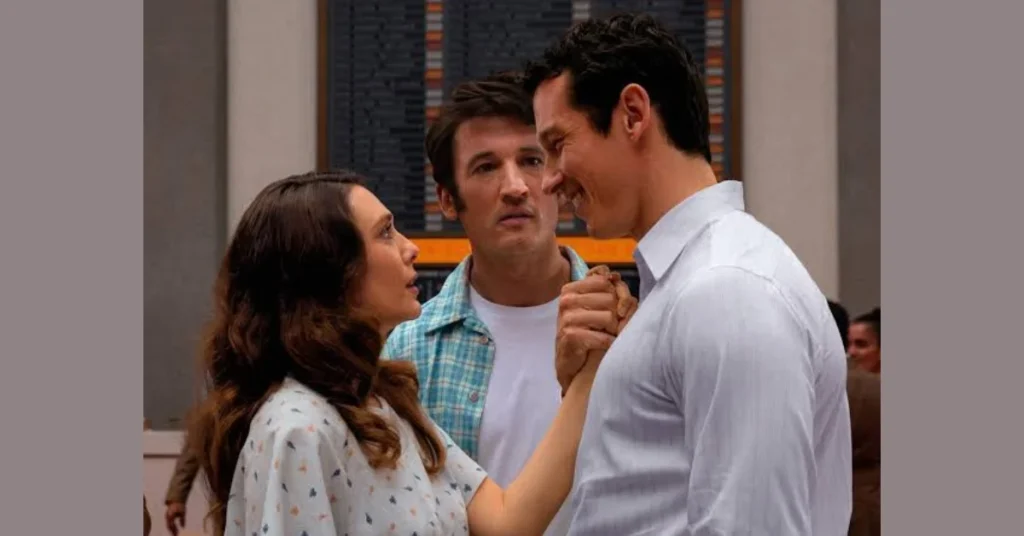
Eternity stars Elizabeth Olsen as a woman in the afterlife forced to choose whom to spend forever with: her second husband of 65 years, played by Miles Teller, or her first husband who died young, portrayed by Callum Turner. That basic premise sounds clean enough. But the film layers on enough emotional weight to make the choice genuinely agonizing.
Joan dies not long after Larry. Souls arriving at the afterlife’s Junction have one week to decide where to spend eternity, and once they commit, they cannot switch. The film treats that rule as a real threat — not a comedy device. Attempting to escape a chosen eternity can get someone dropped into an empty void, described as the closest thing to hell in this world.
Luke represents the promise of a life she never got to live. Larry represents the one she actually built. That single line from the film’s press materials is the entire emotional engine of the story. Every scene builds outward from it.
The Two Men, Explained
Larry is not the obvious romantic hero. He’s the one who already got the girl, already had 65 years, already built the home and raised the kids. He is the person Joan grew with, argued with, and aged with — which means their love includes friction. That friction isn’t a flaw in their relationship. The film argues it’s the definition of it.
Luke’s eternity has been one long vigil. He never moved on. Instead, he held off on choosing his own eternity, an irreversible decision, and tended bar at the Junction for 67 years, waiting for Joan. That’s either the most romantic gesture in cinema history or a slightly concerning refusal to let go — depending on which side of the argument you’re on.
Because Luke died young, the relationship stays permanently intense and permanently unfinished. That makes it easy for Joan to project a complete future onto him, since the real future never happened. The film is sharp enough to name this clearly. Luke’s pull is the pull of the unlived life. It’s powerful precisely because it was never tested.
And that’s the thing. An untested love is always perfect. It never has to survive a bad Tuesday.
What the Research Shows
The film taps into something psychologists have studied for years: the lasting hold of interrupted relationships. People who lose a partner early — to death, circumstance, or timing — often carry that relationship at a higher emotional pitch than their longer, more grounded partnerships. The Archives in the film — a long hallway of diorama-like memory spaces where moments exist as walkable exhibits — dramatize the difference between fantasy and lived history.
Joan literally walks through both lives. She visits Luke’s mountain paradise version of eternity: quiet, romantic, preserved in amber. She visits Larry’s version: Beach World, sunny, crowded, imperfect. Their old rhythm slips back into place; the lightness fades into reflection.
The film’s emotional argument is that imperfection is not a bug. It’s the proof that something was real.
Who Does She Choose in Eternity? The Full Answer
Joan’s final answer comes after a prolonged back-and-forth that refuses to make the decision easy. Initially, Larry backs out of the competition after realizing that Joan’s afterlife form reflects her happiest moments — and that she appears as she did when she was with Luke. He steps aside and lets her go.
Joan initially chooses Luke. But while Luke and Joan are together, she grows increasingly distant from her first love and begins to miss Larry. Luke, to his credit, doesn’t cling. He reluctantly comes to terms with her true feelings and helps her escape.
So who does she choose in eternity? Joan chooses Larry — the second husband she actually lived a full life with, rather than Luke, the first love she lost to war. The closing beats are staged as Joan accepting the life she lived over the life she imagines she might have lived. That acceptance is the emotional payoff the entire film is building toward.
In Joan’s own words from the film: “Love isn’t just one happy moment, right? It’s a million. And it’s bickering in the car, and supporting someone when they need it, and it’s growing together, and looking after each other.” That quote functions almost as the film’s thesis statement.
Why the Ending Works — and Why Some Viewers Disagree
Not everyone leaves satisfied. The debate among audiences after watching Eternity is genuinely split. Director David Freyne told interviewers the ending is the decision he always wanted Joan to make, and that it was right because it reflects who she is now rather than a past version of herself.
But some viewers pushed back hard. One critical reading argues Joan initially made the braver choice before Larry coaxed her into another decision — and that she should have chosen herself entirely, stepping into her own eternity rather than anchoring it to either man.
That’s not a fringe take. A lot of people who watch the film feel exactly that way. Joan spends the entire story being competed over, negotiated for, and pulled in two directions. Her moment of near-independence, before she commits to Larry, reads to some as the most authentic version of herself the film ever shows.
The director’s response? He says he likes that audiences argue over it, and that as long as viewers are Team Joan in some form, the debate doesn’t concern him.
Which brings us to the real point: the film works because the question — who does she choose in eternity — doesn’t have a clean answer. Both sides of the debate are rooted in genuine emotional logic.
What the Film Says About Love, Memory, and Time
Eternity isn’t just a love triangle. It’s a film about what happens when memory and lived experience go to war with each other. Director Freyne frames it as the dilemma of choosing between your first great love and your last great love, inspired by films like The Wizard of Oz and A Matter of Life and Death.
The Junction setting as an afterlife bureaucracy works better than it sounds. The world is more bureaucratic than stories of pearly gates, with a busy convention hall where agents help newcomers decide which themed eternity fits them. Options include Queer World, Wine World, Man-Free World, and a suspiciously crowded beach. The comedy comes from normalizing a cosmic decision the way a conference hall normalizes a sales pitch.
But the emotional core never gets lost inside the jokes. A great current of sadness runs under just about every conversation in the film, and that’s what lifts it above a standard rom-com structure.
As of 2026, Eternity continues streaming on Apple TV+ and has generated ongoing discussion about its ending, which is a reliable sign that the film landed somewhere meaningful for audiences even when it didn’t fully satisfy them.
The Supporting Characters Who Steal Everything
Da’Vine Joy Randolph and John Early deserve their own paragraph. Anna and Ryan, the afterlife coordinators, have a quibbling charisma and consistently steal scenes throughout the film. Randolph in particular brings warmth and weight to a role that could easily have been purely comedic.
Anna quietly reveals to Larry that she came from a hard life but has found meaning in her position as an afterlife coordinator. That backstory adds texture to what could have been a functional plot device of a character. Same with Ryan, played by Early, whose flustered energy gives Olsen’s Joan someone to play off as she wrestles with the impossible.
The film also quietly traces other relationship arcs through the Junction. Joan’s friend Karen discovers a new part of herself after her own husband dies, and Anna and Ryan develop something quietly affectionate in the background. Eternity keeps suggesting that connection takes many forms — and that the afterlife offers more room for that than the living world ever did.
Is Eternity Worth Watching If You Already Know the Ending?
Yes. Knowing who does she choose in eternity doesn’t deflate the experience — it changes it. On a second viewing, every time Larry steps back to let Joan choose freely, and every time Joan gravitates back toward him without realizing it, the inevitability feels earned rather than predictable.
Critics describe it as a spiritual successor to classic romantic screwball comedies that’s worthy of their company, with an original high concept and a compelling love triangle. Not everyone agrees — some reviews noted the film runs out of gas and should have been closer to 90 minutes rather than nearly two hours — but the central performances carry even the slower stretches.
Elizabeth Olsen, Miles Teller, and Callum Turner are doing genuinely interesting work here. Olsen plays Joan as nervously caught in the middle of an impossible situation, with a new determination not to sacrifice her own happiness for others. Teller plays Larry like an older man truly seeing his partner for the first time. Turner plays Luke at a softer register, his quiet confidence shaped by decades of patient waiting.
The trio’s chemistry sells the central dilemma in a way that the script alone couldn’t. You believe all three of them. That’s why the ending stings, regardless of which team you’re on.
Final Thoughts
Eternity asks the kind of question most romantic stories avoid: what happens to love when there’s more than one version of it, and time is no longer the limiting factor?
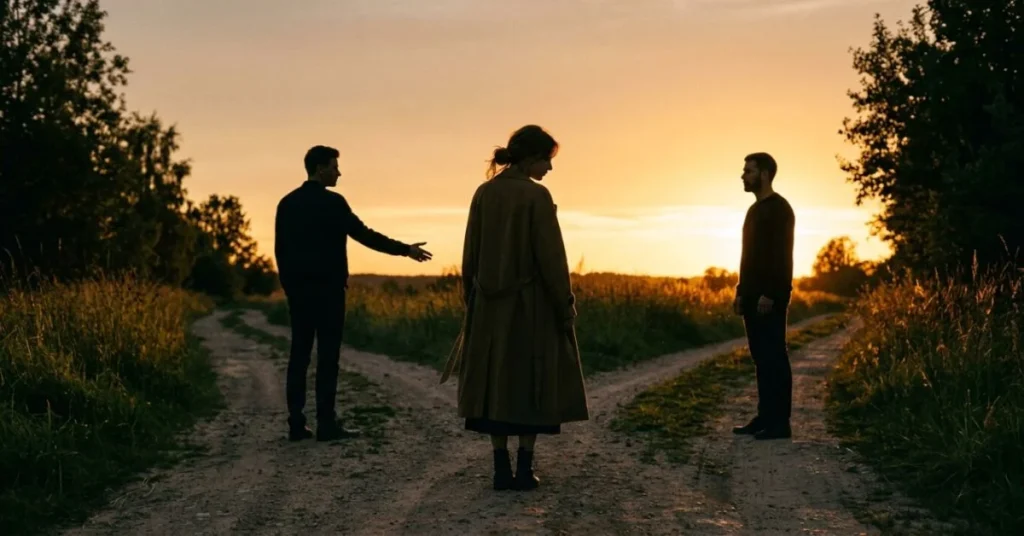
Joan’s choice — who does she choose in eternity — comes down to a truth the film earns quietly and slowly. The love she and Larry built wasn’t easier than what she had with Luke. It was harder. And it still held. That’s the argument the film makes, and it makes it without dismissing Luke or turning him into a villain. He waited 67 years. He let her go. He was the bigger man in the end, in the most literal sense.
Whether you think Joan chose right or not almost doesn’t matter. The film made you care enough to have an opinion. In an age of algorithmically optimized content, that’s rarer than it sounds.
FAQs
Does Joan choose Luke or Larry in Eternity?
She ultimately chooses Larry, the husband she spent 65 years with, after initially testing an afterlife with Luke and realizing her heart had shifted over decades.
Why does Joan appear as her younger self in the afterlife?
The film establishes that people arrive at the Junction as they were during their happiest moments. Joan’s form reflects her time with Luke, which initially shakes Larry before he steps aside.
What happens to Luke after Joan chooses Larry?
Luke helps Joan escape from the eternity she chose with him and accepts her decision. He doesn’t have a confirmed next step shown in the film, though the implication is that he’ll eventually choose his own path.
What is the Junction in Eternity?
The Junction is the afterlife’s transit hub — a giant waystation modeled like a convention center where newly arrived souls have one week to choose their forever destination from a range of themed eternities.
Is the ending of Eternity controversial?
Yes. Audiences remain genuinely split. Some viewers think Larry was the right choice. Others believe Joan should have chosen herself entirely rather than anchoring her eternity to either man.