
Summer arrives and the melon comes out, and the question lands the same way it does every year: can 9 month old eat watermelon without choking or reacting badly to it? The short answer is yes, most babies at this age can eat watermelon safely, as long as it’s prepared the right way. This piece walks through exactly how to do that, what the actual risks are, and what to watch for once the fruit hits the highchair tray.
Can 9 Month Old Eat Watermelon? The Quick Answer
Yes. By nine months, most babies have moved well past the earliest stage of solids and are working on their pincer grasp, which makes watermelon a genuinely good fit. Pediatric feeding specialists generally place watermelon among the easier fruits to introduce because it’s soft, naturally sweet, and doesn’t require cooking.
So when parents ask can 9 month old eat watermelon, the real question underneath it is usually about safety, not whether the fruit itself is appropriate. And that’s a fair thing to ask. Nine-month-olds are still developing the coordination to chew and move food around their mouth, so preparation matters more than the fruit itself.
Watermelon isn’t classified as a major choking hazard the way grapes or whole nuts are. It’s soft enough to mash between a baby’s gums, which is one reason pediatric dietitians list it as a reasonable early finger food.
Why Watermelon Works So Well At This Age
Babies lose fluid faster than adults relative to their body weight, and hot months make that worse. Watermelon is roughly 91% water, so a few bite-sized pieces do double duty as hydration and as a food-exploration exercise. One cup of watermelon provides about 46 calories, 1 gram of protein, 12 grams of carbs, and 14% of the daily value for vitamin C.
That vitamin C content matters more than it might seem. It supports iron absorption from other foods on the tray, like lentils, beans, or iron-fortified cereal, something a lot of parents don’t realize until a dietitian mentions it. The fruit also contains lutein and lycopene, two antioxidants tied to reducing oxidative damage in the body.
There’s also the sensory side of things. Watermelon has a texture unlike most other early foods: juicy, slightly fibrous, and cold if served chilled. Anyone who has watched a baby’s face the first time they taste something genuinely new understands why texture exposure matters just as much as nutrition at this stage.
How To Cut Watermelon Safely For A 9 Month Old
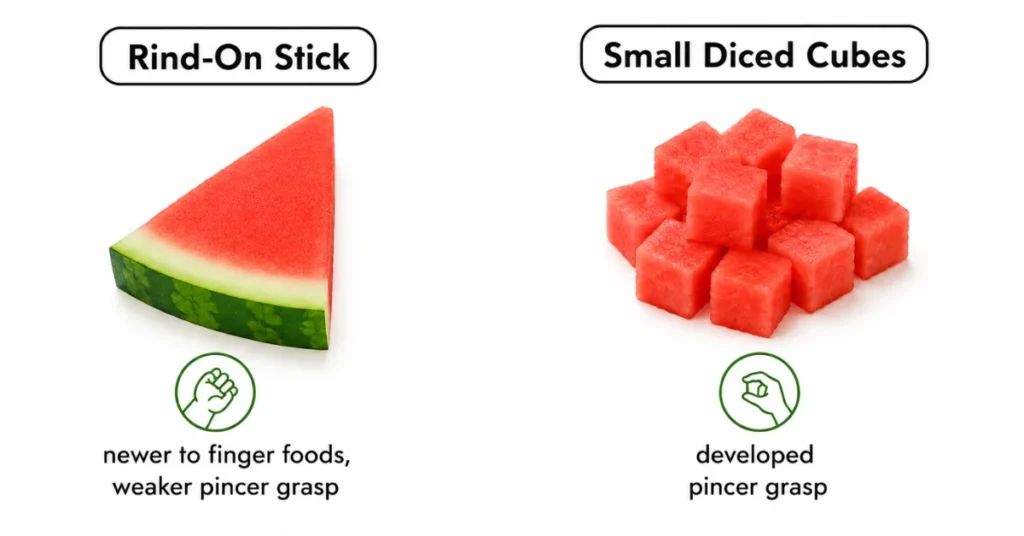
This is where most of the actual risk lives, not in the fruit itself but in how it’s cut. A large slab with the rind attached behaves very differently in a baby’s mouth than a small diced cube.
Parents managing this stage of feeding tend to settle on one of two approaches, depending on their baby’s grasp development and comfort with finger foods.
Picking a genuinely ripe melon makes the whole process easier. Look for a creamy yellow patch on one side, where the fruit sat on the ground as it grew. A dull thud rather than a sharp sound when you tap the rind, along with a melon that feels heavy for its size, usually means the flesh inside is soft and ready to eat. Underripe watermelon is firmer and harder to mash, which raises the choking risk regardless of how small you cut it.
Method 1: Rind-on sticks. Cut a wedge about the width of two adult fingers, leaving the rind attached as a built-in handle. Babies gnaw and suck the flesh while the rind gives them something to grip that they can’t easily bite through.
Method 2: Small diced pieces. Once the pincer grasp is developing, cut deseeded, soft flesh into pieces roughly a half-inch across. This works well for babies who’ve already had practice with finger foods.
| Preparation Style | Best For | What To Watch |
|---|---|---|
| Rind-on stick or wedge | Babies newer to finger foods, weaker pincer grasp | Large bites that could be pushed to the back of the mouth |
| Small diced cubes (½ inch) | Babies with developed pincer grasp | Pieces small enough that gagging doesn’t turn into choking |
| Mashed or pureed | Babies not yet ready for texture, or as a backup method | Consistency thin enough to swallow without effort |
| Frozen watermelon puree pops | Teething relief on hot days | Always supervised, never left unattended with a pop |
Whichever method fits your baby, always remove every visible seed first. Black seeds are hard and can be a genuine hazard, while the small white seeds found in seedless varieties are usually soft enough to pass through without issue.
The rind itself is technically edible, but it’s fibrous and tough, so it isn’t meant to be swallowed at this age. Its job here is purely to act as a handle, and if your baby manages to bite off a piece of it, treat that the same way you’d treat any firm food: stay calm, let them work it forward, and step in only if needed.
Watermelon also carries more natural sugar than many other first fruits, which is worth knowing even though it’s a different category from added sugar. There’s no need to limit it for that reason alone, but it’s one more reason to treat watermelon as part of a varied diet rather than the only fruit on repeat.
Food safety matters just as much as cutting technique with this fruit, since melons grow close to the soil and their rind can carry bacteria that transfers to the flesh once a knife cuts through it.
| Storage Step | Guidance | Why It Matters |
|---|---|---|
| Washing before cutting | Rinse the whole rind under running water and scrub gently before slicing | Prevents surface bacteria from being dragged into the flesh by the knife |
| Time at room temperature | Refrigerate cut watermelon within about two hours | Bacteria multiply quickly on cut, moist fruit left out |
| Refrigerator temperature | Store at or below 40°F (4°C) in a sealed container | Slows bacterial growth on the exposed flesh |
| How long to keep it | Use within a few days and discard anything that smells off, feels slimy, or looks discolored | Cut melon spoils faster than most other fruits once opened |
None of this means watermelon is riskier than any other fruit when it’s handled properly. It just means the same care that goes into cutting it safely should carry over into how it’s washed and stored.
Choking Risks Parents Should Actually Know About
Watermelon sits lower on the choking-risk list than round, firm foods like grapes or whole cherry tomatoes, but that doesn’t mean zero risk. UK food safety guidance recommends cutting large or firm fruits like melon into slices rather than small chunks, and softening firm produce where needed.
Gagging is not the same thing as choking, and this distinction trips up a lot of new parents. Gagging is loud, visible, and usually resolves itself as baby pushes food forward with their tongue. Choking is often silent. If your baby goes quiet, turns blue, or can’t cough, that’s an emergency, not a normal part of feeding.
A few practical rules reduce risk significantly:
- Always supervise, seated, upright, every single time.
- Feed only in a proper highchair at roughly a 90-degree angle, never in a reclined car seat, bouncer, or stroller.
- Never offer watermelon in a moving car.
- Skip the rind entirely if your baby has a habit of biting off large chunks.
- Keep bites proportional to what your baby has already handled with other soft foods.
Parents managing this stage of feeding often find that gagging decreases naturally as the baby gets more practice, not less exposure. Research cited by UK parenting bodies has found that babies following a self-feeding approach are not more likely to choke, and babies unfamiliar with finger foods may actually face higher risk.
Knowing what gagging looks like matters, but knowing what to do if a baby actually chokes matters more. If your baby can’t cough, cry, or breathe, call emergency services immediately and begin infant back blows and chest thrusts if you’ve been trained to do so. This isn’t something to learn for the first time mid-emergency, so taking a certified infant first aid or CPR course before starting solids is one of the most useful things a parent or caregiver can do, watermelon or otherwise.
Signs Your Baby Isn’t Quite Ready Yet
Not every nine-month-old is at the same stage, and that’s normal. A few signals suggest waiting a week or two before offering diced watermelon specifically:
Baby still struggles to move food from the front to the back of the mouth. Baby hasn’t yet started developing a pincer grasp and can only palm large objects. Baby has recently started a new solid food and is still adjusting to it.
None of these mean watermelon is off the table forever. It just means starting with the mashed or rind-on stick method rather than small diced pieces might make more sense for a few more weeks.
Watermelon Allergies And Reactions Worth Watching For
True watermelon allergy is uncommon in infants, but it isn’t nonexistent. Some babies with pollen sensitivities can develop a mild reaction known as oral allergy syndrome, which shows up as slight redness or itching around the mouth where the fruit made contact. Watermelon belongs to the same plant family as ragweed, so if there’s a family history of ragweed or pollen allergies, it’s worth introducing it in a small amount first and watching a little more closely than usual.
Loose stools are the more common reaction, and it’s usually about quantity rather than intolerance. Because watermelon carries so much natural water and some fructose, larger servings can move through a baby’s digestive system faster than expected. If you notice this, cutting back the portion size for a few days usually solves it.
As with any new food, the standard three-day introduction rule still applies. Offer watermelon on its own, watch for a reaction over the following days, then layer it into mixed meals once you’re confident it agrees with your baby.
Watermelon Compared With Other Popular First Fruits
Parents often ask how watermelon stacks up against the other fruits that typically appear on a nine-month-old’s tray. Here’s a side-by-side look.
| Fruit | Prep Needed | Choking Risk Level | Hydration Value |
|---|---|---|---|
| Watermelon | Deseed, cut into sticks or cubes | Low-moderate | Very high |
| Banana | Peel, cut into spears | Low | Low |
| Avocado | Peel, mash slightly or slice | Low | Moderate |
| Grapes | Must be quartered lengthwise | High if whole | Moderate |
| Apple | Must be cooked or grated raw | Moderate-high raw | Moderate |
Watermelon compares favorably here because it needs almost no cooking or softening compared to apples or pears, and its risk profile sits closer to banana than to grapes when it’s cut correctly.
What Feeding Experts Are Seeing In 2026
Detailed analysis of infant feeding guidance over the past several years points toward one consistent theme: texture progression and supervision matter more than any single food’s inherent risk. Global health authorities generally recommend introducing solid foods from around six months, noting this is when infants start needing nutrients that breastmilk or formula alone can’t fully supply.
Examining feeding studies closely also reveals that babies exposed to a wider variety of textures earlier tend to handle new foods, including fruit like watermelon, with less gagging over time. That pattern shows up across baby-led weaning research fairly consistently, and it’s part of why so many pediatric feeding specialists now favor early texture exposure over prolonged pureeing.
Baby-Led Weaning Versus Purees: Which Fits Watermelon Best
Both approaches can work here, and this isn’t really an either-or decision for most families.
Baby-led weaning parents typically hand over a rind-on stick and let the baby control the pace, gnawing and sucking the juice out before working through more of the flesh. Puree-focused parents can blend watermelon into a thin puree, sometimes mixed with yogurt or oats to soften the texture further and add staying power.
A lot of households land somewhere in the middle, offering purees for predictability at breakfast and finger-food watermelon for the more relaxed, exploratory afternoon snack. Either path answers the same underlying question, can 9 month old eat watermelon safely, as long as the prep method matches where the baby’s skills actually are.
Can 9 Month Old Eat Watermelon Every Day? Portion Sizes Explained
There’s no strict daily limit, but moderation still matters. A few tablespoons of diced watermelon, two to three times a week, is a reasonable starting point for most nine-month-olds. Watching stool consistency over the first week or two will tell you whether that amount sits well or needs trimming back.
Serving it slightly chilled, rather than straight from the fridge, also helps. Very cold food can be uncomfortable for some babies and may cause them to reject it outright, so letting it sit at room temperature for ten minutes before serving tends to go over better.
Mobile Parents, First-Timers, And What Changes By Household
Not every household approaches this the same way, and the question of can 9 month old eat watermelon comes up differently depending on who’s asking. First-time parents often want a rigid rule, a fixed number of pieces, a fixed size. In practice, babies vary enough that watching your own child’s cues matters more than following a chart exactly.
Parents managing a second or third baby tend to relax faster, having already seen a sibling gag safely dozens of times without real danger. That experience is useful, but it’s worth remembering that no two babies handle textures identically, so what worked for an older child isn’t a guarantee for a younger one.
For parents feeding on the go, watermelon travels less well than some other finger foods since it’s juicy and can get messy in a bag or cooler. A small leak-proof container with pre-cut pieces, kept cold with an ice pack, solves most of that problem for daycare drop-offs or outings.
Grandparents and other caregivers stepping in for occasional feeds should get the same brief: seeds out, pieces sized to the baby’s current skill, and full attention during the meal. Consistency across caregivers reduces the chance of a preventable choking incident far more than any single feeding technique does.
Watermelon In Mixed Meals And Beyond The Highchair Tray
Once your baby has handled plain watermelon a few times without issue, it’s worth folding it into mixed dishes rather than always serving it solo. A simple approach many parents land on: mashed watermelon stirred into plain yogurt, which mellows the sweetness and adds protein and calcium to the same bite.
Frozen watermelon puree, poured into a mesh feeder or silicone teether tray, also doubles as relief during teething flare-ups. The cold numbs sore gums a little, and the natural sugar makes it more appealing than plain ice or a chilled washcloth.
Some parents blend watermelon into a thin smoothie with banana or oats for babies who are still transitioning textures. This keeps the nutritional benefits intact while easing anyone who isn’t quite ready for whole pieces yet, and it still answers the same practical question parents keep circling back to: can 9 month old eat watermelon in a form that fits where their baby actually is right now.
Conclusion

So, can 9 month old eat watermelon? Yes, and it’s genuinely one of the easier fruits to start with, provided the seeds are gone, the pieces match your baby’s current skill level, and someone is watching the whole time. Watermelon brings real hydration value, useful vitamin C, and a texture experience that helps build the chewing skills your baby will lean on for years of meals ahead. Start small, stay close, and let your baby’s own pace guide how quickly you move from sticks to cubes.
This article is for informational purposes only. Always consult a qualified pediatrician or healthcare provider before introducing new foods to your baby, especially if there’s a family history of allergies.
Frequently Asked Questions
Is watermelon a common choking hazard for babies?
Not typically. It sits lower on the risk scale than firm, round foods like grapes, but seeds should always be removed and pieces should match your baby’s chewing ability. This is usually the first thing parents wonder when they ask can 9 month old eat watermelon in the first place.
Can 9 month old eat watermelon seeds?
Black seeds should be removed before serving. The small white seeds in seedless varieties are generally soft enough to pass through safely, but removing them is still the safer habit.
How much watermelon can a 9 month old have in one sitting?
A few tablespoons is a sensible starting portion. Watch for loose stools, which usually means the amount needs to come down slightly.
Should watermelon be served cold or room temperature?
Room temperature or lightly chilled tends to be easiest for babies to accept. Straight-from-the-fridge cold can cause some babies to refuse it.
What if my baby gags on watermelon?
Gagging looks alarming but is usually a normal reflex that helps move food forward in the mouth. It’s different from choking, which is silent and requires immediate action.
Does the answer to can 9 month old eat watermelon change for premature babies or babies with reflux?
Babies born prematurely or dealing with reflux sometimes reach feeding milestones on a slightly different timeline. Check with your pediatrician before introducing textured fruit like watermelon if your baby falls into either category, since their readiness cues may show up later than the standard nine-month mark.