
Few horror endings from the last few years have left audiences as rattled as this one. If you just watched the final ten minutes with your jaw on the floor, you’re not alone. Anyone searching for when evil lurks ending explained right now is probably doing it for the same reason: the film refuses to hold your hand, and the last scene needs some unpacking.
Demián Rugna’s Cuando Acecha la Maldad (its Spanish title) dropped on Shudder and in theaters in October 2023, and it’s still generating conversation heading into 2026 thanks to a fresh 4K release. The film follows two brothers, Pedro and Jimi, in rural Argentina, who stumble onto a demonic possession that spreads faster than anyone can contain it. What happens by the closing frame isn’t just grim. It’s a complete rejection of the genre’s usual comfort. This is why when evil lurks ending explained is such a popular query.
Let’s walk through what actually occurs, why it happens, and what it says about the film’s bleak worldview.
Setting the Stage Before the Finale
Pedro and Jimi find a mutilated body near their land after hearing gunshots. That corpse belonged to a “Cleaner,” someone trained to properly kill a possessed person, known in the film’s world as a “Rotten,” before a demon can be born through them.
The man responsible, Uriel, is still alive and rotting from the inside. Instead of waiting for a replacement Cleaner, the brothers help move Uriel off the property. That single decision sets off a chain reaction. The corruption spreads to livestock, then to people, then to children, and eventually to Pedro’s own family.
A former Cleaner named Mirta later explains a set of survival rules: no guns, no fire near a Rotten, don’t say the demon’s name, and above all, don’t give in to fear, because fear is what feeds it. Nearly every character breaks one of these rules before the credits roll, and each violation makes things worse.
When Evil Lurks Ending Explained: What Happens to Jair
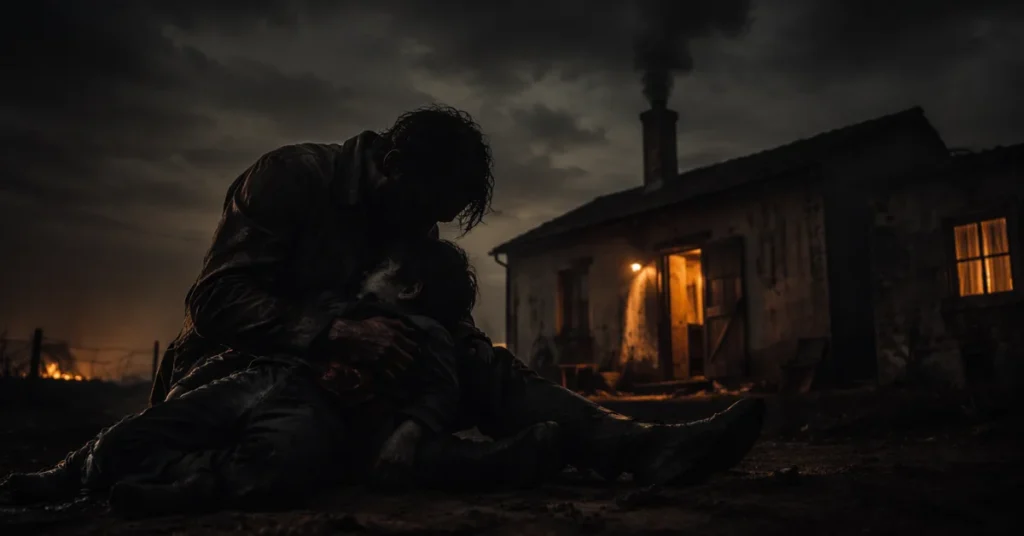
This is the heart of the finale. Pedro’s older son Jair is autistic, and Mirta warns early on that autistic minds are harder for a demon to fully occupy at first, though not impossible. Throughout the film, Jair shows small, unsettling signs: repeating words he shouldn’t know, moving with more control than before, staring a little too long.
After Pedro fails to stop the demon’s birth at a schoolhouse (more on that below), the brothers reunite and bring Jair home, believing the worst is behind them. It isn’t. Pedro gives Jair a scoop of ice cream to calm him down. Jair starts choking, and what comes out of his mouth is a clump of hair and a necklace belonging to his grandmother, Sara.
The implication lands hard: Jair, now fully possessed, killed and ate part of his own grandmother while the brothers were away. Pedro realizes his son is gone in every way that matters. He walks outside and collapses, wailing, while smoke later rises from the chimney, a strong suggestion that Pedro makes the unbearable choice to burn his son’s body to stop the demon from spreading further.
Anyone who has followed horror cinema for a while knows child-in-peril material is common. What sets this apart is that the child becomes the danger, and the parent becomes the one forced to act.
Why Uriel’s Death Wasn’t a Victory
Before the Jair reveal, Pedro and Mirta track Uriel to a schoolhouse where possessed children have already killed the surrounding adults. Mirta begins a ritual meant to destroy the demon properly, using specific tools and steps passed down through her training as a Cleaner.
Pedro, impatient and terrified, breaks away to grab a fire axe instead of trusting the process. While he’s gone, the children imprison him and murder Mirta, destroying her ritual equipment in the process. Pedro escapes and beats Uriel to death with his bare hands.
It should feel like a win. It isn’t. A demon child is born from Uriel’s corpse anyway, naked and blood-soaked, and it simply looks at Pedro before letting him walk away. That detail matters. The demon doesn’t need to kill Pedro because it already knows where the story is headed. This is arguably the clearest statement the film makes: violence without proper knowledge doesn’t stop evil, it just changes its shape. This bleak realization is the true core of when evil lurks ending explained.
When Evil Lurks Ending Explained: Why the Demon Wins
Every attempt at heroism in this film backfires. Ruiz shoots a possessed goat and gets killed by his own wife. Leonardo shoots the family dog and ends up possessed himself, driving his truck into his wife and stepdaughter. Pedro grabs an axe instead of trusting a ritual, and Mirta dies as a direct result.
The pattern is deliberate. Fear and violence are shown as fuel for the demon rather than weapons against it. The film’s rules, no guns, no fire, no fear, exist precisely because every instinctive human reaction to a threat like this makes the infection spread faster.
By the final scene, nearly everyone connected to Pedro is dead, possessed, or unaccounted for. Eduardo, Uriel’s younger brother, admits he killed the original Cleaner and later killed and ate his own mother while under the demon’s influence, and it’s heavily implied Sara suffered a similar fate at Jair’s hands. Nobody gets a clean resolution. That’s the entire point.
The Symbolism Behind Fire and Autism in the Story
Fire shows up early when Pedro burns his own clothes after contact with Uriel’s rotting body, treating it as a purification ritual. By the ending, fire returns as something closer to an execution, a father destroying what’s left of his son’s body to keep the demon from spreading any further. The same symbol that once represented cleansing becomes a tool of last-resort tragedy.
Jair’s autism is another layer worth sitting with. Mirta explains that a demon takes longer to understand an autistic mind, which delays possession but doesn’t prevent it. Some viewers read this as the film exploring how developmental differences get misread or dismissed by people around them, including a father who wants desperately to believe his son is simply having a hard day rather than facing something far worse.
What the Research Shows: Horror Fans and Ambiguous Endings
Industry analysts covering horror trends note that possession films have leaned increasingly toward “infection” style narratives rather than single-victim exorcism stories, and this film sits squarely in that shift. On Rotten Tomatoes, critical response has been overwhelmingly positive, with the aggregator’s consensus praising the film as a viscerally unsettling addition to the possession genre.
Interviews with director Demián Rugna reveal that the story’s origins trace back to news coverage of farm pesticide health problems in Argentina, not to any specific folklore or religious text. That detail matters for anyone trying to map the film onto existing mythology; the rules and the “Rotten” concept are original to this story rather than pulled from established religious tradition.
Those following the film’s ongoing conversation into 2026, including its recent limited-edition Blu-ray release, consistently point to the same thing: the ending resists closure on purpose, and that’s exactly why it keeps getting discussed.
Lingering Questions the Film Leaves Open
A few threads never get resolved on screen. What happens to Eduardo after his confession is never shown, though given his own possession it’s unlikely to end well. Why the demon marks Pedro instead of killing him outright is left entirely up to interpretation, whether as mockery, a delayed punishment, or simple indifference. Jimi’s own fate after the final scene is similarly left hanging.
This isn’t sloppy storytelling. It’s consistent with a film that has spent nearly two hours showing that logic, planning, and good intentions don’t hold up against something this old and this adaptable.
Who Should Watch This Film (And Who Might Want to Skip It)
This is not a casual horror watch. Violence against children and animals is explicit and sustained throughout, and the tone stays bleak from the opening scene to the last. Fans of folk horror, possession stories with real teeth, or filmmakers like Ari Aster and Jordan Peele will likely find plenty to admire in the craft here. Viewers sensitive to harm depicted against kids or pets should go in with that warning firmly in mind.
Final Thoughts
Understanding when evil lurks ending explained comes down to one central idea: evil in this story isn’t a problem you defeat, it’s a problem you fail to contain fast enough. Pedro loses his son, his mother, and nearly everyone he loves not because he’s a coward, but because every choice available to him was already too late by the time he made it. That’s a much colder message than most horror films are willing to deliver, and it’s exactly why this ending still gets people talking well into 2026.
This article discusses graphic and disturbing plot content from an educational, film-analysis perspective.
FAQS
Does Pedro die at the end of When Evil Lurks?
No. Pedro survives the final scene, but he loses his son Jair, his mother Sara, and his younger son Santino over the course of the film, leaving him emotionally devastated rather than physically harmed.
What does the smoke from the chimney mean in the last scene?
It strongly suggests Pedro burns Jair’s body after realizing his son has become fully possessed, using fire as a last resort to stop the demon from spreading further through the family.
Is Jair possessed the whole movie?
No. Jair shows early warning signs, but Mirta explains that autistic minds are harder for the demon to fully take over at first. His full possession happens later, while Pedro and Jimi are away trying to stop Uriel.
Why can’t the characters use guns on the possessed?
Firearms and violence in general act as a trigger that strengthens the demon’s ability to spread. The film’s internal rules state that fear and aggression feed the infection rather than stopping it.
Is there a sequel planned for When Evil Lurks?
As of 2026, Demián Rugna has not confirmed a direct sequel, though he has spoken about developing new scripts and hasn’t ruled out returning to this world on his own terms.