
Your baby is around ten months old, suddenly clingier than usual, and sleeping like a newborn again. If you’ve been searching for answers, you’ve probably landed on leap 7 for babies, a term parents use to describe one specific stretch in a well-known infant development framework. Here’s what it actually means, when it tends to show up, and what you can do about it while it’s happening.
What Is Leap 7 for Babies, Exactly?
The concept comes from The Wonder Weeks, a parenting framework first published in Dutch in 1992 by physical anthropologist Hetty van de Rijt and developmental psychologist Frans Plooij, later joined by their daughter Xaveira Plas-Plooij as co-author. The book argues that babies pass through ten predictable mental growth periods, or “leaps,” during their first twenty months.
Leap 7 is nicknamed the World of Sequences. Before this leap, babies mostly explore by pulling things apart, tossing, banging, poking. After it, something shifts. They start putting things together in order: stacking a cup inside another cup, pointing at an object and then reaching for it, understanding that pressing a button leads to a sound.
That’s the skill on the other side of the fuss. And the fuss is real, even if the science behind the exact timing is debated (more on that below).
When Does Leap 7 Start, and How Long Does It Last?
According to the framework, leap 7 for babies typically begins somewhere between 41 and 46 weeks after your baby’s due date, not their birth date. That distinction matters a lot for babies born early or late.
A rough breakdown:
- First signals often appear around 41 weeks
- Fussy behavior tends to peak closer to 44 to 46 weeks
- The full stretch, from first signs to the calmer skills phase, usually runs 4 to 6 weeks
- In calendar terms, most babies hit this around 10 to 11 months old
That 4 to 6 week window can feel endless at 3 a.m. It helps to know it has an actual, predictable shape: a rough patch first, then a noticeable jump in what your baby can do.
Signs Your Baby Is Going Through Leap 7
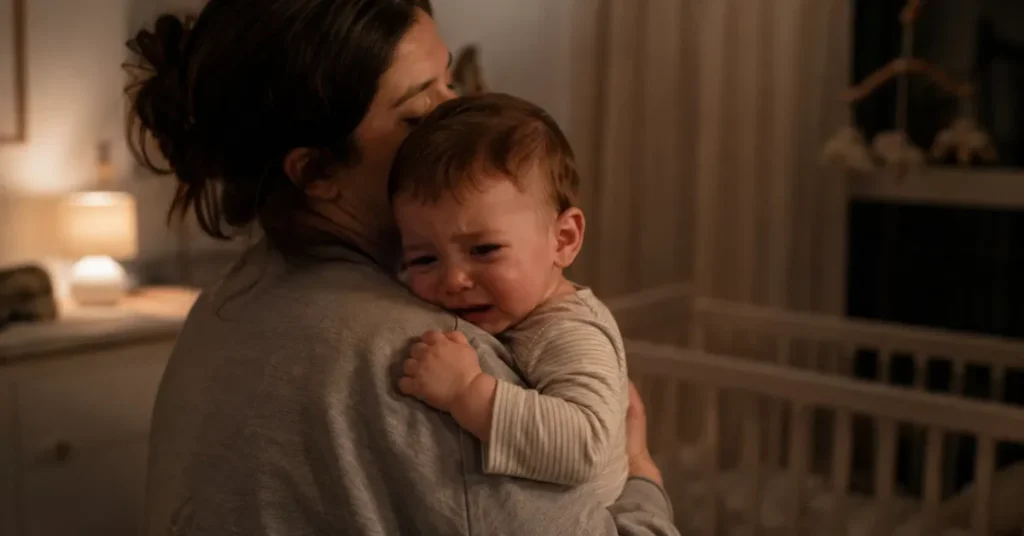
Every baby shows this differently, but a few patterns come up again and again in parent accounts and pediatric development resources. Watch for:
- Sudden clinginess, wanting to be held far more than usual
- Sleep disruption, including more night wakes or shorter naps
- Increased crying or general crankiness with no obvious cause
- New interest in cause-and-effect toys, like stacking rings or shape sorters
- Copying small sequences of actions, such as clapping after you clap
- A short attention span for things that used to hold their focus
Here’s a quick way to separate what’s typical fussiness from what’s the newer skill showing through.
| What You’re Seeing | Likely Cause | What Usually Follows |
|---|---|---|
| Won’t be put down, cries when you leave the room | Brain is processing new sequencing awareness | Calmer separations within a few weeks |
| Waking every 1-2 hours overnight | Overstimulated nervous system during the leap | Sleep tends to settle as the leap resolves |
| Suddenly obsessed with putting objects inside other objects | Emerging sequencing skill (the actual “leap” forward) | More deliberate, purposeful play |
| Frustrated easily during play | Wanting to do more than current coordination allows | Improved fine motor control |
| Watching your face intently during routines | Learning to predict what happens next | Anticipatory behavior, like reaching before you finish a task |
Where the Ten-Leap Theory Actually Stands
This is the part most Wonder Weeks articles skip, and it changes how you should read all of it.
The original 1992 book was based on close observation of a small group of infants. A follow-up study run by Plooij’s own PhD student, Carolina de Weerth, tested the claims in 1998 on four babies and confirmed the predicted pattern in only one of them. That’s a thin result for a theory that gets treated like a fixed calendar in so many parenting apps.
So here’s the honest middle ground. Fussy stretches, clinginess, and disrupted sleep around the first year are well documented in general infant development research, no argument there. What’s shakier is the specific claim that every baby hits ten leaps on a precise week-by-week schedule.
Anyone who has actually lived through a rough patch with a baby knows the pattern rings true even when the exact week is off by seven or ten days. Treat leap 7 for babies as a loose lens rather than a countdown clock, and it becomes genuinely useful instead of one more thing to stress about.
How to Support Your Baby During Leap 7 for Babies
You can’t skip a developmental leap, and you shouldn’t try to. What you can do is make the stretch easier on everyone in the house.
Lean into the new skill instead of fighting it. Stacking cups, shape sorters, and simple puzzles with two or three pieces give your baby a safe outlet for the sequencing drive that’s making them restless.
Keep routines boring and predictable. This isn’t the week to introduce a new sleep training method or switch daycare rooms. Predictability is the thing their brain is craving right now, so give them plenty of it.
Expect regression, not failure. A baby who was sleeping through the night might start waking again. That’s not a habit forming, it’s a temporary overload. Respond the way you normally would and expect it to settle within a few weeks.
Watch, don’t force, the clinginess. Fighting the need for extra contact usually backfires. Holding a fussier baby more for two or three weeks doesn’t create a lasting habit; toddlers don’t demand to be carried because you comforted them as infants.
Get outside when you can. A short walk changes the sensory input enough to reset a meltdown for a lot of babies at this age, and it does the same for tired parents.
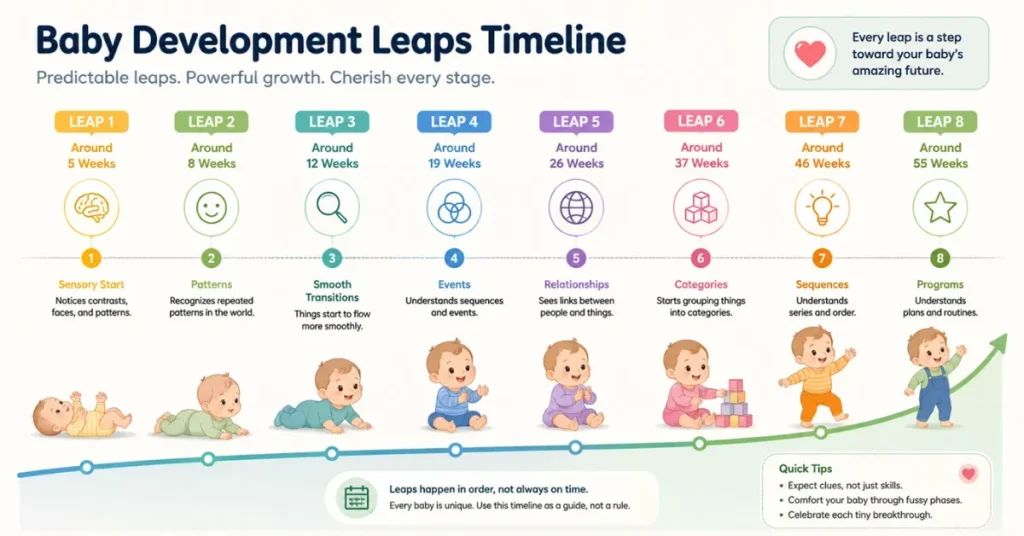
The Full Wonder Weeks Leap Timeline
For context, here’s where leap 7 sits inside the full ten-leap framework, using the weeks counted from due date that the original book proposes:
| Leap Number | Approximate Week | Rough Age |
|---|---|---|
| 1 | 5 weeks | ~1 month |
| 2 | 8 weeks | ~2 months |
| 3 | 12 weeks | ~3 months |
| 4 | 19 weeks | ~4.5 months |
| 5 | 26 weeks | ~6 months |
| 6 | 37 weeks | ~8.5 months |
| 7 | 46 weeks | ~10.5 months |
| 8 | 55 weeks | ~12.5 months |
| 9 | 64 weeks | ~14.5 months |
| 10 | 75 weeks | ~17 months |
Every baby is unique, and the experience of each leap varies quite a bit. Some skip a leap entirely, some hit two close together, and plenty of perfectly healthy babies don’t follow the chart at all.
Who Should Pay Closer Attention
Most parents searching leap 7 for babies just want reassurance that the sudden clinginess and sleep chaos are temporary. A few groups need slightly different context.
Parents of premature babies should count from the due date, not the birth date, when estimating leap timing. A baby born six weeks early will typically show leap 7 behavior six weeks later than a full-term peer of the same birth age.
Parents of twins or multiples often see leaps land closer together or further apart between siblings, even with identical due dates. Temperament plays as big a role as timing here.
Second-time and third-time parents sometimes assume they know what to expect, only to find this particular baby’s leap 7 looks nothing like an older sibling’s did. That’s normal; leaps aren’t a fixed personality trait.
Parents worried about a stalled skill should know the difference between a leap-related regression and a genuine developmental delay: a leap regression is temporary and resolves within weeks, while a true delay in areas like babbling, eye contact, or movement tends to persist and is worth raising with your pediatrician regardless of what week it happens to be.
Conclusion
Leap 7 for babies isn’t a medical diagnosis and it isn’t a guaranteed calendar event either. It’s a useful, imperfect way to make sense of a specific, exhausting stretch around ten to eleven months old, where your baby’s clinginess and disrupted sleep line up with a real cognitive jump: understanding that actions happen in order. Hold the timing loosely, lean into the new skills your baby is chasing, and remember the fussy phase has a track record of ending on its own within a few weeks.
This article is for informational purposes and reflects general parenting frameworks, not individual medical guidance. If you have concerns about your baby’s development, talk to your pediatrician.
FAQs
Is leap 7 the same for every baby?
No. The 4 to 6 week window and the specific signs vary quite a bit between babies, and some infants barely show noticeable changes at all.
How do I know if it’s leap 7 and not teething?
Teething usually comes with drooling, gum swelling, and a preference for chewing on things. Leap 7 centers more on new sequencing behavior, like stacking or copying actions, alongside the fussiness.
Does leap 7 affect sleep training?
It can temporarily disrupt whatever schedule you’ve built. Most sleep coaches suggest holding steady on your existing routine rather than starting a new method mid-leap.
What if my baby skips leap 7 entirely?
That’s common and not a red flag on its own. The ten-leap schedule is a loose observational pattern, not a clinical checklist every baby has to hit.
When should I actually worry instead of waiting it out?
If fussiness, sleep disruption, or feeding changes last well beyond six weeks, or if you notice a loss of skills your baby already had, that’s worth a conversation with your pediatrician rather than attributing it to a leap.