
A dorm room with no stove. A hotel suite with nothing but a mini-fridge and a countertop microwave. A kitchen where every burner is already busy with sauce, garlic bread, and a pan of vegetables. This is exactly where knowing how to cook pasta with microwave power actually pays off. It isn’t a gimmick or a shortcut that ruins the noodle. Done right, it produces the same al dente bite you’d get from a pot of boiling water, minus the wait for that pot to boil in the first place.
Anyone who’s tried both methods side by side knows the microwave version isn’t cheating. It’s physics doing the same job a stovetop does, just packaged differently.
How to Cook Pasta With Microwave in Five Simple Steps
The process barely changes no matter what shape of pasta sits in your pantry. Here’s the version that works across fusilli, penne, macaroni, and broken spaghetti.
- Place dry pasta in a large, deep microwave-safe bowl. Leave room for it to expand, since pasta roughly doubles in size as it cooks.
- Pour in cold water until the pasta sits fully submerged, with about an inch of water above the noodles.
- Stir in a pinch of salt. It seasons the pasta from the inside, not just the surface.
- Microwave on full power for the time listed on the pasta box, plus an extra 2 to 3 minutes. An 8-minute box time becomes roughly 10 to 11 minutes in the microwave.
- Stir at the halfway mark, then check for doneness near the end, adding 1-minute bursts if the noodles still have bite left in them.
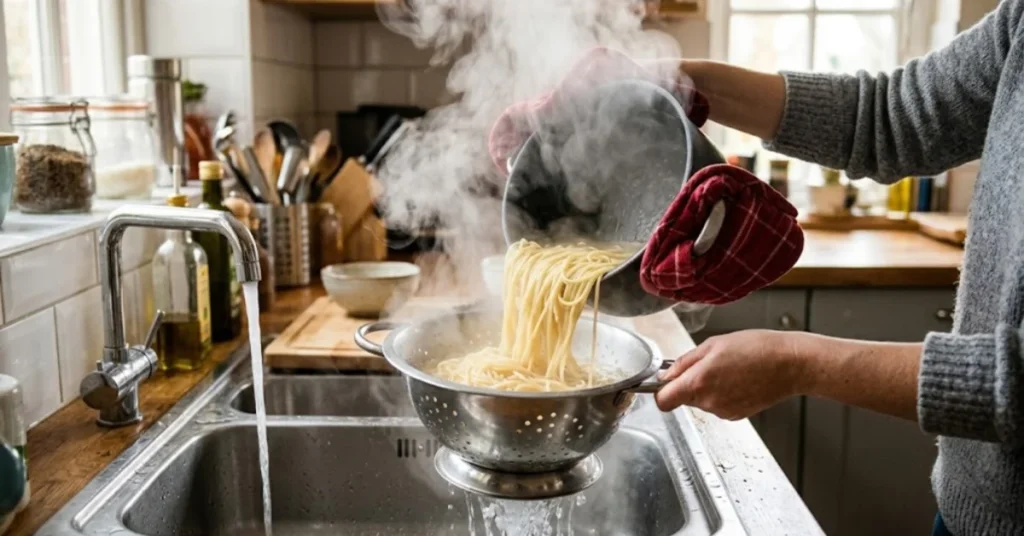
Once it’s tender, drain through a colander, toss with a little oil or butter so it doesn’t clump, and add whatever sauce is waiting.
Why the Microwave Actually Works for Pasta
Microwaves cook by exciting water molecules, and pasta cooking is fundamentally a water-absorption process. That overlap is why this method works instead of just being a novelty trick.
A microwave’s magnetron produces waves that get absorbed by the moisture already inside your bowl of pasta and water. That energy creates the same starch-softening heat a stovetop delivers, just generated inside the food and water rather than transferred through a metal pot. Wattage matters here, since a 1000-watt oven cooks noticeably faster than a 700-watt one, so the “packet time plus a few minutes” rule is really a starting point, not a fixed law.
The one real difference from stovetop cooking is that there’s no rolling boil pushing noodles around. That’s why stirring halfway through matters more here than it does on a stove. Without it, pasta near the bottom of the bowl can stick together while the top layer stays undercooked.
Best Bowl and Water Ratio for Even Cooking
Anyone searching for how to cook pasta with microwave results that actually taste right usually runs into the same sticking point: the ratio. Getting the ratio right is the single biggest factor separating good microwave pasta from a soggy, clumped mess.
- Bowl size: Go bigger than feels necessary. A cramped bowl causes boil-over, and starchy water spilling inside a microwave is a genuine mess to clean.
- Water level: Cover the pasta by about an inch. Too little water and the noodles cook unevenly or dry out before they’re tender; too much just adds extra minutes to the timer.
- Salt: A teaspoon per cup of dry pasta is a reasonable starting point, adjustable to taste.
- Portion size: One to two servings works best in a standard home microwave. Larger batches clump together and cook unevenly, since the microwave energy can’t reach the center of a dense mass of noodles as efficiently.
Gluten-free pasta needs a slightly different touch. It overcooks fast and turns mushy if left unattended, so shorter 2-minute intervals with frequent stirring beat one long uninterrupted cook.
Whole wheat and protein-enriched pastas behave a little differently too. They tend to hold their shape longer and can need an extra minute or two beyond the standard timing, since denser flour blends absorb water more slowly than refined semolina varieties.
Cooking Pasta With Sauce Directly in the Microwave
Skipping the separate draining step entirely is possible, and it’s become a popular one-bowl approach for busy weeknights.
Combine roughly half a cup of dry pasta, a cup of water, and half a cup of your favorite sauce directly in a microwave-safe bowl. Cover loosely with a lid or vented wrap, then microwave for around 8 to 10 minutes, stirring once halfway through. The pasta absorbs both the water and the sauce as it softens, which means less washing up afterward and a dish that’s already seasoned by the time it’s done.
This shortcut works best with smaller shapes like macaroni or small shells, since long noodles like spaghetti don’t distribute evenly without a bigger, more careful setup.
Mistakes to Avoid When You Learn How to Cook Pasta With Microwave Timing
Most people looking up how to cook pasta with microwave heat for the first time run into the same handful of avoidable habits.
Skipping the extra water is the biggest one. Pasta that isn’t fully submerged dries out on top while the bottom overcooks. Using a bowl that’s too shallow is a close second. That starchy water needs somewhere to go, and a shallow bowl practically guarantees a boil-over onto the microwave floor.
Walking away without stirring is another frequent misstep. Since there’s no current pushing noodles around the way boiling water does on a stovetop, pasta left untouched tends to clump into a solid mass near the center of the bowl.
And forgetting to vent a plastic wrap cover, if one’s used, traps too much steam and pressure. A loosely vented cover or a microwave-safe lid left slightly ajar solves that without letting all the moisture escape.
Stovetop vs Microwave: Which Is Actually Faster
For a single serving, the microwave often wins outright, since it skips the several minutes it takes a full pot of water to reach a boil. For larger batches feeding a family, a big stockpot on the stove still has the edge, since microwave energy distribution gets less efficient the more mass you’re heating at once.
Where the microwave clearly pulls ahead is convenience in places without a working stovetop: RVs, dorms, hotel rooms, or offices with only a shared microwave. Anyone who’s lived in a dorm or traveled for extended stretches knows how often that single detail decides what gets cooked for dinner.
What the Research Shows
Detailed guidance from food safety agencies gives useful context for anyone relying on a microwave as a primary cooking tool. Oven wattage varies significantly between models, which is why published cooking times are always approximate rather than exact. Uneven heating and so-called cold spots are a documented characteristic of microwave cooking, which is part of why stirring food partway through, pasta included, improves consistency across the whole dish.
When examining this closely, the advice to cover food loosely, stir midway, and rotate the dish if there’s no turntable applies just as well to a bowl of noodles as it does to a plate of leftovers. That single stirring step is consistently the difference between an evenly cooked bowl and one with a hard, undercooked pocket near the bottom.
Who Should Use This Method
This isn’t only for people without a stove. It suits:
- Students and dorm cooks working with a single shared appliance
- Remote workers and travelers in hotel rooms or short-term rentals
- Anyone cooking a single serving who doesn’t want to boil and drain a full pot for one portion
- Busy weeknight cooks who want one less pan to wash
Once you know how to cook pasta with microwave timing that actually works for your appliance, it’s less ideal for large family-sized batches, where a stovetop pot still handles volume more evenly and quickly.
For anyone using a shared or communal microwave, like in an office kitchen or a college dorm floor, timing this method around quieter hours helps too. Fewer people waiting on the appliance means less rushing through the stirring steps that make the difference between an evenly cooked bowl and a clumped one.
Conclusion
Learning how to cook pasta with microwave methods isn’t about replacing the stovetop for good. It’s about having a reliable backup that actually delivers proper al dente texture. Get the water ratio right, use a bowl with room to spare, stir at the halfway point, and the results hold up next to anything made in a pot. That’s a small skill that solves a surprisingly common kitchen problem, whether you’re in a dorm, a hotel room, or just short on stovetop space tonight.
Microwave wattages vary, so cooking times are approximate; always use microwave-safe containers, ensure food is heated thoroughly, and handle hot bowls carefully to avoid burns. This guide is for informational purposes only, and results may vary based on your specific appliance.
FAQs
Can you really cook pasta in the microwave without it turning mushy?
Yes. The key is checking doneness a minute or two before the timer ends rather than letting it run the full extra time blindly, since ovens vary in strength.
How much water do I need for microwave pasta?
Enough to cover the pasta by about an inch, adjusting slightly depending on the shape and how much you’re cooking.
Do I need a special microwave pasta cooker?
No. A regular large, microwave-safe bowl works fine. Specialty cookers exist and some people prefer them, but they aren’t required to get good results.
Is it safe to cook pasta with sauce in the microwave?
Yes, as long as the dish is covered loosely to vent steam and stirred partway through for even heating.
Why does my microwave pasta boil over?
Usually the bowl is too small, or the water level is set too high without enough clearance for the boiling starch to expand.