
Every parent has heard it. The whine starts low, then climbs: “I’m bored.” Boredom jar ideas by age exist for exactly this moment, and the concept is simpler than most people expect. You fill a jar with slips of paper, each one listing a small activity, and let a child pull one out whenever the complaining starts.
What makes the idea work isn’t the jar itself. It’s matching the activities inside to what a child can actually do alone at their stage of development. A three-year-old and a fifteen-year-old need completely different lists, and that mismatch is where most boredom jars quietly fail.
What Boredom Jar Ideas by Age Really Solve
A toddler jar filled with “build a blanket fort” won’t hold a teenager’s attention for thirty seconds. A teen jar filled with “text a friend to plan a hangout” means nothing to a four-year-old who can’t read yet.
That’s the whole premise behind boredom jar ideas by age. The jar isn’t one static list. It’s a system that gets rebuilt every couple of years as a kid’s independence, attention span, and interests shift.
Parents who’ve run one of these jars for years usually end up with two or three versions stashed in a drawer, swapped out as their kids outgrow the last batch. It’s less a single craft project and more an ongoing habit.
How to Actually Set One Up
Ideas alone don’t build a jar. A few practical steps make the difference between something that gets used daily and something that sits forgotten on a shelf.
- Pick the container first. A mason jar works, but so does an old cookie tin, a shoebox, or even a zip bag for travel. The container doesn’t need to be fancy, it just needs a lid or a way to keep slips from spilling.
- Write one idea per slip. Fold each slip so the activity stays hidden until it’s pulled. For non-readers, draw a small picture instead of words.
- Start with 20 to 30 slips. Fewer feels thin within a week, more becomes overwhelming to sort through on a bad day.
- Label the jar clearly. A simple sticker or painted title helps younger kids recognize it as “their” jar rather than a random container.
- Set a redraw rule. Most working jars use some version of this: a child can put one slip back and pick again, but the second pull has to be done, no more swapping. Without this rule, kids often just keep drawing until they land on their favorite, which defeats the purpose.
Multi-Age Households: What Actually Works
Families with kids spanning several ages usually run into the same question: one jar or several? Here’s a quick comparison of the common approaches.
| Approach | How It Works | Best For | Downside |
|---|---|---|---|
| Separate jars per child | Each kid has their own age-matched jar | Siblings more than 3 years apart | Takes up more space, more upkeep |
| One jar, color-coded slips | Slips sorted by colored paper per age group | Siblings close in age, shared shelf space | Younger kids may peek at older colors |
| One shared jar, mixed difficulty | All slips together, any child can pull any slip | Kids who enjoy doing activities together | Younger kids can draw a task too hard for them |
Most families with a wide age gap end up defaulting to separate jars simply because it causes the fewest arguments over whose turn it is and which slip belongs to whom.
Age-by-Age Breakdown at a Glance
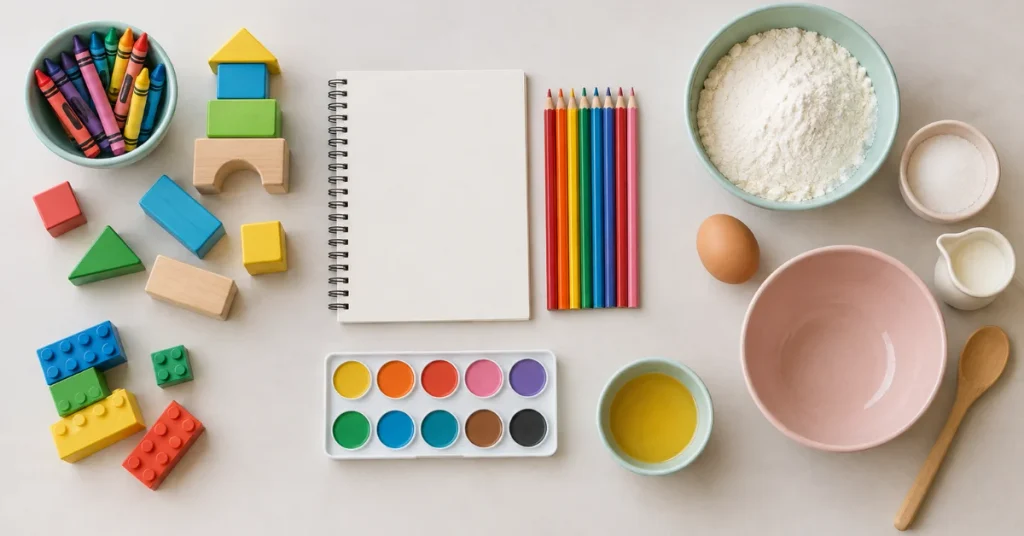
Here’s a quick comparison before the detailed sections below.
| Age Range | Independence Level | Best Activity Types | Sample Ideas |
|---|---|---|---|
| 2–4 years | Needs supervision | Sensory play, movement | Sock puppet, sticker chart, dance to a song |
| 5–7 years | Semi-independent | Simple crafts, short games | Draw a treasure map, build a pillow tower, scavenger hunt |
| 8–12 years | Mostly independent | Projects, skill-building | Learn a card trick, code a simple game, start a mini business |
| 13–17 years | Fully independent | Social, creative, real-world | Cook a new recipe, edit a video, volunteer for an hour |
That table is a starting point, not a rulebook. A confident six-year-old might handle “tween” tasks just fine, and every kid’s readiness looks a little different.
Toddler and Preschool Boredom Jars (Ages 2 to 4)
At this stage, a boredom jar doubles as a parenting tool more than a solo activity generator. Kids this young usually can’t read the slips, so pictures or simple symbols work better than words.
Good entries for this age group lean on movement and the senses: stack blocks into a tower, hunt for something red in the house, or smell three different spices and guess which is which. Anything that runs longer than five or ten minutes without a grown-up nearby is probably asking too much.
Anyone who’s parented a toddler through a rainy afternoon knows the real goal here isn’t independence yet. It’s redirecting energy before a meltdown builds. The jar gives a parent a fast, low-effort menu instead of scrambling for ideas on the spot.
Early Elementary Boredom Jars (Ages 5 to 7)
Kids in this range can usually read short instructions or at least recognize a few key words, which opens the jar up considerably. This is where boredom jar ideas by age start looking more like an actual activity list and less like a distraction tactic.
Craft-based entries work well: draw a comic strip, make a paper airplane and test how far it flies, or build an obstacle course out of couch cushions. Short games also fit, things like “find five things that start with the letter B” or a simple scavenger hunt around the yard.
Most kids at this age still want a parent checking in occasionally, even if they’re technically doing the activity alone. Ten to twenty minutes of independent play is realistic without it becoming a battle to keep them on task.
Tween Boredom Jars (Ages 8 to 12)
This is where the jar starts to reflect a kid’s actual personality rather than generic age-appropriate filler. Tweens can plan, follow multi-step instructions, and stick with something for thirty minutes or longer if it genuinely interests them.
Strong ideas at this stage include learning a magic trick from a video, starting a small drawing series, writing the first chapter of a story, or teaching a pet a new command. Some families add lightly independent outdoor tasks too, like riding a bike to a nearby park or building something out of spare wood.
Tweens tend to reject anything that feels babyish almost instantly, so recycling toddler ideas into this jar is a fast way to make it collect dust. Swapping the jar’s contents every school break keeps it feeling current instead of stale.
Teen Boredom Jars (Ages 13 to 17)
Teenagers rarely want to be told what to do, so a jar aimed at this age works best when it leans into independence and social connection rather than solo crafts. Anyone who has raised or worked with teenagers knows the tone has to shift, or the whole idea gets dismissed outright.
Effective entries include cooking a meal from scratch, learning three chords on a guitar, editing a short video, applying to volunteer somewhere nearby, or organizing a low-key hangout with friends. A few families add “life skill” slips too, like learning to change a tire or filing something for a part-time job application.
The tone matters more here than the content. A jar that feels like a chore list gets ignored. One that feels like a menu of things a teen would choose anyway tends to actually get used.
Adapting the Jar for Neurodivergent Kids
Most boredom jar guides assume every child processes the slips the same way, and that’s rarely true. For kids with ADHD, autism, or sensory sensitivities, a few small changes make the jar far more usable.
Shorter, single-step tasks tend to work better than multi-part ones, since long instructions can feel overwhelming before the activity even starts. Adding a picture next to the text helps kids who read slower under stress. Pairing a visual timer with the jar, even a simple sand timer, gives a concrete end point that some kids need to feel comfortable starting a task at all. Sensory-friendly entries, like squeezing putty, sorting objects by color, or noise-canceling headphone time, are also worth including alongside the standard craft and movement slips.
None of this requires a separate jar. A handful of adapted slips mixed into the existing age-based jar is usually enough.
A Travel-Friendly Version
Most boredom jar ideas by age assume a child is at home, but car rides, waiting rooms, and flights create their own version of the same problem. A compact version solves this without hauling a full jar around.
A small tin or zip bag with 10 to 15 slips covers most trips. Good entries lean on things that don’t need much space or mess: spot a specific color of car, play twenty questions, doodle on a small notepad, or listen to one song and describe what it’s about. For younger kids, a few felt or magnetic pieces on a small board can substitute for the paper slips entirely.
What Child Development Experts Have Found
Boredom itself has drawn real attention from child development researchers over the past decade, and the pattern is fairly consistent. Unstructured time, when a child has to generate their own activity rather than being handed one, is repeatedly linked to stronger creative problem-solving in later childhood.
A 2014 psychology study found that boredom increases what researchers describe as “internal stimulation,” meaning people generate more ideas when left without direction than when kept constantly occupied. Separately, brain-imaging research has connected quiet, undirected mental states to a network associated with daydreaming, memory, and creative thinking, the same state a child slips into right before reaching for a boredom jar.
Current pediatric guidance also connects loosely to why families lean on jars like this instead of a screen by default. National guidance for children ages two to five recommends limiting high-quality screen media to roughly one hour a day, while school-aged kids and teens are generally pointed toward one to two hours of recreational use, with an emphasis on what’s being watched rather than just the clock. A boredom jar fits naturally into that gap, giving kids something screen-free to reach for first.
Early adopters of the boredom jar concept, going back well over a decade in parenting communities, consistently report the same thing: the jar matters less over time as kids get older, but the habit of self-directing free time sticks around long after the physical jar gets retired.
Making Boredom Jar Ideas by Age Actually Stick
A jar that gets built once and never updated quietly turns into background clutter. Families who keep theirs useful tend to follow a few consistent habits.
- Rebuild the jar every 12 to 18 months, or sooner if a kid starts skipping the same three slips repeatedly.
- Let the child help write new ideas. Buy-in goes up sharply when it’s not entirely parent-generated.
- Mix low-effort and higher-effort entries so there’s always something matching the mood, not just the age.
- Keep a “wildcard” category for one-off special activities, like baking something new or a mini backyard camp-out.
- Retire anything that gets pulled and immediately put back more than twice.
Anyone who has managed one of these jars long-term knows the real skill isn’t picking the ideas. It’s noticing when the current list has quietly gone stale and needs a refresh before the kids notice first.
What It Costs to Set One Up
Cost is rarely mentioned, but it’s part of why the idea has stuck around for so long. A basic jar built from supplies already in most homes, an empty container and scrap paper, costs close to nothing. A version bought new, with a labeled mason jar and printed activity cards, typically runs somewhere in the range of a few dollars for paper and tape, plus whatever the container costs if one isn’t already on hand. Compared to a subscription activity box or a new toy, it’s one of the cheapest tools in a parent’s routine.
Common Mistakes to Avoid
A few patterns show up again and again in families who try this and give up early.
The first is overloading the jar with ideas that need constant parent supervision, which defeats the purpose for older kids trying to build independence. The second is ignoring a child’s actual interests in favor of generic “wholesome” activities nobody asked for. The third is treating the jar as a punishment rather than a genuine menu, which turns it into something kids actively avoid.
A jar that respects a kid’s age and interests, rather than an idealized version of childhood, tends to outlast the ones built purely around what looks good on a shared photo online.
Outlook Going Into 2026
As screen guidance continues shifting toward quality over strict time limits, low-tech tools like boredom jars are getting renewed attention from parenting communities and schools alike. The appeal is straightforward: no app, no subscription, no login, just a jar and a stack of paper slips that cost almost nothing to make.
Expect more families to build digital-adjacent hybrids too, jars that mix in a few screen-based options like a coding challenge or a photo-editing task alongside the traditional crafts, especially for tweens and teens who split time between analog and digital hobbies.
Final Thoughts

Boredom jar ideas by age aren’t complicated, and that’s kind of the point. A jar, some paper, and a list matched to what a kid can genuinely do alone turns “I’m bored” into a five-second decision instead of a daily argument. Built well and refreshed on schedule, it’s one of the few parenting tools that gets more useful the longer a family sticks with it.
Frequently Asked Questions
What age should a boredom jar start at?
Most families introduce one around age three or four, once a child can follow a short spoken instruction without constant hand-holding.
How many activities should go in a boredom jar?
Somewhere between 20 and 50 slips works well. Fewer than that and repeats happen too fast; more and the jar becomes overwhelming to sort through.
Should a teenager’s jar look completely different from a toddler’s?
Yes. Boredom jar ideas by age should shift substantially with independence level, moving from supervised sensory play toward self-directed, social, or skill-based activities as kids get older.
Can one jar work for siblings of different ages?
It’s possible with color-coded slips or two separate age-matched jars, and most families with a noticeable age gap find separate jars cause fewer arguments over which slip gets pulled.
Do boredom jars actually reduce screen time?
They can, particularly when placed somewhere visible and treated as the default “what now” answer before a tablet or phone gets handed over.