
My neighbor tried it in January. Three kids, one grocery run, and a jar of hand-written dares taped to the fridge. By day nine, her ten-year-old had built a blanket fort empire and stopped asking for the tablet. That’s the kind of thing a family no spend challenge with kids tends to produce: not misery, just a different rhythm.
A family no spend challenge with kids is a set stretch of days, usually a week or a month, where a household pauses non-necessary purchases and swaps them for free or already-owned activities. Groceries and bills stay. Takeout, impulse toys, and streaming add-ons go. It sounds restrictive on paper. In practice, most families who try it describe it as the opposite.
What a Family No Spend Challenge With Kids Actually Looks Like
The rules aren’t complicated, and that’s the point. Pick a start date, pick an end date, and write down what counts as “spending” in your house.
Most families keep three categories open no matter what: groceries already budgeted, medical needs, and school-related costs. Everything else, from drive-thru runs to a new video game, gets parked until the challenge ends.
Kids get a say in the rules, and that part matters more than parents often expect. A nine-year-old who helps write the list is a lot less likely to sneak snacks money at the gas station than one who had the whole thing handed down from above.
Your Day One Starting Step
Don’t overplan this part. Grab a calendar, circle a start date and an end date, and tape it to the fridge tonight. That’s it. Everything else, the want jar, the activity list, gets built once the dates are locked in.
Setting Ground Rules Before You Start
A short planning conversation the night before saves a week of arguments. Sit the kids down, pull out paper, and ask three questions together: What counts as spending? What doesn’t? What happens if someone slips?
Here’s the deal. Slipping isn’t failure. A five-dollar ice cream run on day four doesn’t end the challenge. It just gets written down and the family keeps going.
Some households add a small twist that keeps younger kids invested: a “want jar.” Anyone who feels the itch to buy something writes it on a slip of paper and drops it in instead of acting on it. At the end of the challenge, the family opens the jar together and talks about which wants were real and which ones faded on their own.
What Never Gets Paused
Some costs stay untouched no matter what, and writing them down before day one stops confusion mid-week. Medical needs, prescription refills, a school fee tied to an exam or a required supply, and anything tied to safety, like a car repair needed to get to work, don’t belong in the challenge at all.
Treat this list as a wall, not a suggestion. A family that pauses a genuinely necessary cost just to “win” the week ends up worse off than one that never tried.
Free Activities That Keep Kids Engaged All Week

Boredom is the real enemy here, not the lack of money. Free activities need to be lined up in advance or the challenge falls apart by Wednesday.
A few that consistently work across age groups:
- Library story hour or a self-guided scavenger hunt through the stacks
- A neighborhood nature walk with a simple checklist (five different leaves, one bird, one bug)
- Backyard camping, even if the backyard is a living room floor
- A cardboard box building contest, judged by whoever’s turn it is that day
- Free community events at parks, rec centers, or local museums on discount days
None of these require a purchase, and most take under an hour to set up. Anyone who has run a house full of kids on a rainy Saturday knows the difference between an activity that’s planned and one that’s improvised on the spot.
What the Numbers Say About Family Spending
Money habits formed young tend to stick, and the data backs that up with real numbers rather than a vague feeling.
A national Parents, Kids & Money survey found that kids who receive an allowance are about twice as likely to say they understand how to manage personal finances compared to kids who don’t. Among households where parents talk about money often, 46% of kids described themselves as knowledgeable about managing their own finances, against just 14% in homes where those conversations were rare.
Meanwhile, federal economic data tracked the household saving rate at 2.7% in June 2026, down from north of 4% earlier in the year. That drop reflects tighter grocery and utility bills pressing on family budgets nationwide, which is exactly the kind of squeeze a short no-spend stretch is built to answer.
Put those two data points together and a pattern shows up: households under budget pressure who also talk openly with their kids about money tend to raise kids who feel more capable handling their own cash later on. A no-spend week is one of the few activities that does both at once. It saves real dollars and it gives kids something concrete to talk about.
Screen Time and Sneaky Spending
Not all spending happens at a cash register anymore. Parents increasingly report finding an online purchase their child made without asking first, sometimes adding up to real money before anyone notices it on a statement.
That’s worth folding into a family no spend challenge with kids directly. Turn off saved payment methods on tablets and game consoles for the week, and tell kids exactly why, not as a punishment but as part of the same pause covering everything else in the house.
For families who leave digital purchases open year-round, this piece alone is often the one that saves the most money once the challenge ends.
A Sample Week Table
Families who plan day by day report fewer arguments than those who wing it. Here’s a starter framework you can copy and adjust for your own household.
| Day | Free Activity | Family Task | Money Lesson Discussed |
|---|---|---|---|
| Monday | Library visit + book swap | Pack lunches together | Needs vs. wants |
| Tuesday | Backyard scavenger hunt | Clean out one toy bin | Where allowance goes |
| Wednesday | Board game night from the shelf | Meal-prep leftovers | Comparing prices |
| Thursday | Neighborhood walk, count houses/dogs | DIY car wash at home | Saving vs. spending |
| Friday | Indoor camping in the living room | Homemade pizza night | What “want jar” slips said |
| Saturday | Park visit, bring a picnic | Yard work for “pretend pay” | Earning vs. receiving money |
| Sunday | Family movie from what you own | Plan next week’s meals | What to keep doing after the challenge |
Feel free to swap any row. The structure matters more than the exact activity.
The Three-Jar System: What to Do With What You Saved
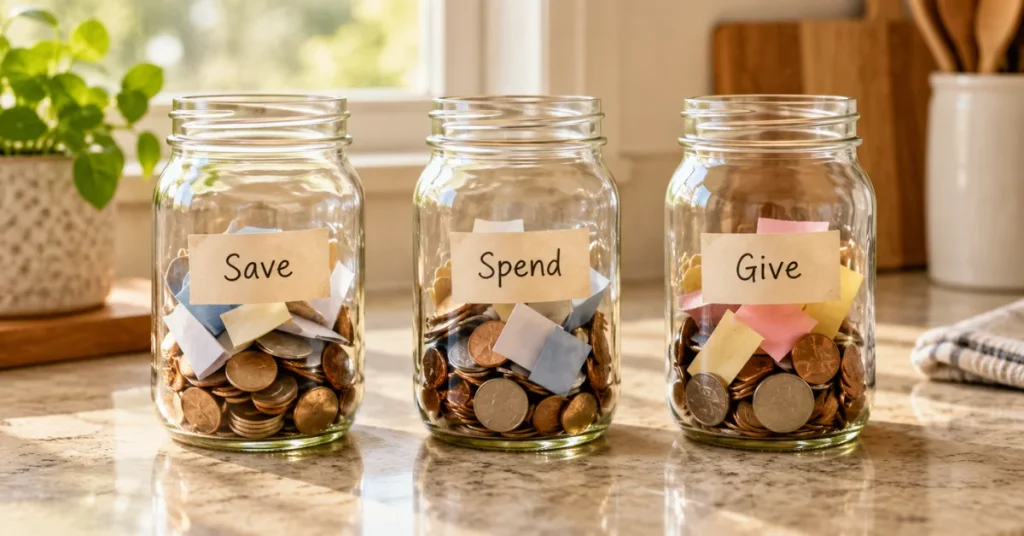
The challenge doesn’t really finish when the calendar runs out. What a family does with the money it didn’t spend matters just as much as the week itself.
A simple split works well for most households: one jar labeled Save, one labeled Spend, and one labeled Give. Whatever the family didn’t spend during the week gets divided across the three, with kids helping decide the split.
The Give jar is the piece most no-spend guides skip entirely. Even a small amount handed to a food bank or a local shelter turns a week of restriction into a week with a purpose kids can point to.
How to Calculate What You Actually Saved
A challenge without a number at the end is hard to repeat. Before day one, write down what a typical week costs across a few categories. After the challenge, write down what actually got spent, and subtract.
| Spending Category | Typical Week | Challenge Week | Amount Saved |
|---|---|---|---|
| Takeout and dining out | $60 | $0 | $60 |
| Impulse toys or extras | $25 | $0 | $25 |
| Digital or in-app purchases | $15 | $0 | $15 |
| Coffee, snacks on the go | $20 | $0 | $20 |
| Total | $120 | $0 | $120 |
Numbers will look different in every household. Running this simple math is what turns a family no spend challenge with kids into a habit instead of a one-time event, since the point isn’t hitting a specific figure, it’s having a real one to show the kids at the end of the week.
Common Struggles Families Run Into
Teenagers push back harder than younger kids, and that’s worth planning for ahead of time. A fourteen-year-old with a part-time job or their own cash may not feel bound by the same rules as a six-year-old, and forcing the issue usually backfires.
A workable fix: let teens keep spending their own earned money, but ask them to track it the same way the rest of the family tracks the want jar. They stay part of the exercise without feeling controlled.
Birthdays and existing commitments (a dance class already paid for, a friend’s party with a gift expected) don’t need to derail the whole week either. Anyone running this kind of challenge for the first time quickly learns that a few built-in exceptions, agreed on ahead of time, keep everyone from quietly abandoning the whole thing by Thursday.
One more thing worth saying out loud to kids: this challenge is a choice, not a reflection of what the family can or can’t afford. Kids who go without to spare a classmate’s feelings, or who mention the challenge at school without meaning to, sometimes need a reminder that other households handle money differently, and that’s fine too.
Age-by-Age Breakdown: Toddlers to Teens
Toddlers and preschoolers don’t grasp money yet, so the challenge for them is really about parents modeling calm instead of reaching for a snack aisle bribe. Free sensory play, sidewalk chalk, and water tables do the heavy lifting here.
Elementary-age kids are the sweet spot. They’re old enough to write want-jar slips, count days on a calendar, and feel proud crossing off a full week. This age group tends to enjoy the challenge more than parents expect.
Middle schoolers respond well to friendly competition. Two siblings tracking who sticks closest to the rules, with a small non-monetary prize at the end, keeps the exercise from feeling like a punishment.
Teens need autonomy folded into the plan, as covered above. A challenge that respects their independence tends to outlast one that doesn’t.
Avoiding the Rebound Spending Trap
The day after a challenge ends is when most of the progress quietly disappears. A family that held off all week sometimes makes up for it in a single afternoon, buying everything that got written on want-jar slips at once.
Plan the “re-entry” the same way the challenge itself got planned. Pick one or two items from the want jar to actually buy, and agree as a family to sit on the rest for another week before deciding.
This step is the one most guides leave out entirely, and it’s often the difference between a challenge that changes habits and one that just delays spending by seven days.
Why a Family No Spend Challenge With Kids Works Long After It Ends
The week itself isn’t really the win. What sticks is the habit of pausing before a purchase and asking whether it’s a want or a need, something most adults could stand to practice too.
A family no spend challenge with kids costs nothing to try and, based on what parents report after running one, tends to leave behind routines that outlast the challenge itself: a want jar that stays on the counter, a Sunday planning habit, a kid who thinks twice at the checkout line. That’s a fair return for one week without the drive-thru.
Disclaimer: This article is for informational and lifestyle purposes only and doesn’t constitute financial advice. Families with specific budgeting or debt concerns should speak with a qualified financial advisor.
FAQs
How long should a family no spend challenge with kids last?
Most families start with seven days. A full month works once the household has a successful week under its belt.
What if a kid breaks the rules?
Write it down, talk about why it happened, and keep going. One slip doesn’t cancel the challenge.
Does this work for single-parent households?
Yes. The structure scales down easily, and some single parents find the accountability easier with fewer schedules to coordinate.
Can teenagers really participate without feeling punished?
Yes, especially when they help set the rules and keep control over any money they’ve earned themselves.
What’s the best way to end the challenge?
Open the want jar together, calculate what got saved using the categories above, and decide as a family which habits are worth keeping.