
That little hand flapping at Grandma through a car window. The first time your baby seems to actually mean it when they wave at daycare drop-off. Parents ask when do babies wave bye more than almost any other early milestone question, and for good reason. It’s one of the first signs your child understands that a gesture can carry meaning.
The short answer: most babies wave bye between 8 and 12 months old, though the normal range stretches from as early as 7 months to as late as 16 or 17 months. What matters more than the exact week is the pattern building around it.
This guide breaks down the full timeline, what a “real” wave actually looks like at each stage, and when it’s worth a conversation with your child’s doctor.
When Do Babies Wave Bye? The Short Answer
Waving isn’t just cute. It’s language before language.
A baby who waves is combining three separate skills at once: they can copy a movement they’ve watched, they’ve connected that movement to a specific meaning, and they understand there’s a person on the other end who will respond to it. That’s a lot of brain work packed into one tiny hand flap.
Pediatric development guidance groups waving alongside other early social gestures, including pointing, clapping, and head-shaking for “no,” as part of the communication skills babies typically build across the second half of their first year. So when do babies wave bye in practical terms? Somewhere in that 8-to-12-month window is where most families notice it click.
Galena Rhoades, a psychology professor at the University of Denver who directs a parent-support research program, has noted that a purposeful wave “hi” or “bye” tends to show up around 9 months as a general rule. That lines up closely with what most milestone checklists list as well.
The Detailed Timeline, Month by Month
Every baby moves at their own pace, and waving is one of those skills with a genuinely wide normal range. Here’s how it typically unfolds.
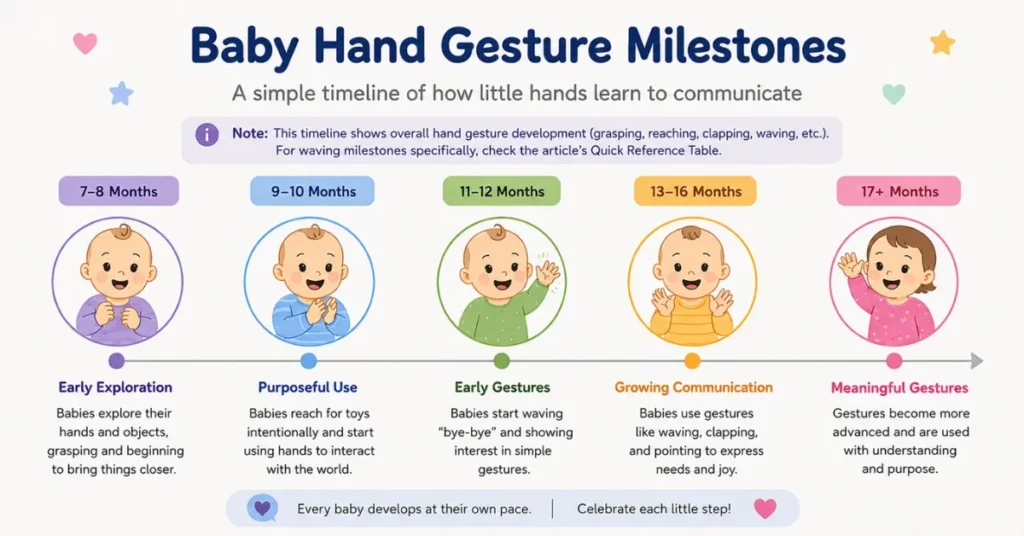
7 to 8 months. Some babies start experimenting with big arm movements after watching an adult wave several times a day. It won’t look intentional yet. Think of it as a whole-arm flap rather than a controlled wrist motion.
9 to 10 months. This is where the gesture starts gaining meaning. A baby at this stage often copies your wave in the moment, especially during a greeting or a goodbye at the door.
11 to 12 months. Around the first birthday, many babies begin initiating the wave themselves, without needing you to wave first. This is usually the point where it starts feeling like a real “bye-bye” rather than mimicry.
13 to 16 months. The gesture becomes more refined. Instead of a full-arm flap, you’ll often see a smaller wrist-and-finger wave, sometimes paired with an attempt at the word “bye-bye” itself.
17 months and beyond. By this point, most full-term babies have the wave down. A 2013 study published in the journal Pediatrics International found that all full-term infants in the research group could wave bye-bye by 16 months, with babies born preterm taking roughly a month longer on average once corrected for their early arrival.
That last detail matters. If your baby was born early, it’s worth adjusting your mental timeline by their corrected age rather than their birth date.
Quick Reference Table: Waving Milestones by Age
| Age Range | What’s Typically Happening | What You Might Notice |
|---|---|---|
| 7–8 months | Early imitation attempts begin | Whole-arm flap after you wave first |
| 9–10 months | Wave starts connecting to meaning | Baby copies your wave during hello or goodbye |
| 11–12 months | Independent, purposeful waving | Baby initiates the wave without a prompt |
| 13–16 months | Wave becomes more refined | Wrist-and-finger motion, sometimes with “bye-bye” |
| 17+ months | Should be established by now | Worth mentioning at a checkup if still absent |
Why This Milestone Happens When It Does
Waving sits at an interesting intersection of physical and social development, which explains why it doesn’t show up sooner.
On the physical side, a baby needs enough hand and arm coordination to produce a controlled, repeated motion. That kind of fine motor control is still developing through the middle of the first year.
On the social side, a baby needs to grasp something more abstract: that a gesture can stand in for a word, and that another person will understand it. Researchers describe this as an early building block for language, since gestures at this age reliably predict vocabulary size later on. A baby who’s actively gesturing, pointing, and waving is practicing the same communication instincts they’ll later use with actual words.
That’s part of why the question when do babies wave bye comes up so often in parenting forums and pediatric visits alike. It’s not just about the wave itself. It’s a window into how a baby’s whole communication system is coming together.
Signs Your Baby’s Wave Is Right on Track
Not every baby’s wave looks the same, and that’s completely normal. Here’s what generally counts as being on schedule:
- Copying a wave after watching you do it a handful of times
- Producing any version of the gesture, even a clumsy full-arm flap
- Combining the wave with eye contact or a smile toward the person leaving or arriving
- Occasionally waving without being prompted by 12 to 13 months
- Gradually refining the motion into a smaller, wrist-based wave over the following months
Anyone who has spent time around a group of one-year-olds knows the variation is enormous. One baby waves at every stranger in the grocery store; another saves it exclusively for a favorite grandparent. Both are entirely typical.
When a Missing or Lost Wave Needs Faster Attention
Most gaps in this milestone sort themselves out with time, but a few specific situations are worth a quicker conversation with your child’s doctor rather than a wait-and-see approach.
A wave that disappears. If your baby was waving regularly and then stops for several weeks, that matters more than a wave that simply hasn’t started yet. Losing a skill they had already picked up is generally treated as a stronger signal than a delayed first appearance, and it’s worth mentioning at the next visit rather than the one after.
One-sided waving only. A baby who consistently waves with one hand and never uses the other, or who seems to favor one side of the body across several gestures, is something pediatric guidance flags for a closer look.
No gestures paired with limited eye contact. A missing wave on its own rarely points to anything specific. It’s the combination, missing gestures alongside limited eye contact, name response, or shared attention, that developmental screenings are built to catch early. Raising it doesn’t confirm anything on its own; it simply lets a professional rule things in or out sooner.
Situations That Call for a Closer Look
| Situation | Why It Matters | What To Do |
|---|---|---|
| Baby waved before, then stopped | Losing an established skill is a stronger signal than a delayed one | Mention it at the very next checkup |
| Only one hand ever waves | May reflect uneven muscle tone or strength on one side | Bring it up alongside any other one-sided patterns noticed |
| No wave plus no pointing, babbling, or eye contact by 12 months | The combination of missing skills matters more than any single gesture | Ask for a developmental screening at the wellness visit |
| Baby was born preterm and hasn’t waved by corrected 17 months | Corrected age, not birth date, is the right benchmark | Track using the due date, not the birth date |
Noticing a pattern like this isn’t the same as diagnosing anything. It simply gives your pediatrician useful information to work with.
When to Bring It Up With a Pediatrician
A baby who hasn’t started waving by their first birthday isn’t automatically a cause for concern on its own. Development doesn’t move in a straight line, and gestures are one of the more variable milestones out there.
That said, pediatric guidance generally suggests raising it at a wellness visit if, by around 12 months, your baby also isn’t:
- Pointing at objects or pictures
- Searching for something they’ve watched you hide, like a toy under a blanket
- Attempting single words such as “mama” or “dada”
- Responding to their name or simple requests
It’s the combination that matters more than any single missing piece. A baby who’s chatty, points constantly, and plays peekaboo but just hasn’t picked up waving yet is a very different picture from a baby who isn’t gesturing or communicating in any form. Anyone who has raised more than one child will tell you siblings can hit this milestone months apart and both turn out perfectly on schedule.
How to Help Your Baby Learn to Wave
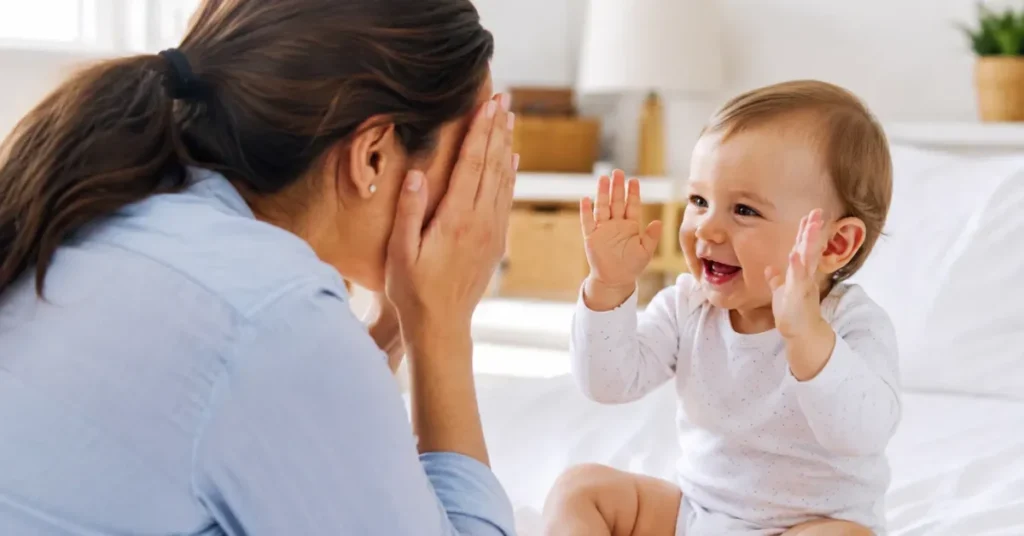
You can’t force a developmental milestone, but you can absolutely create more opportunities for it to click.
Wave first, every time. Say “bye-bye” and wave whenever someone leaves the room, even if it feels repetitive. Babies learn gestures the same way they learn everything else: through repetition.
Narrate the moment. Pairing the word with the action, every single time, helps your baby connect the sound to the gesture faster.
Play games that use the same muscles. Peekaboo, pat-a-cake, and simple hand-clapping songs build the same fine motor and imitation skills that waving relies on.
Respond enthusiastically to any attempt. Even a random hand flap deserves a big reaction. Babies are natural people-pleasers at this age, and positive feedback speeds up learning.
Use it in daily routines. Waving goodbye to the mail carrier, a sibling leaving for school, or a pet walking out of the room gives babies far more repetitions than a single daily goodbye at daycare.
Note the date of the first real attempt. A quick note or short video with a date attached makes future checkups easier, since most parents genuinely forget the exact week a milestone first appeared once a few months have passed.
What Not to Do While Waiting for This Wave
Waiting for a milestone brings out well-meaning habits that don’t actually speed things up and can add unnecessary pressure.
Don’t physically move your baby’s hand for them. Guiding a hand through the motion once in a while for fun is fine, but relying on it as the main teaching method skips the imitation step that makes the gesture meaningful in the first place.
Don’t compare against one specific baby. A cousin, a daycare classmate, or an older sibling waving earlier tells you very little about your own baby’s timeline. The normal range genuinely spans several months.
Don’t confuse random arm movement with an actual wave. Babies flap their arms for all kinds of reasons, excitement, frustration, simple movement practice, and none of that counts as a wave on its own. A real wave usually comes with eye contact, a smile, and timing that lines up with a greeting or goodbye. Watching for that combination is more useful than counting hand flaps.
Don’t panic over one missed checkup question. If a doctor asks about waving and your baby hasn’t started, that’s a normal part of a routine visit, not an emergency. Most of the time it simply gets a follow-up mention at the next appointment.
When Do Babies Wave Bye Compared to Other Early Gestures
It helps to see waving next to the other social gestures babies typically develop around the same window, since parents often ask about all of them together.
Clapping usually starts slightly earlier, often becoming recognizable by 9 to 13 months, and it relies more heavily on pure motor coordination than social understanding. Pointing tends to develop on a similar or slightly later curve, with open-hand pointing appearing first and a refined index-finger point showing up closer to 14 months. Head-shaking for “no” often lands in the same general window as waving.
So when parents ask when do babies wave bye compared to when they start pointing or clapping, the honest answer is that all three tend to cluster in the same broad developmental season, roughly 8 to 13 months, even though each one draws on a slightly different mix of skills.
Who Should Pay Closer Attention to This Timeline
Every family tracking milestones benefits from understanding the general waving window, but a few groups have particular reason to watch it closely.
Parents of babies born preterm should track this milestone using corrected age, not the calendar date of birth, since research consistently shows premature infants take a bit longer on average to reach the same point.
Families with a history of speech, language, or developmental delays in older siblings may want to mention gesture development proactively at checkups, simply because early gestures are one of the stronger early predictors of later language skills.
Caregivers in group settings like daycare are often the first to notice a wave, since babies frequently pick up social gestures faster in an environment full of other children modeling them throughout the day.
Special Situations: Vision, Hearing, and Multilingual Homes
Most milestone guides assume one default setup, but plenty of real households look different, and this timeline still applies with a few adjustments.
Babies with limited vision. Since waving is normally learned by watching someone else do it, a baby with a vision impairment may need more hands-on teaching, like gently guiding their hand through the motion while saying “bye-bye,” repeated often, rather than relying on visual imitation alone.
Babies with hearing differences. Waving is a visual gesture rather than an auditory one, so babies who are deaf or hard of hearing typically pick it up on a comparable timeline to hearing babies, often even earlier, since visual communication becomes a stronger focus in these households from the start.
Multilingual homes. Parents raising a baby with two or more languages often worry that gestures or speech will lag behind. Early gesture development, including waving, generally tracks with motor and social readiness rather than the number of languages spoken at home, so there’s little reason to expect a later wave purely because of a bilingual environment.
Twins and multiples. It’s common for one twin to wave weeks or months before the other. Comparing them directly rarely tells you anything useful, since even babies from the same pregnancy can land at very different points on the same normal range.
Inside the Data: What Studies Reveal About Baby Waving
Detailed analysis of published developmental research points to a fairly consistent pattern. The most frequently cited study tracking this exact milestone followed full-term and preterm infants and found that all full-term babies could wave bye-bye by 16 months, with the preterm group needing roughly one additional month once age was adjusted for how early they arrived.
Broader research into infant gesture development, published through outlets like Reading Rockets and referenced in speech-language literature, has found that the number of gestures a baby uses between 9 and 16 months is linked to their vocabulary size roughly two years later. Waving is one of the earliest and most consistent gestures counted in that research.
Taken together, the pattern is clear: waving isn’t an isolated party trick. It’s an early marker researchers and pediatricians use as one small piece of a much larger communication picture.
The Bottom Line
If you’ve been wondering when do babies wave bye, the honest answer is a range rather than a single date: most start somewhere between 8 and 12 months, with plenty of healthy variation on either side. What matters far more than hitting an exact week is the broader pattern of gestures, sounds, and connection building around it.
Keep modeling the wave, keep responding with enthusiasm to every attempt, and mention it at your next checkup if it’s paired with other missing communication milestones. That little hand flap will show up when your baby’s brain and body are ready, and it’s worth every bit of the wait.
This article is for informational purposes only and does not replace professional medical advice. Always consult your child’s pediatrician with specific concerns about their development.
Frequently Asked Questions
Is it normal if my baby waves “hello” the same way they wave “bye”?
Yes. Most babies don’t distinguish between the two gestures right away and will use the exact same wave for greeting and leaving. The distinction usually sharpens closer to 18 months once language catches up.
My baby waves at everyone, including strangers. Is that unusual?
Not at all. Some babies wave indiscriminately at anyone who catches their eye, while others reserve it for familiar faces. Both patterns are typical and often reflect temperament more than development.
Should I be worried if my 10-month-old isn’t waving yet?
Generally, no. Ten months sits comfortably within the normal window, and many babies don’t establish a consistent wave until closer to their first birthday.
Does not waving mean my baby might have a developmental delay?
Not by itself. A missing wave only becomes something to flag alongside other missing communication skills, like pointing, babbling, or responding to their name, around the 12-month mark.
Can I teach my baby to wave, or does it just happen on its own?
Both play a role. Babies need to see the gesture modeled repeatedly before they can imitate it, so waving whenever you say goodbye genuinely speeds up the process.
My baby used to wave and suddenly stopped. Should I be concerned?
This is worth mentioning to your pediatrician sooner rather than later. Losing a skill a baby already had is generally taken more seriously than a skill that simply hasn’t appeared yet.
Will speaking two languages at home delay my baby from waving?
Not typically. Gesture milestones like waving are tied more closely to motor coordination and social understanding than to the number of languages spoken around a baby.