
Most parents ask when do babies start reaching for people around the same week their baby starts locking eyes with them a little longer than usual. The honest answer: it happens gradually, not overnight, and it starts earlier than most guides admit. Somewhere between two and four months, babies begin moving their arms and bodies toward the people they trust. By nine months, that reach turns into something unmistakable: lifted arms, an open hand, a clear “pick me up” signal aimed straight at mom or dad.
This isn’t one single moment. It’s a chain of small physical and social steps that build on each other. Once you know what to look for, you’ll probably realize your baby has already been doing some version of it for weeks.
Pediatric growth tracking guidelines describe this as part of social-emotional development, not just motor development. A baby reaching for a rattle uses many of the same muscles as a baby reaching for a parent’s face. The reasons behind each motion are completely different though, and that difference matters for how parents read their baby’s cues.
Knowing exactly when do babies start reaching for people also helps parents feel less anxious during the in-between weeks, when a baby seems interested in faces but hasn’t quite figured out how to close the physical gap yet.
The Early Signs Before Reaching Actually Starts
Before any real reaching happens, babies send smaller signals. Watch closely in the first two months and you’ll catch them.
A newborn’s arm movements are mostly reflexive. They jerk, wave, and startle without much control. By around six to eight weeks, something shifts. Babies start holding eye contact longer. They smile when a familiar face leans in close.
That social smile is the real starting point. It’s not reaching yet, but it’s the emotional groundwork for it. Parents who watch this stage closely notice their baby’s whole body gets more animated around familiar faces. Legs kick. Arms wave. Breathing quickens with excitement.
By around three months, coordination improves enough that arm movements stop being random. Babies start batting at objects that dangle nearby, and they’ll often do the same thing toward a parent leaning over the crib. It’s clumsy. It’s often more of a lunge than a controlled reach. But it’s the first physical attempt at connection, and it sets the stage for everything that follows.
Feeding time and diaper changes are good windows for noticing this stage. Babies tend to be calm, alert, and focused on the face closest to them, which makes early social cues easier to spot than during play.
When Do Babies Start Reaching for People Compared to Reaching for Objects?
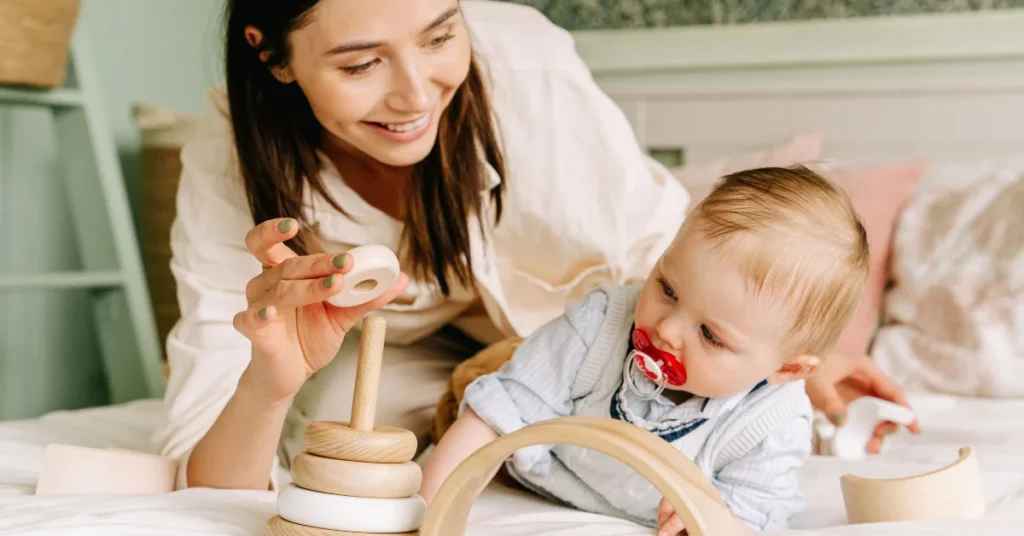
Here’s where things get interesting, because reaching for a toy and reaching for a person don’t develop on identical timelines, even though the movements look similar from the outside.
Reaching for objects typically starts around three to four months, beginning as swiping motions before turning into accurate, purposeful grabs by five or six months. That timeline stays fairly consistent across pediatric development tracking, and it’s one of the more predictable fine motor milestones parents can watch for.
Reaching for people follows a slightly different emotional curve. Around four months, babies start looking, moving, and making sounds specifically to get or keep a parent’s attention. That’s an early social cue that isn’t quite reaching yet, but it’s doing the same emotional job as a reach would.
By six months, most babies clearly recognize familiar faces and show excitement or curiosity when someone they know comes into view. Sitting with support also starts around this age, which frees up the arms for more expressive movement toward caregivers.
The clearest, most obvious version of reaching for people shows up around nine months. This is when babies commonly lift their arms to signal they want to be picked up, a gesture pediatric specialists classify as an early form of nonverbal communication rather than just a physical movement.
So if you’re wondering exactly when do babies start reaching for people in the fullest sense, nine months is usually when the gesture becomes unmistakable, even though the roots of it started months earlier. Some babies get there closer to seven months. Others take until ten or eleven. Both are within the normal range.
Why Babies Reach for People Before They Reach for Toys
There’s a reason this milestone carries more emotional weight than most others parents track.
Reaching for a caregiver isn’t only about wanting physical comfort. It’s a baby communicating trust before they have any words to say it with. Anyone who has spent real time around infants knows that outstretched-arms moment hits differently than watching a baby grab a rattle off the floor.
This gesture also tends to show up alongside other social milestones. Around the same age babies start lifting arms to be picked up, many also begin showing mild stranger anxiety and getting upset when a familiar caregiver leaves the room. Both behaviors point to the same underlying shift. Babies are learning who their safe people are, and they’re starting to ask for them directly instead of just watching and waiting.
Premature babies often reach these points a little later, based on adjusted age rather than the calendar date. A baby born six weeks early may hit this milestone roughly six weeks behind a full-term baby, and pediatric specialists who work with preterm infants consider that entirely normal.
Twins and other multiples sometimes reach this stage on slightly different weeks from each other too, even when born on the same day. Comparing siblings against a single chart rarely tells the full story.
What the Research Shows
Detailed analysis of infant development tracking data reveals a consistent four-category framework used to monitor babies from birth through age five: movement, language and communication, cognitive skills, and social-emotional growth. Reaching for people sits right at the intersection of the last two categories.
Recent pediatric guidance updated its milestone checklists to reflect what roughly three out of four babies can do by a given age, rather than treating each skill as a strict pass-or-fail deadline. That shift matters here, because reaching for people has one of the widest normal ranges of any early social milestone. Some babies show clear “pick me up” gestures by seven months. Others get there closer to ten.
Early adoption of adjusted-age tracking for premature infants has grown noticeably in recent pediatric practice through 2025 and into 2026, reflecting a broader move toward individualized development monitoring rather than one-size-fits-all charts. Professionals working in pediatric development consistently report that parents who track milestones with some flexibility, rather than rigid deadlines, report less day-to-day anxiety and still catch genuine concerns just as quickly.
Occupational therapists who specialize in infant development also note that tummy time plays a bigger role in this milestone than most parents expect. Stronger shoulder and core muscles from regular tummy time tend to support earlier, steadier reaching, both toward objects and toward people.
Signs to Watch and When to Talk to a Pediatrician
Milestones exist to guide observation, not to diagnose anything on their own. Still, a few signs are worth flagging to your baby’s doctor if you notice them.
- Your baby doesn’t seem to enjoy being around people or never smiles spontaneously by around two months.
- By six months, your baby shows no interest in looking, moving, or making sounds to get your attention.
- By nine months, your baby doesn’t reach for objects with either hand or shows no interest in being picked up.
- Your baby seems unusually stiff, floppy, or reaches with only one hand consistently.
- Your baby doesn’t respond to their name or seems uninterested in familiar faces by nine months.
None of these signs automatically mean something’s wrong. Development moves at different speeds for different babies. Early evaluation, when something genuinely feels off, tends to make a real difference though. Trust your instincts here. You know your baby better than any chart does.
This article is for informational purposes only. Always consult a qualified pediatrician or healthcare provider about your baby’s individual development.
Parents sometimes bring up when do babies start reaching for people during well-child visits specifically because it’s such a visible, photographable moment. Pediatricians tend to welcome the question, since it opens the door to a broader conversation about social-emotional growth rather than just physical checkpoints.
Who Should Pay Extra Attention to This Milestone
New parents aren’t the only audience asking when do babies start reaching for people. Grandparents, childcare providers, and adoptive or foster parents meeting a baby later in infancy often watch for this exact cue too, since it’s one of the clearest signs a baby feels safe with them.
Parents of twins or multiples sometimes notice one baby reaching for people earlier than the other. That’s normal. Siblings, even identical ones, don’t always hit social milestones on the same week or even the same month.
Working parents relying on daycare or a nanny often ask this question for a different reason entirely. Watching a baby reach for a caregiver other than themselves can bring up mixed feelings. Pediatric specialists are consistent on this point though: a baby reaching for multiple trusted adults is a sign of healthy attachment, not a sign of divided loyalty or weaker bonding at home.
Non-mobile babies with certain physical conditions may also show delayed reaching for reasons unrelated to social development. In these cases, pediatricians typically separate motor delays from social delays during evaluation, since the two don’t always move together.
The Bottom Line
So, when do babies start reaching for people? The short version: small signals start around two months, purposeful movement toward familiar faces builds through four to six months, and the classic arms-up gesture usually settles in by around nine months. Every baby moves through this at their own pace, and that range stays wide and normal throughout the first year.
What matters more than the exact week is the pattern. A baby who’s looking, smiling, babbling, and slowly reaching toward the people who care for them is doing exactly what healthy development looks like, even if the timeline doesn’t match a chart to the day. Parents who understand when do babies start reaching for people tend to worry less about small variations and focus more on the overall pattern of connection building week by week.
This article is for informational purposes only. Always consult a qualified professional regarding your baby’s individual development.
Frequently Asked Questions
Is it normal if my baby hasn’t started reaching for people by six months?
Yes, in many cases. The normal range for this milestone is wide, and some babies take a little longer to combine physical coordination with social motivation. If you’re concerned, mention it at your next well-check.
Do premature babies reach for people later than full-term babies?
Often, yes, based on adjusted age rather than birth date. A baby born several weeks early typically catches up to this milestone on a similar delay.
Is reaching for people different from reaching for toys?
They involve similar arm movements but different motivations. Reaching for objects is largely about motor coordination, while reaching for people is tied to social bonding and trust.
What if my baby only reaches for one parent and not the other?
This is common, especially around six to nine months when stranger anxiety and preference for a primary caregiver often peak. It usually evens out over the following months.
Should I be worried if my baby doesn’t lift their arms to be picked up by nine months?
Not automatically, but it’s worth mentioning to your pediatrician, especially if paired with other missing social cues like limited eye contact or no interest in familiar faces.
Does daycare or shared caregiving change when do babies start reaching for people?
Not in any meaningful way. Babies raised with multiple consistent caregivers, whether at home or in daycare, typically reach this milestone on a similar timeline, since the skill depends more on general social exposure than on any single caregiving setup.