
A newborn’s fists stay curled for weeks. Then one afternoon, something shifts. When do babies find their hands? Most infants notice their own fingers somewhere between six and ten weeks old, though the full process of hand discovery stretches from about two months to four months. This isn’t a single flip-a-switch moment. It’s a slow, funny, oddly moving unfolding that pediatricians call “hand regard,” and it tells you a lot about what’s happening inside your baby’s growing brain.
When Do Babies Find Their Hands: The Week-by-Week Breakdown
Parents who deal with sleepless nights and endless diaper changes often describe this milestone as the first real “aha” moment they get to witness. Here’s roughly how it plays out.
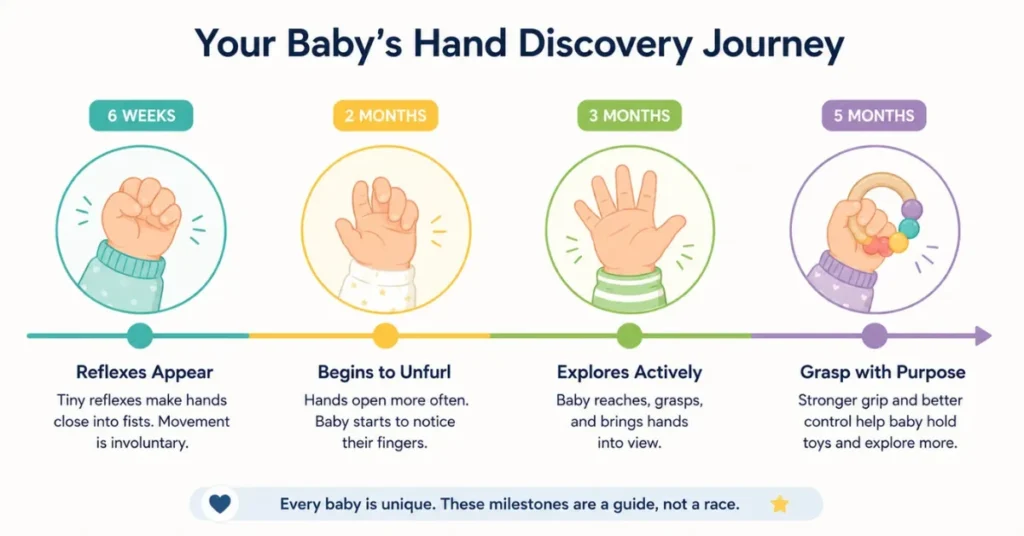
Birth to 6 weeks: A newborn’s hands stay clenched most of the time. This is reflexive, not intentional. The palmar grasp reflex causes fingers to close automatically around anything pressed into the palm, and it typically fades on its own by five to six months as voluntary grasping takes over. Around the same early weeks, the asymmetrical tonic neck reflex, sometimes called the “fencer pose,” turns the head to one side and straightens the arm on that same side. This reflex is one of the earliest physical triggers that puts a baby’s own hand directly in their line of sight.
6 to 10 weeks: Fingers begin relaxing. Fists open more often. Some babies start bringing a hand toward the mouth on purpose rather than by accident.
2 months: According to CDC developmental tracking, opening the hands briefly is a recognized movement milestone at this age. Many infants also begin calming themselves by bringing hands to their mouths.
2 to 3 months: This is the classic window. The baby lifts a fist in front of their face and simply stares. Pediatric researchers call this hand regard, and it’s the moment most parents mean when they ask when do babies find their hands.
3 to 4 months: Sustained staring at the hands is extremely common. The baby may wave both hands, clap them loosely, or swat at nearby toys without much accuracy yet.
5 to 6 months: Reaching becomes more deliberate. The hand moves toward an object while the eyes shift back and forth between hand and target, refining the connection.
What Hand Regard Actually Means
Hand regard sounds like a minor quirk. It isn’t. Anyone who has studied infant motor development knows it marks one of the earliest signs that a baby is starting to link vision with movement.
Before this stage, a newborn’s hands and eyes operate almost independently. The baby might stare in one direction while their arm drifts somewhere else entirely. Younger infants genuinely don’t process their hands as part of themselves yet, they’re just objects that occasionally float into view.
Once hand regard kicks in, that separation starts closing. The brain begins building the neural wiring that eventually lets a baby reach accurately, grasp a rattle, and later, feed themselves. Researchers who’ve tracked this pattern describe a clear sequence: hand regard around two months, occasional swatting by four months, and a real, aimed reach by around five months.
Timing lines up closely with how a newborn’s eyesight matures. A brand-new baby can only focus clearly on objects roughly eight to twelve inches away, which happens to be almost exactly the distance between a raised fist and a baby’s own face. As vision sharpens over the following weeks, the hand simply becomes something the baby can finally see well enough to study.
A Simple Timeline Table
| Age Range | What Typically Happens | Common Parent Observation |
|---|---|---|
| 0–6 weeks | Fists stay closed, reflexive grasping | “She won’t let go of my finger” |
| 6–10 weeks | Fingers loosen, hand-to-mouth begins | “He keeps sucking on his fist” |
| 2 months | Brief hand-opening, self-soothing | “She calms down when her hand’s near her mouth” |
| 2–3 months | Hand regard, staring at own fist | “He just stares at his hand like it’s magic” |
| 3–4 months | Waving, loose clapping, swatting | “She swats at toys but misses a lot” |
| 5–6 months | Deliberate, aimed reaching | “He grabbed the rattle on the first try” |
Every baby moves through these stages at a slightly different pace, and gaps of a few weeks in either direction are completely normal.
Reflex Movement vs. Voluntary Movement
Parents often can’t tell whether a hand movement is a leftover newborn reflex or genuine, intentional control. Here’s a quick side-by-side.
| Movement | Type | Roughly Fades or Strengthens By |
|---|---|---|
| Palmar grasp reflex (fist closes around a finger) | Reflex | Fades by 5-6 months |
| Asymmetrical tonic neck reflex (“fencer pose”) | Reflex | Fades by 4-6 months |
| Hand regard (staring at own fist) | Voluntary/emerging | Strengthens from 2-4 months |
| Swatting at toys | Voluntary/emerging | Strengthens from 3-4 months |
| Aimed reaching and grasping | Voluntary | Strengthens from 5-6 months onward |
Seeing the reflexes fade out just as the voluntary skills strengthen is a good reminder that this whole stage is really a handoff, automatic newborn wiring stepping aside for movement the baby is starting to control on purpose.
Why Some Babies Discover Their Hands Earlier or Later
Anyone who has raised more than one child knows exactly how much variation exists between siblings. Hand discovery timing depends on several factors working together.
- Muscle tone and strength. Babies with looser muscle tone sometimes take a bit longer to control deliberate hand movement.
- Tummy time habits. Regular tummy time builds the upper-body strength that supports early reaching and hand awareness.
- Prematurity. Babies born early are typically assessed using their adjusted age rather than their birth date, so hand regard may appear later on the calendar but right on schedule developmentally.
- General temperament. More alert, visually curious babies sometimes notice their hands sooner simply because they’re already scanning their surroundings more.
None of these variables are cause for panic on their own. Developmental ranges exist precisely because healthy babies don’t all hit the same marker on the same day.
Encouraging Hand Discovery Naturally
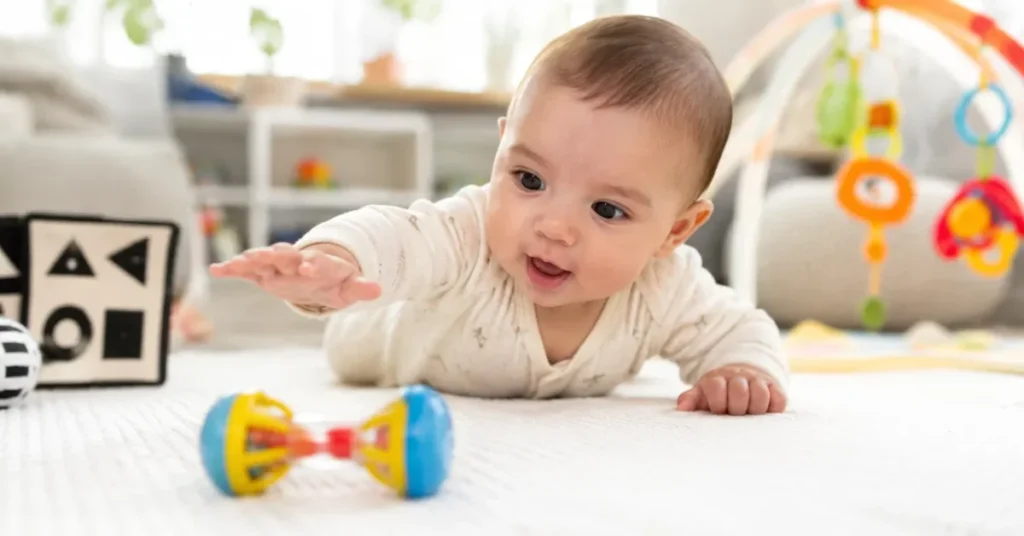
Parents don’t need special equipment or programs. A few simple habits support this stage well.
- Give supervised tummy time daily, even short stretches build the strength needed for later reaching.
- Hold a rattle or high-contrast toy within view and let the baby track it before trying to grab it.
- Leave a baby’s hands unmittened when it’s safe and warm enough, mittens delay the sensory feedback that drives discovery.
- Talk about their hands during diaper changes: “There’s your hand!” Naming body parts reinforces the connection.
- Avoid overstimulating environments during this stage, a calm setting helps a baby focus on their own movements.
- Keep small objects, cords, and anything chokable well out of reach once hand-to-mouth behavior picks up, this is exactly the stage where things start heading straight for the mouth.
None of this speeds up biology, and it shouldn’t try to. It just gives a baby’s natural timeline the best conditions to unfold in.
What the Research Shows
Detailed analysis of infant motor studies consistently points to hand regard as a genuine developmental checkpoint rather than a cute coincidence. Longitudinal observation work going back decades has tracked this same sequence: fisted hands early on, hand regard emerging around eight to nine weeks, sustained visual fixation through roughly the third month, and a measurable earliest reach by around five months.
Government developmental tracking programs echo this pattern. Two-month checklists list brief hand-opening as an expected movement skill, and four-month checklists build on it with more purposeful hand-to-mouth activity and improved head and hand coordination.
When examining this closely, the consistency across independent sources, clinical observation, government milestone tracking, and academic motor-development research, is what makes this such a reliable marker for pediatricians. It isn’t guesswork. It’s one of the most well-documented sequences in early infant motor growth.
When to Mention It to a Doctor
Most of the time, this milestone needs no intervention at all. Still, pediatricians generally suggest raising a concern if, by around three to four months, a baby:
- Keeps hands tightly fisted almost all the time
- Shows no interest in bringing hands toward the mouth
- Doesn’t visually track a toy or a hand movement
- Shows one hand used far more than the other this early
That last point is worth a quick clarification: true hand dominance, being left- or right-handed, usually doesn’t settle in until a child is two to three years old. A slight preference at three or four months isn’t the same thing, and on its own it rarely means anything. It’s the combination of several signs together, not one hand preference alone, that’s worth flagging.
Any one of these on its own usually isn’t alarming. A pattern of several together is worth flagging at a routine checkup. Doctors would rather field an early question that turns out to be nothing than have a genuine delay go unnoticed.
When Do Babies Find Their Hands Compared to Other Early Milestones
Parents often ask when do babies find their hands in the same breath as questions about smiling, rolling over, or lifting their head. It helps to see hand regard next to those other early markers, since several of them cluster around the same two-to-four-month window.
Head control usually arrives first. By around two months, most babies can briefly lift their head during tummy time, and by three to four months they hold it steady while upright. Social smiling tends to show up around six to eight weeks, often overlapping almost exactly with the earliest stages of hand regard. Rolling from tummy to back typically comes later, closer to four months, and full back-to-tummy rolling often waits until five or six months.
Seeing hand discovery inside this bigger picture matters because no single milestone happens in isolation. A baby who’s building neck strength, tracking faces, and starting to coordinate hand movement is really developing several connected skills at once. The nervous system doesn’t treat these as separate checklist items, it treats them as one continuous project of learning to control a body.
This is also why pediatricians look at clusters of milestones rather than a single behavior in isolation. A baby who’s slightly behind on hand regard but right on track for head control and social smiling is usually just fine. It’s an unusual pattern across multiple categories, not one delayed skill, that tends to prompt a closer look.
Different Babies, Different Paths
Professionals in pediatric development know that the two-to-four-month window is an average, not a rule carved in stone. Some healthy, thriving babies notice their hands as early as five weeks. Others take until closer to five months, and go on to hit every later milestone right on schedule.
First-time parents often worry the most about timing, simply because they have no personal reference point. If this describes you, it helps to know that the range pediatricians consider normal is genuinely wide, and a few weeks of variation rarely means anything.
Parents of premature babies should use adjusted age, counting from the original due date rather than the birth date. A baby born six weeks early who discovers their hands at four months by the calendar is right on track once that adjustment is made.
Parents of twins or multiples sometimes notice one baby reaching this stage before the other. Twins don’t automatically develop in lockstep, and separate timelines within the same pregnancy are completely ordinary.
Caregivers of babies with low muscle tone or other diagnosed conditions should lean on their pediatrician’s specific guidance rather than general averages, since typical ranges may not apply in the same way.
Common Mistakes Parents Make During This Stage
A few habits can unintentionally slow down or mask this milestone, even though they come from good intentions.
Keeping a baby in mittens around the clock is one of the most common. Mittens are useful for preventing scratches in the first couple of weeks, but leaving them on constantly blocks the sensory feedback a baby needs to start noticing their own fingers.
Overscheduling tummy time into long, forced sessions can backfire too. Short, frequent stretches spread across the day tend to build strength more effectively than one long session that ends in frustration and crying.
Comparing a baby’s pace too closely to a sibling’s or a friend’s baby’s timeline is another trap. Development charts describe population averages, not individual guarantees, and a two- or three-week gap in either direction rarely means anything on its own.
Finally, some parents assume that because a baby is staring at their hand, they must already understand cause and effect the way an older infant does. In reality, this early staring is more about visual fascination and building neural connections than deliberate reasoning, that level of understanding comes later.
Final Thoughts
So, when do babies find their hands? Somewhere in that tender window between six weeks and four months, depending on the baby. It’s a small moment in the grand scope of childhood, and yet it’s one of the clearest windows into how a newborn’s brain starts wiring vision to movement. Watch for it, enjoy it, and don’t stress if your baby’s timeline looks a little different from the one in a book.
This article is for informational purposes only. Always consult a qualified pediatrician about your child’s individual development.
Frequently Asked Questions
When do babies find their hands for the first time?
Most infants first notice their hands somewhere between six and ten weeks old, with the classic hand-staring stage settling in around two to three months.
Is it normal if my baby hasn’t found their hands by three months?
Yes, in most cases. The developmental window stretches into the fourth month for plenty of healthy babies. If nothing has changed by four months, mention it at the next checkup.
Why does my baby keep sucking on their hands?
It’s a self-soothing behavior that often overlaps with hand discovery. It also helps babies gather sensory information about their own bodies.
Does hand discovery relate to later crawling or walking?
Indirectly, yes. The hand-eye coordination built during this stage lays groundwork for reaching, grasping, and eventually the coordinated movement needed for crawling.
Should I stimulate my baby’s hands to speed things up?
Gentle encouragement, tummy time, unmittened hands, simple toys, supports the process. Nothing reliably speeds up the underlying neurological timeline, and there’s no need to try forcing it.