
If you’ve been asking yourself why does my jaw hurt every time you chew, yawn, or wake up in the morning, you’re far from alone. That dull ache near your ear or along your cheekbone has a name, and in most cases, it’s nowhere near as serious as it feels.
The Most Common Reason: TMJ Disorders
The jaw joint sits just in front of each ear, connecting your lower jaw to your skull. When something goes wrong there, doctors call it a temporomandibular disorder, or TMD for short. It’s one of the top answers whenever someone types why does my jaw hurt into a search bar at 2am.
According to health researchers at leading UK hospitals, jaw joint problems are very common and typically improve within a few months. Pain here usually shows up as a dull ache in front of the ear, sometimes spreading toward the cheek or down into the neck. It tends to flare up during chewing or stressful stretches of the day.
People who deal with this condition often describe it as tightness that builds gradually rather than a sudden sharp pain. Anyone who has gone through a stressful few weeks at work knows how easily that tension migrates straight into the jaw.
What’s Actually Causing the Pain
Several things can trigger jaw discomfort, and they don’t always show up alone.
- Teeth grinding or clenching, especially overnight
- Stress-related muscle tightness around the jaw and temples
- A jaw joint disc that’s slipped slightly out of position
- Arthritis affecting the joint, more common with age
- Nail biting or chewing on pens
- Missing back teeth or an uneven bite
- A direct injury, like a blow to the face or whiplash
- Recent wisdom teeth removal, where swelling and muscle strain linger for days
Dental researchers note that in a large share of cases, no single obvious cause is ever pinpointed. The pain often comes from overworked jaw muscles rather than damage to the bone itself, which is actually reassuring news.
Other Causes That Get Mistaken for TMJ
Not every ache near the jaw comes from the joint itself. A few conditions sit close enough to the jaw that people confuse them with TMD, and treating the wrong one wastes time.
A cavity or an abscessed tooth can cause pain that radiates outward, often triggered by hot or cold food. Sinus infections press on the upper jaw and cheekbones, and the pain usually gets worse when you lean forward. Ear infections sit right next to the jaw joint, so their pain can easily feel like it’s coming from the jaw. In rare cases, sharp, electric-shock-like facial pain points to trigeminal neuralgia, a nerve condition that needs specialist care rather than home remedies.
| Condition | Pain Pattern | Key Clue | Right Person to See |
|---|---|---|---|
| TMJ disorder | Dull ache near ear, worse with chewing | Clicking or popping sound | Dentist |
| Tooth abscess or cavity | Sharp, localized to one tooth | Worse with hot or cold food | Dentist |
| Sinus infection | Pressure across upper jaw and cheeks | Worse when bending forward | Doctor |
| Ear infection | Pain near jaw hinge, often with hearing changes | Fever, ear discharge | Doctor |
| Trigeminal neuralgia | Sudden, sharp, shooting pain | Triggered by touch or wind on face | Neurologist |
Jaw Pain Symptoms and What They Usually Mean
| Symptom | Likely Cause | Typical Duration | Self-Care Approach |
|---|---|---|---|
| Clicking or popping when opening mouth | Disc slightly out of position | Weeks to months | Soft foods, avoid wide yawning |
| Dull ache near the ear | Muscle tension, grinding | Days to weeks | Warm compress, jaw rest |
| Pain when chewing | Overuse of jaw muscles | Varies | Smaller bites, softer diet |
| Locked jaw or limited opening | Joint or disc problem | Needs assessment | See a dentist or doctor |
| Jaw pain with headache | Stress, clenching | Ongoing if untreated | Stress management, mouthguard |
| Sudden severe pain after injury | Possible fracture or dislocation | Immediate | Seek urgent care |
Is Stress Really to Blame?
Yes, more often than most people expect. When the body is under pressure, jaw muscles tighten without you noticing, particularly during sleep. Professionals who work in dentistry consistently report a rise in grinding-related jaw pain during high-stress periods of the year.
That tightening, night after night, wears on the joint and surrounding muscles. Anyone who has managed a stretch of poor sleep and mounting deadlines knows how quickly that tension shows up somewhere in the body. For a lot of people, the jaw is where it lands first.
Everyday Habits That Quietly Make Jaw Pain Worse
A few ordinary habits add strain without anyone noticing at first.
Holding a phone between your shoulder and ear during calls forces the jaw and neck muscles into an awkward position for long stretches. Slouching over a desk or laptop pulls the head forward, which adds pressure through the jaw joint. Sleeping face-down, or on one side with the jaw pressed into a pillow, keeps the joint compressed for hours at a time.
Small adjustments here, like switching to headphones or sleeping on your back, often ease symptoms faster than any medication.
When Jaw Pain Signals Something More Serious
Most jaw discomfort resolves on its own with rest and simple home care. That said, certain signs shouldn’t be ignored.
Seek prompt medical attention if you notice:
- A jaw that suddenly locks and won’t open or close
- Severe pain following a fall or blow to the face
- Swelling, fever, or difficulty swallowing alongside the pain
- A lump, sore, or patch in the mouth that doesn’t heal within a couple of weeks
- Pain radiating into the chest or arm, which could point to a heart-related issue rather than the jaw itself
Health authorities are clear that jaw or facial pain paired with chest tightness, shortness of breath, or arm pain needs urgent evaluation, since it can sometimes indicate a cardiac event rather than a dental one.
How Common Is TMJ? The Numbers Behind Jaw Pain
Detailed analysis of temporomandibular disorders shows they affect roughly 1 in 10 people at some point in their lives, based on figures cited by NHS patient information services. Separate estimates from Cleveland Clinic put the number affected in the United States alone at up to 12 million, with the condition appearing about twice as often in women as in men, most frequently between ages 20 and 40.
Examining this closely, researchers also point out that TMDs aren’t a single condition but a group of more than 30 related disorders, according to the U.S. National Institute of Dental and Craniofacial Research. That’s part of why the pain shows up so differently from person to person, and why one home remedy doesn’t work for everyone.
How Long Should You Wait? Acute vs Chronic Jaw Pain
Jaw pain lasting a few days to a couple of weeks is generally considered acute, and home care is usually enough. Once pain sticks around for more than three months, it’s classed as chronic, and that’s the point where a specialist referral becomes worth pursuing rather than continuing to wait it out.
Tracking how your pain behaves over that window gives you, and any professional you eventually see, a much clearer picture than trying to describe it from memory.
Home Relief That Actually Helps

Before jumping to medication or a specialist visit, a few simple habits tend to make a real difference:
- Stick to softer foods for a few days, cutting food into smaller pieces
- Use ice for the first 48 hours after an injury or sudden swelling, then switch to a warm compress for ongoing muscle tension
- Avoid wide yawning or chewing gum during flare-ups
- Try gentle jaw stretches: slowly open and close your mouth in a straight line, hold for a few seconds, and repeat a few times daily
- Add chin tucks to correct forward head posture, which takes pressure off the jaw
- Wear a night guard if grinding is suspected
- Sleep on your back where possible, keeping weight off the jaw
Milton Keynes University Hospital’s patient guidance notes that most jaw joint problems, even when uncomfortable, resolve without lasting damage once the underlying muscle tension eases.
If you’re using over-the-counter pain relief like ibuprofen or naproxen, stick to the labeled dose and avoid extending use beyond a week or two without checking with a pharmacist, especially if you have stomach, kidney, or heart conditions.
Track Your Symptoms Before Your Appointment
A short pain diary speeds up diagnosis more than people expect. Note when the pain starts, what you were doing beforehand, how long it lasts, and anything that eases it. Bringing that pattern to a dentist or doctor gives them a real starting point instead of a vague description.
Who Should Worry, and Who Shouldn’t
Not every case needs a dentist appointment right away. Mild clicking with no pain often just needs monitoring. But if jaw pain sticks around for more than a couple of weeks, disrupts sleep, or keeps you from opening your mouth fully, it’s worth getting checked.
Non-technical readers searching why does my jaw hurt usually just want relief, not a diagnosis session. In most mild cases, rest, warmth, and a softer diet resolve things within days. Persistent or worsening symptoms are the signal to book an appointment rather than wait it out.
A Quick Look at Treatment Options
For cases that don’t improve with home care, a dentist or doctor may suggest:
- Over-the-counter anti-inflammatory medication for short-term relief
- A custom-fitted mouthguard to reduce grinding damage
- Physical therapy focused on jaw and neck muscles
- In rare, more severe cases, corticosteroid injections or, less commonly, surgery
Before reaching a treatment plan, a provider will usually do a physical exam, checking how the jaw moves and feeling for tenderness or clicking. If the picture isn’t clear, they may order an X-ray to check the teeth and bone, or an MRI to see whether the joint disc is sitting correctly. If your pain started right after a wisdom teeth extraction, mention that specifically, since it usually points to swelling and muscle strain rather than a joint disorder, and settles within one to two weeks.
Mayo Clinic’s guidance frames these options as a stepped approach, starting conservative and escalating only if simpler measures fail.
What Recovery Usually Looks Like
For most muscle-related jaw pain, noticeable improvement shows up within one to two weeks of consistent rest, warmth or ice, and a softer diet. Joint-related cases, where the disc has shifted, can take four to six weeks to settle. If there’s been no improvement at all after three to four weeks of home care, that’s a reasonable point to book a professional assessment rather than keep waiting.
A Note for Parents: Jaw Pain in Children
Kids and teenagers get jaw pain too, though the causes lean differently. Teething in younger children, injuries from sports or falls, and teeth grinding linked to anxiety are common triggers. Persistent jaw pain in a child, especially with clicking or difficulty opening the mouth fully, is worth a pediatric dentist visit rather than assuming it will simply pass with age.
Final Thoughts
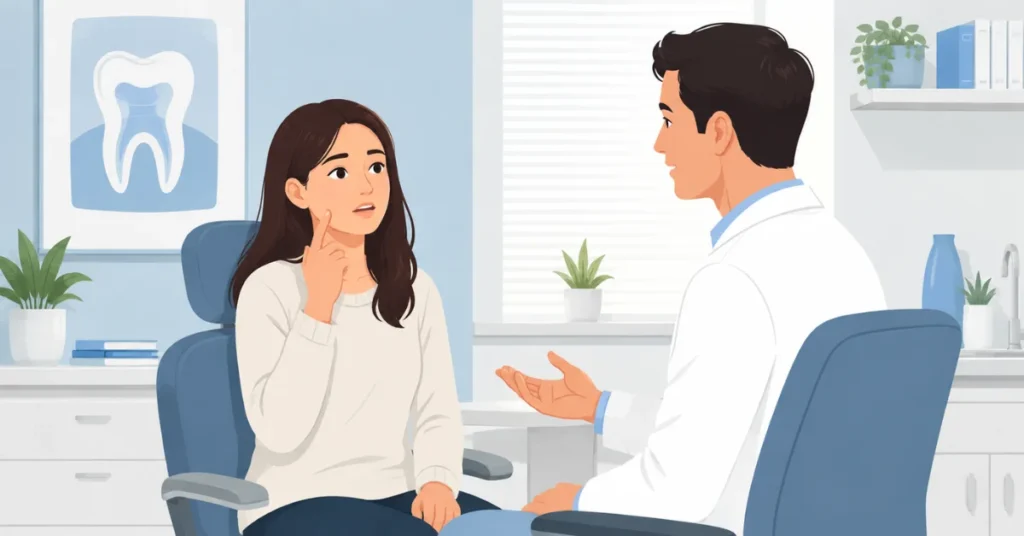
So, why does my jaw hurt? For most people, the answer comes down to stress, grinding, or a joint that’s simply overworked, not a serious underlying disease. Paying attention to the pattern of your symptoms, and giving the jaw a genuine chance to rest, resolves the issue for the vast majority of cases.
Still, persistent, severe, or unusual jaw pain deserves a professional opinion rather than guesswork. That’s the safest way to rule out anything more serious and get back to chewing, talking, and yawning without a second thought.
This article is for informational purposes only. Always consult a qualified professional for diagnosis or treatment.
FAQs
Q: Why does my jaw hurt only on one side?
One-sided pain usually points to muscle tension or joint irritation on that specific side, often from chewing habits or sleeping position.
Q: Can anxiety really cause jaw pain?
Yes. Anxiety commonly leads to unconscious clenching or grinding, particularly overnight, which strains the jaw muscles.
Q: How long does TMJ-related jaw pain usually last?
Most cases improve within a few weeks with rest and simple care, though some people experience longer flare-ups tied to stress cycles.
Q: Should I see a dentist or a doctor for jaw pain?
Either can help initially. Dentists often manage TMD and dental causes directly, while a doctor may be needed if injury, sinus infection, or nerve-related pain is suspected.
Q: Is jaw pain ever a sign of a heart problem?
Rarely, but yes, particularly when paired with chest discomfort or shortness of breath. That combination needs urgent medical attention.
Q: Why does my jaw hurt after getting my wisdom teeth removed?
This is usually swelling and muscle strain from the procedure itself, and it typically eases within one to two weeks without needing separate treatment.