
Your toddler bends her knees, flaps her arms, grunts like she’s lifting a couch, and… nothing happens. Both feet stay glued to the floor. So when do babies jump, really? The honest answer is later than most baby milestone charts suggest, and the confusion around it sends a lot of parents down a worry spiral they don’t actually need.
Jumping isn’t a baby skill at all, in the strict sense. It’s a toddler skill that grows out of months of walking, climbing, and general chaos around the living room. Knowing the real timeline helps you tell the difference between normal variation and something worth mentioning at the next checkup.
When Do Babies Jump? The Short Answer
Most children make their first real attempt at jumping somewhere between 18 and 24 months, but true jumping, meaning both feet leave the ground at the same time, usually doesn’t show up reliably until closer to age 2 to 2.5. By age 3, the large majority of toddlers can jump forward with both feet together without falling.
That’s a wide window. And it should be, because jumping depends on several other skills lining up first: leg strength, balance, and the ability to plan a movement before your body actually does it.
So if you’re scrolling through baby milestone lists at 10 months wondering why your infant hasn’t jumped yet, relax. Nobody’s infant jumps. This is a toddler thing.
What Has to Happen Before a Baby Jumps
A baby can’t jump before she can stand confidently on her own two feet, and she usually needs a good six months of walking practice under her belt before jumping becomes physically possible.
Here’s the rough sequence most toddlers follow:
- Independent walking (around 12 to 15 months)
- Running, even a clumsy version (around 16 to 18 months)
- Climbing onto low furniture and walking up stairs with a hand held (18 to 24 months)
- Attempting to leave the ground, often leading with one foot (18 to 24 months)
- True two-footed jumping (24 to 30 months)
Notice how jumping sits near the end of that list, not the beginning. It’s one of the last big gross motor skills to click into place, which is exactly why parents asking when do babies jump are often comparing their toddler to an older cousin or a daycare classmate instead of a genuine benchmark.
The Real Age-by-Age Timeline
Different pediatric therapists phrase the ranges slightly differently, but the pattern holds steady across sources. Here’s a simplified breakdown:
| Age Range | What You’ll Typically See |
|---|---|
| 15–18 months | Bouncing knees, no feet leaving the ground yet |
| 18–24 months | First attempts, often leading with one foot; jumping off a low step |
| 24–27 months | Both feet briefly leave the ground together, short distance |
| 27–30 months | Jumping forward a few inches with a two-footed landing |
| 3 years | Jumping over small objects, jumping down from a step confidently |
| 4 years | Hopping on one foot, jumping and turning in the air |
Individual timing varies a fair bit, and that’s normal. A toddler who’s cautious by nature might wait until closer to 3 to attempt a real jump, while a more physically fearless kid could be launching off the couch cushions at 22 months.
When Do Babies Jump Compared With Other Big Milestones?
It helps to see jumping next to the milestones parents track more closely. Walking alone typically lands around 12 to 15 months. Running follows within a few months after that. Jumping trails behind both of them by close to a full year in most cases.
Anyone who has raised more than one child knows this order can shift slightly, but it rarely reverses. A toddler who isn’t walking confidently yet has no business jumping, because the balance and leg strength required for walking form the base that jumping is built on. So the practical answer to when do babies jump is: after walking is solid, not before.
Compare that to fine motor skills, like stacking blocks or holding a crayon, and you’ll notice jumping develops on a completely separate track. A toddler can be advanced with language and still be a late jumper, and that’s not a contradiction. Gross motor, fine motor, and language development don’t move on the same clock.
Jumping is just one of many exciting motor milestones. Before this, you might have noticed your baby starting to reach for people as they developed their coordination and strength.
Signs Your Toddler Is Getting Close
Before the first real jump, most toddlers show a handful of warm-up behaviors:
- Bouncing repeatedly at the knees without lifting off
- Walking on tiptoes for short bursts
- Stepping off low surfaces with one foot leading
- Climbing on and off furniture without help
- Showing interest in watching other kids jump at the park
If your toddler is doing several of these, jumping is likely a matter of weeks or a couple of months away, not something to rush.
What About Premature or Late-Walking Babies?
Parents of premature babies often ask a slightly different version of this question, and it deserves its own answer. Corrected age matters here. A baby born eight weeks early should generally be measured against milestones using her adjusted age for at least the first two years, which naturally pushes jumping later on the calendar too.
The same logic applies to toddlers who walked later than average. If your child took her first independent steps at 17 months instead of 13, expect jumping to arrive later as well, since it’s built directly on top of walking and running experience. This isn’t a red flag on its own. It’s just math.
When to Talk to a Pediatrician
Pediatric physical therapists generally start paying closer attention if a child shows no attempt at jumping by around 2.5 to 3 years old. It’s also worth a conversation if you notice:
- A strong side preference, always pushing off with the same foot
- Legs that buckle or give out on landing every single time
- Visible fear or resistance whenever jumping is suggested
- No progress at all despite plenty of practice opportunities
None of these automatically mean something’s wrong. But they’re worth flagging early rather than waiting, since early evaluation tends to be simpler and less stressful than catching an issue later.
How to Help Without Turning It Into Pressure
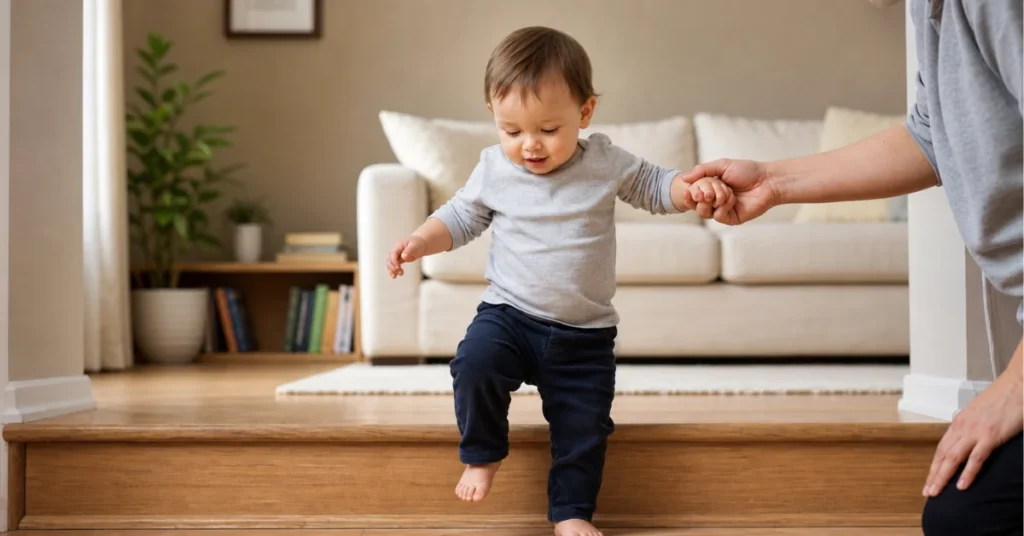
You can’t force a jump before a toddler’s body is ready, and trying usually backfires into frustration for both of you. What actually helps is low-key exposure.
Let your toddler bounce on a mattress or a padded mat. Encourage jumping off the bottom stair while you hold a hand nearby. Blow bubbles outside and let her chase and stomp them, since that builds the same leg power without feeling like a drill. Barefoot practice on grass or carpet gives better sensory feedback than shoes do, which is why many pediatric therapists recommend skipping footwear for early jumping attempts indoors.
Watching other kids jump matters more than most parents realize too. Toddlers learn an enormous amount through observation, so a trip to the playground where slightly older kids are jumping off ledges can do more than any at-home coaching session.
Key Findings From Recent Research
Detailed analysis of pediatric motor development data shows that jumping is consistently one of the later-arriving gross motor milestones, sitting well after walking, running, and stair climbing in the typical sequence. Research into early childhood movement patterns has found that by roughly 24 months, close to half of toddlers can manage a two-footed jump, with that number climbing sharply between 24 and 30 months as leg strength and motor planning catch up.
Examining this closely, the gap between “first attempt” and “reliable two-footed jump” often spans six months or more, which lines up with why so many parents feel like their child is stuck somewhere in between for a while. As of 2026, pediatric milestone tracking continues to treat jumping as a marker most children hit somewhere in the 2 to 3 year window rather than a fixed single age.
Final Thoughts

So, when do babies jump? Somewhere in that stretch between 18 months and 3 years, with the real two-footed version usually settling in around age 2 to 2.5 for most toddlers. It’s one of those milestones that rewards patience more than intervention. Anyone who has watched a toddler go from tentative knee-bounces to gleefully leaping off the bottom stair knows the wait is worth it. Give her the space, the soft landing surfaces, and a little time, and the jump will come on its own schedule.
This article is for informational purposes only. If you have specific concerns about your child’s motor development, please consult a pediatrician or pediatric physical therapist.
Frequently Asked Questions
Is it normal for a baby to not jump at all by age 2?
Yes. Plenty of toddlers don’t manage a true two-footed jump until closer to 2.5 or even 3 years old, and that’s still within the typical range.
When do babies jump with both feet at the same time?
Most toddlers manage this somewhere between 24 and 30 months, though some do it a bit earlier and plenty do it a bit later.
Can I teach my toddler to jump faster?
You can create opportunities, like bouncing on soft surfaces or jumping off a low step with support, but you can’t rush the underlying leg strength and balance. Practice helps timing, not the biology behind it.
Does not jumping by 18 months mean something is wrong?
No. Eighteen months is actually early for jumping in most toddlers. This age is typically still in the walking-and-running phase.
Should premature babies be judged against the same jumping timeline?
Not directly. Adjusted age, based on the original due date rather than the birth date, gives a fairer comparison for at least the first couple of years.