
Standing over a hot oven wondering if dinner’s ready is a familiar spot for most home cooks. If you’ve searched how long to cook chicken thighs tonight, the short answer is 35 to 45 minutes at 400°F for bone-in pieces, and 20 to 30 minutes for boneless. But the full answer depends on more than just a timer.
Chicken thighs are more forgiving than breast meat. Anyone who’s cooked both knows thighs rarely turn out dry, even with a few extra minutes in the oven. Still, getting the exact timing right is what separates rubbery, pink-tinged meat from something genuinely worth serving.
How Long to Cook Chicken Thighs by Oven Temperature
Temperature changes everything about how long to cook chicken thighs, and it’s the first variable to nail down before anything else.
At 350°F, bone-in, skin-on thighs typically need 45-50 minutes, while boneless thighs require 30-35 minutes at this temperature. This lower, slower approach gives more margin for error, which makes it a solid pick for anyone still learning to judge doneness by feel.
At 400°F — the temperature most recipe developers land on — bone-in chicken thighs require 35-40 minutes, while boneless thighs need 25-30 minutes. This is the sweet spot most kitchens use, balancing crisp skin against moist meat.
Push the oven to 425°F and the clock moves faster. Bone-in thighs take 25-30 minutes and boneless thighs need 20-25 minutes, though the higher heat demands closer attention so the outside doesn’t scorch before the inside catches up.
One widely used bone-in method lands right in the middle of these ranges: roasting at 400°F without flipping, until the thighs register 170°F on an instant-read thermometer, which generally takes 35-45 minutes depending on size.
Bone-In vs. Boneless: Why the Cut Changes the Clock
The single biggest factor in how long to cook chicken thighs is whether you’re working with bone-in or boneless cuts. Bone slows heat transfer to the center of the meat, which is why bone-in thighs consistently take longer than boneless ones at the same oven setting.
Boneless, skinless thighs cook noticeably faster. One tested method has them ready in roughly 17-22 minutes, or until the chicken reaches 170 degrees F on an instant read thermometer. Skip that adjustment and boneless thighs can dry out fast, since there’s no bone or skin insulating the meat.
Skin matters too, separate from the bone question. Skin-on thighs render fat as they cook, which bastes the meat from the outside in. That’s part of why bone-in, skin-on thighs stay juicy even when a recipe runs a few minutes long.
What Internal Temperature Actually Matters
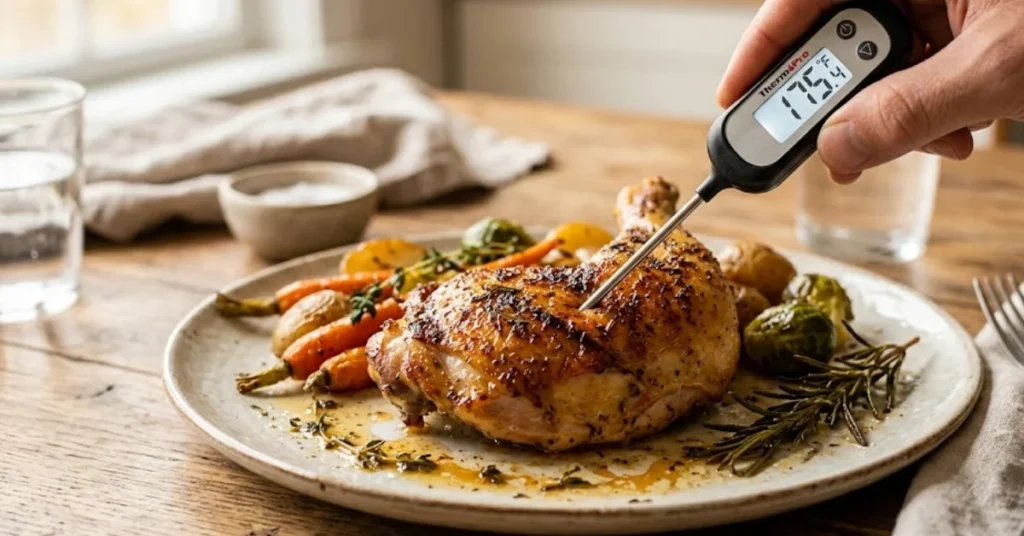
Timers are a guide. A thermometer is the actual answer. The USDA’s Food Safety and Inspection Service recommends cooking chicken pieces, including thighs, until they reach a safe minimum internal temperature of 165°F, checked with a food thermometer inserted into the thickest part of the meat.
That said, 165°F is a safety floor, not necessarily a flavor target. Dark meat cuts like thighs and drumsticks tend to turn out juicier and more tender when cooked somewhat higher than the bare minimum. Many recipe developers push thighs to 175-185°F, since that extra range gives connective tissue time to break down.
For thermometer placement, always test the thickest section, away from bone. Cooking chicken to a lower temperature and holding it there for the right amount of time can also produce safe, juicier results, but that method requires precision most home kitchens skip in favor of the straightforward 165°F-plus approach.
Cooking Methods Beyond the Oven
Baking isn’t the only way to answer how long to cook chicken thighs, and different methods change the math entirely.
Grilling follows the same safety threshold as any other method. Poultry should be cooked to a minimum internal temperature of 165°F as measured with a food thermometer, regardless of whether it’s over direct flame or indirect heat. Bone-in thighs on a grill generally take 30-40 minutes over indirect heat, flipped once partway through.
Pan-searing on the stovetop works fastest for boneless thighs, usually 6-8 minutes per side over medium heat, finished with a lid on to trap steam and push the center to temperature.
Slow cooking takes the opposite approach entirely — low and unhurried, often 3-4 hours on low heat, which breaks down connective tissue slowly rather than fast.
Common Mistakes That Throw Off Timing
A few habits consistently mess with how long chicken thighs actually need in the oven.
- Cooking straight from the fridge without letting the chicken sit out briefly first, which leads to uneven cooking
- Crowding the pan, so thighs steam instead of roast
- Skipping the thermometer and guessing by color, which is unreliable since chicken can appear pink even when fully cooked due to myoglobin in the meat or freezing before cooking
- Not patting the skin dry before seasoning, which stops the skin from crisping properly
Fixing these has more impact on the final result than chasing an exact minute count.
What the Research Shows
Food safety researchers have been consistent on one point for years. Cooking poultry to 165°F ensures it’s safe to eat, a recommendation based on advice from the USDA’s National Advisory Committee on Microbiological Criteria for Foods. That committee’s finding still anchors nearly every modern recipe and food safety chart in 2026.
Beyond safety, texture research from recipe testers points the same direction. Kitchens that batch-test thighs at different final temperatures consistently report that 170-185°F produces more tender results than stopping right at the legal minimum, because the extra heat gives fat and connective tissue more time to soften.
Who Should Pay Closer Attention to Timing
Not every cook needs the same level of precision. Meal-preppers reheating thighs later benefit from slightly undercooking by a couple of minutes, since reheating finishes the job. Parents cooking for picky eaters often push toward the higher end of the temperature range, since well-done dark meat tends to read as more “normal” texture to kids used to fast food. Anyone hosting a group is better off using a thermometer rather than a clock, since oven calibration and pan crowding vary so much that two ovens set to the same number rarely finish at the same minute.
Conclusion
How long to cook chicken thighs comes down to three things: the cut, the temperature, and whether you’re trusting a timer or a thermometer. Bone-in thighs at 400°F land in the 35-45 minute range, boneless thighs closer to 20-30. But the number on the clock only gets you close. The number on the thermometer is what actually tells you dinner’s ready.
FAQs
How long to cook chicken thighs at 375°F?
Bone-in thighs generally need 40-45 minutes at 375°F, while boneless thighs run closer to 25-30 minutes, sitting between the 350°F and 400°F ranges.
Can chicken thighs be pink and still be safe to eat?
Yes, if the internal temperature has reached 165°F. Color alone isn’t reliable — pigment from myoglobin or prior freezing can leave meat looking pink even when it’s fully cooked.
Why do chicken thighs take longer than chicken breasts?
Thighs are dark meat with more connective tissue and, often, bone-in cuts, both of which slow heat transfer and mean they benefit from a higher target temperature than breast meat.
Is it safe to cook chicken thighs from frozen?
Yes, but expect the cooking time to run significantly longer, and always confirm doneness with a thermometer rather than estimating.
What temperature makes chicken thighs the most tender?
Most tested recipes point to 175-185°F internally for bone-in thighs, well above the 165°F safety minimum, since that range lets connective tissue break down fully.