
Every parent remembers the moment. You’re leaning over the crib at 2 a.m., half-asleep, whispering the same word over and over, hoping something sticks. If you’ve searched for how to get someone to say baby, chances are that “someone” is your own child, and you’re hoping this is the week those first sounds finally turn into a real word. It’s one of the most anticipated milestones in the first year, and it doesn’t happen on command. It happens through repetition, timing, and a nervous system that’s still under construction.
This isn’t a trick you can perform once and get instant results. It’s a process. And once you understand how that process actually works, you’ll stop waiting anxiously and start doing the small things that genuinely move the needle.
Why Babies Don’t Just “Say Baby” on Command
Speech doesn’t start with words. It starts with sound, and sound starts long before a baby can sit up on their own.
By around 3 months, most infants are cooing, those soft “ahh” and “ooh” sounds that feel like a first conversation. Babies begin cooing as a happy, gentle, repetitive vocalization by the end of the third month. That’s not talking yet, but it’s the foundation.
Between 4 and 6 months, things shift. As babies start reaching for people and experimenting with consonant-vowel combos, “ba-ba,” “da-da,” “ma-ma,” almost like they’re testing which sounds feel good in their mouth. Parents play a pivotal role in a child’s speech development during this window, mostly by talking back, narrating daily routines, and reacting with genuine excitement to every attempt.
By 7 to 12 months, something clicks. The baby starts learning that the noises they make actually get attention, and they begin to understand that the words adults use carry meaning. This is the stage where a real, intentional word can show up for the first time. It’s not random babble anymore; it’s communication.
How to Get Someone to Say Baby: What the Timeline Actually Looks Like
Here’s the part most articles gloss over: there isn’t one universal age. There’s a range, and it’s wider than people expect.
- 8 to 12 months — the earliest window for a first recognizable word, often “mama” or “dada.”
- 10 to 14 months — the age range most children say their first words, usually simple nouns.
- 12 to 18 months — the age most babies say a first word, according to speech-language pathologists, though early cooing and babbling start almost right after birth.
- 18 months — many babies have a vocabulary of 10 to 50 words by this point.
- 24 months — most toddlers combine two words into short phrases and use roughly 50 words total.
Anyone who has parented more than one child knows these timelines shift wildly. One kid says “dog” at nine months. Another stays quiet until 16 months, then suddenly won’t stop talking. According to CDC’s developmental tracking, milestones like a first word by around 12 months are things “most children” (roughly 75% or more) reach by that age, not every child. That distinction matters more than people give it credit for.
Proven Ways to Encourage a Baby’s First Words
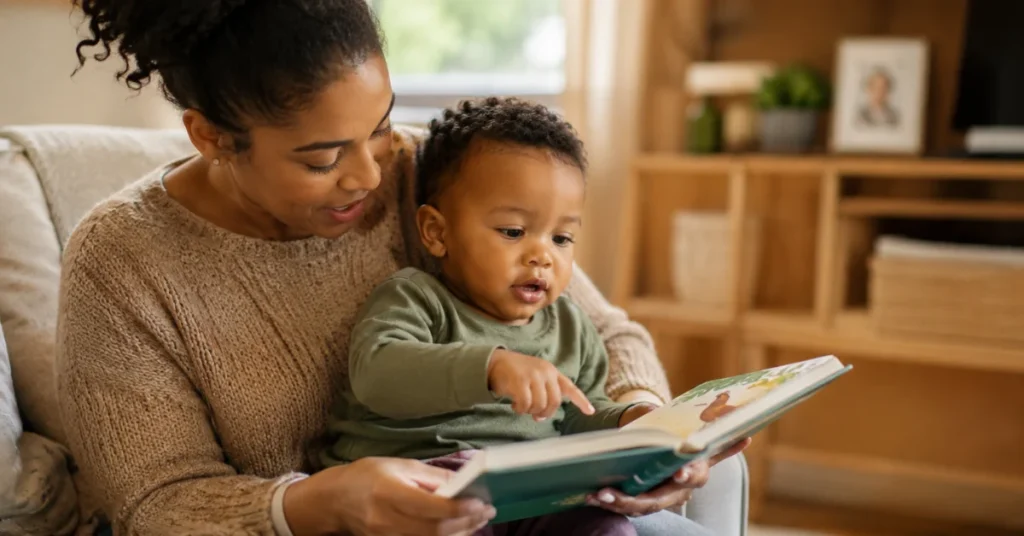
If your real goal is figuring out how to get someone to say baby, or any first word for that matter, these are the habits that consistently help.
- Narrate everything. Talk through what you’re doing as you change, feed, or bathe your child. “Now we’re putting on your socks.” It sounds silly. It works.
- Repeat, don’t correct. If your baby says “ba” for bottle, respond with “Yes, bottle!” rather than pushing for the perfect pronunciation.
- Read out loud daily. Even board books with three words a page build vocabulary exposure long before a child can talk back.
- Respond to babbling like it’s a real sentence. Pause, make eye contact, react. Turn-taking teaches the rhythm of conversation.
- Use gestures alongside words. Waving while saying “bye-bye” or clapping during “yay” links the physical action to the sound.
- Cut back on passive screen time. Background TV and video content don’t teach language the way face-to-face interaction does, especially under 18 months.
- Say the target word often, in context. If you want your baby to say “baby,” point to a photo, a doll, or a sibling and say it clearly, then pause and wait.
None of these guarantee a specific word on a specific day. What they do is stack the odds in your favor and give your child every reasonable chance to catch on.
Common Mistakes Parents Make While Waiting
A few habits quietly slow things down, and most parents don’t realize it until later.
Talking in an overly simplified, repetitive baby voice for too long past the first year can actually limit vocabulary growth. Toddlers benefit from hearing full, natural sentences once they’re past the newborn stage. Another common one: jumping in to answer for the child before they attempt a sound themselves. Waiting an extra few seconds after asking a question gives a baby room to try.
Comparing siblings or other children’s timelines out loud, in front of the child, doesn’t help either, though it’s an understandable instinct. Every child who has gone through this stage moves at their own pace, and pressure rarely speeds anything up.
When to Talk to a Pediatrician
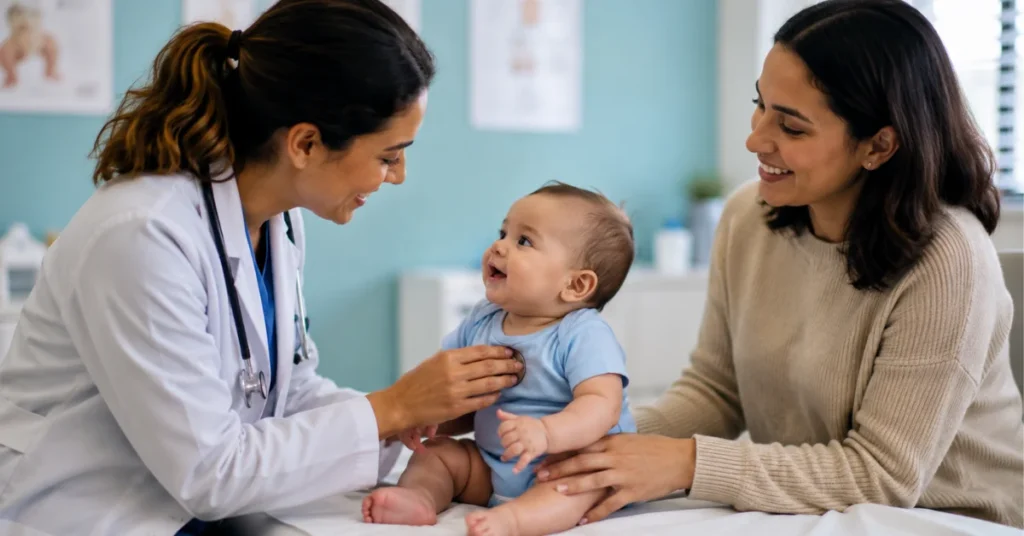
Most delays in early speech resolve on their own with time and everyday interaction. That said, there are specific flags worth mentioning at a checkup:
- No babbling or consonant sounds by 9 months
- No single words by 16 to 18 months
- Not responding to their own name by 12 months
- Loss of previously used words or sounds at any age
As many as 3 out of 1,000 newborns have hearing loss, which can delay speech development, which is part of why hospitals screen for it right after birth. If your baby didn’t pass an initial hearing screening, a full hearing exam by 3 months is worth scheduling.
How to Get Someone to Say Baby If They’re a Toddler, Not an Infant
Not everyone asking this question has a newborn. Some parents are dealing with a toddler who’s already 20 months old and still hasn’t said much of anything. That’s a different situation, and it deserves different advice.
For a toddler who understands plenty but isn’t producing words yet, the focus shifts toward modeling short phrases instead of single words, offering choices (“Do you want milk or juice?”) to prompt a response, and reducing the temptation to hand over items before the child attempts to ask.
Bilingual households often see a slightly later start to spoken words in either language, though total vocabulary across both languages combined typically tracks close to monolingual peers. Parents raising twins frequently notice one twin talking earlier while the other relies on gestures or “twin talk” longer; this is common and usually evens out. And for parents of preemies, pediatricians generally recommend adjusting the milestone timeline based on due date rather than birth date for the first two years.
What the Research Shows
Detailed tracking of childhood development gives a clearer picture than anecdotes alone. As many as 17% of children in the U.S. have a developmental or behavioral disability, including speech and language delays, according to WebMD’s review of pediatric data. Separately, CDC’s “Learn the Signs. Act Early.” program notes that roughly 1 in 6 children has a developmental delay or disability of some kind, which is a large part of why routine milestone checklists exist at every well-child visit.
Interest in early speech development content has grown steadily through 2025 and into 2026, as more parents track milestones through apps and pediatric visits rather than relying on guesswork. That shift toward structured tracking, rather than vague comparison with other kids, tends to catch genuine delays earlier and reduce unnecessary worry over normal variation.
Who Should Pay Closest Attention to This Milestone
First-time parents tend to worry the most and benefit from knowing the range is wide. Parents of preemies should track adjusted age rather than calendar age. Adoptive parents and foster parents, especially those caring for a child who joined the family after infancy, may see speech catch-up happen faster than expected once a stable, language-rich environment is in place. Daycare providers and grandparents providing regular care should stay consistent with the same encouragement techniques used at home, since consistency across caregivers speeds recognition of words.
Final Thoughts
At the end of it all, learning how to get someone to say baby, whether that “someone” is your infant, your toddler, or even a stubborn two-year-old who prefers pointing to talking, comes down to patience paired with consistent, responsive interaction. There’s no shortcut that replaces daily conversation, reading, and genuine attention to every sound your child makes. Keep narrating, keep responding, and keep track of milestones without turning every week into a scoreboard. The words come. Almost always, they come.
This article is for informational purposes only. Always consult a qualified pediatrician or speech-language pathologist for concerns about your child’s development.
FAQs
At what age do most babies say their first word?
Most babies say a recognizable first word somewhere between 8 and 14 months, with many landing right around their first birthday.
Should I worry if my baby isn’t talking by 12 months?
Not necessarily. Milestones cover what most children, roughly 75% or more, can do by a given age. If your baby is babbling, responding to their name, and using gestures, that’s a good sign, but mention any concern at your next checkup.
Does talking to my baby in a high-pitched voice help or hurt speech development?
A slightly higher, exaggerated tone (“parentese”) actually helps very young infants tune in to speech sounds. Past the first year, mixing in normal sentence structure supports vocabulary growth better than sticking with simplified baby talk indefinitely.
Can screen time delay a baby saying their first word?
Passive screen exposure doesn’t build language skills the way live, face-to-face interaction does. Most pediatric guidance recommends limiting screens before 18 months to video calls with family.
What’s the difference between a speech delay and a language delay?
A language delay means a child struggles to combine words into phrases, even if pronunciation is fine. A speech delay means the child has ideas and words but is hard to understand. Both are worth discussing with a pediatrician if they persist.