
The Surprising Truth About Baby Color Vision
Here’s what catches most new parents off guard: your newborn isn’t seeing the world in grayscale anymore within just a few weeks. You’ve probably heard the myth that babies see only black and white for months—and while there’s a kernel of truth there, the actual story is far more fascinating. When can babies see red is one of those questions that reveals just how rapidly an infant’s vision develops during those first critical months of life.
The moment your baby opens their eyes at birth, they’re not experiencing the colorful world you see. But this limitation doesn’t last long. Within the first weeks, something remarkable begins to shift in their visual system. That stunning red blanket your friend gave you? Your baby will notice it soon—much sooner than you might expect.
What Exactly Happens With Baby Color Vision
Understanding when can babies see red requires understanding how vision works at a fundamental level. Your eyes contain three types of cone cells—specialized photoreceptors in the retina. These cones detect different wavelengths of light. Long wavelengths (which we see as red) are detected first in babies because the cones responsible for these wavelengths develop most rapidly.
At birth, your baby’s cone cells aren’t fully mature, and the neural pathways connecting their eyes to their brain are still completing their development. The optic nerve is still myelinating—essentially insulating itself for faster signal transmission. This is why newborns see mostly in shades of gray, with some ability to detect very high-contrast objects like black against white.
But here’s where it gets interesting: this black-and-white phase lasts only a few weeks, not months.
The Month-by-Month Timeline for When Can Babies See Red
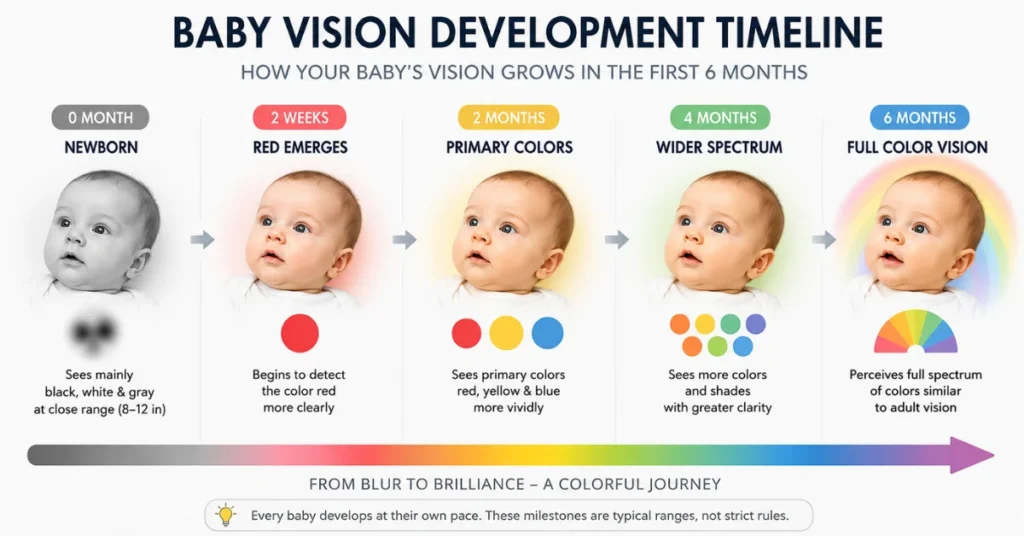
Weeks 1-2: The Gray Beginnings
Your newborn arrives seeing mostly contrast and brightness. Their vision extends roughly 8-12 inches from their face—perfect for looking at you while feeding. Red isn’t yet distinguishable from other colors. What they’re detecting instead are differences in light intensity and high-contrast edges. This is why black-and-white patterns capture their attention so effectively during these early days.
Week 2-4: Red Emerges
This is when the magic starts. Research shows that by around 2-3 weeks of age, babies begin to detect red. This isn’t full color vision yet—their perception is still limited and crude. But the L-cones (long-wavelength cones responsible for red detection) are becoming functional, and signals are beginning to reach their visual cortex. Your baby might not consciously “see” red the way you do, but their brain is responding to it differently than to other colors.
2-3 Months: High-Contrast Color Response
By around 8 weeks, when can babies see red becomes a more confident “yes.” They’re not just detecting it—they’re starting to prefer looking at it. Babies at this age respond strongly to high-contrast primary colors: red, yellow, and blue. Their visual system is tuned to these bold hues because they provide the strongest signal to their still-developing color processing pathways. Parents often notice their baby gazing longer at red toys or clothing during this window. This is also when babies start tracking objects more deliberately with their eyes.
This is also when green begins to register. Research published in developmental psychology shows that the red-green color mechanism (mediated by specific cone-opponent channels in the brain) develops first. The blue-yellow mechanism develops a few weeks later, which is why blue and yellow responses lag slightly behind.
3-4 Months: Color Differentiation Deepens
Around 3-4 months, something important shifts. Your baby can now start noticing differences in shades of the same color. They can distinguish between a scarlet red and a brighter red. More importantly, by 3 months, most babies have achieved trichromatic vision—meaning all three cone types are actively signaling to the brain. Red, green, and blue are all accessible to them now.
4-6 Months: Near-Adult Color Vision
By 4-5 months, your baby’s color vision is largely developed. They can see most colors with reasonable clarity, though their perception still isn’t as sharp as an adult’s. A fascinating development happens around 5-7 months: categorical color perception emerges in the brain. This means your baby begins grouping similar hues together mentally—understanding that different shades of red all belong to the “red” category—before they can speak or name colors.
6-12 Months: Refinement and Preferences
By 6 months, your baby’s color vision is remarkably similar to an adult’s. They can distinguish subtle color differences and are developing visual preferences. Some babies show stronger attraction to certain colors, though whether this is innate or learned through exposure isn’t entirely clear.
What the Research Shows
Color vision development follows a predictable neurological timeline. Studies using visual evoked potentials (special electrodes that measure electrical brain activity) demonstrate that red-green color channels develop first, activated by 4-6 weeks of age. The blue-yellow channels follow a few weeks later.
Brain imaging research reveals another layer: before babies can actually see colors distinctly, their brains are learning something crucial about visual organization. This period of color development coincides with improvements in figure-ground segregation—the ability to separate an object from its background. Once color processing comes online, babies gain a powerful new tool. A red toy on a green blanket suddenly becomes easier to perceive, not just because of brightness differences but because of the hue contrast itself.
Research also shows that color preferences emerge gradually. Early studies suggest babies aren’t born preferring specific colors, but they consistently respond more strongly to red and yellow. This likely reflects both biological factors (these colors create the strongest signals in immature visual systems) and their high brightness relative to other hues.
Why Red First? The Science Behind It
The question of why babies see red first has a definitive answer rooted in physics and biology. The L-cones (long-wavelength cones) that detect red light develop more rapidly than other cone types. Additionally, red light has longer wavelengths, which require less neural processing sophistication than shorter wavelengths like blue.
There’s also a brightness component. Red and yellow appear brighter to developing visual systems than other colors. Your baby’s visual system is optimized for detecting whatever creates the strongest, clearest signal—and at this early stage of development, that’s red.
When Green and Blue Appear
Green emerges around the same time as red strengthens (2-4 months), but blue development follows a slightly different timeline. The S-cones (short-wavelength cones responsible for blue) are the last to reach functional maturity. While some blue sensitivity appears by 2 months, full blue discrimination typically doesn’t emerge until around 2-3 months, with increasing sensitivity through 4-6 months.
This staggered development explains why high-contrast red-yellow combinations grab a young baby’s attention more effectively than blue objects during the first months of life.
How Your Baby’s Brain Processes Color
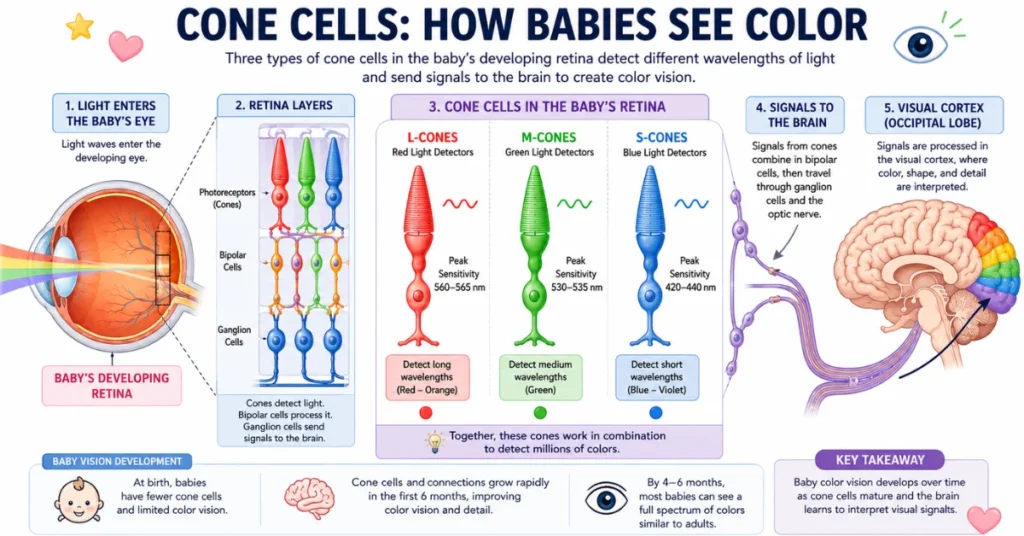
It’s not just about the eyes—it’s about the brain behind them. When you look at red, your brain doesn’t simply register “red.” Instead, your visual cortex processes the signal through two competing pathways: red-green and blue-yellow. These color-opponent channels work together to create your rich color perception.
In babies, these pathways develop sequentially rather than simultaneously. The red-green channel becomes active first. This explains why babies respond to red so early—their brains have the necessary neural machinery in place. The blue-yellow channel, developing later, requires additional weeks of neural maturation.
Another important development: color constancy. This is your brain’s ability to recognize a color as the same color under different lighting conditions. A red shirt looks red whether you see it in daylight or lamplight. Babies don’t have this ability initially. Research suggests color constancy develops over the first year of life, with significant advances by 6-8 months.
Practical Ways to Support Your Baby’s Color Vision Development
For Newborns (0-4 Weeks)
Start with high-contrast black-and-white patterns. While your newborn’s color vision is developing, these stark contrasts are what they can process most effectively. Keep items 8-12 inches from their face, within their optimal focal range.
For 1-2 Month Olds
Introduce bright red objects prominently. Red cards, red blankets, red toys—anything in vivid red will capture your baby’s emerging color perception. Pair red with black or white for maximum contrast.
For 2-4 Month Olds
Expand to the primary color trio: red, yellow, and blue. Use high-saturation versions of these colors (bright, not muted). Mobiles with these colors are particularly effective because movement + color keeps attention engaged. Read picture books with bold, simple illustrations in primary colors.
For 4-6 Month Olds
Add more color variety as your baby’s perception expands. Introduce oranges, greens, and other secondary colors. Pointing out colors and naming them—”Look at the red ball!”—begins building color vocabulary recognition, though your baby won’t speak these words for many months.
Common Questions Parents Have About When Can Babies See Red
Will my baby be colorblind if they don’t respond to colors?
Not necessarily. Babies develop color vision on individual timelines, and testing in the first months is unreliable because they can’t communicate what they’re seeing. If you have family history of color blindness, mention this at pediatric checkups. Formal testing is usually possible after age 3-4 years.
Why does my baby seem more interested in black and white?
This is completely normal through month 2. Black-and-white patterns create the strongest contrast signals in a newborn’s visual system. As color vision develops, interest gradually shifts toward colors, but high-contrast patterns remain engaging.
Does lighting affect how babies see colors?
Yes. Babies’ pupils are smaller, and their rod cells (which handle low-light vision) are still developing. Bright daylight conditions make colors easier for babies to perceive than dim indoor lighting. Natural light windows are excellent times for color-focused activities.
When should I be concerned about my baby’s color vision?
Contact your pediatrician if by 3 months your baby shows no response to any colors, or by 4-5 months they don’t seem to see as well as before (which could indicate other visual issues). Extreme light sensitivity or constant eye deviation also warrant professional evaluation.
Looking Ahead: Color Vision Beyond Infancy
Your baby’s color vision continues refining through the toddler years. By age 3, most children can identify and name colors. By age 5, their color vision is essentially equal to adults’. Visual acuity continues improving until around age 7-10 when the entire visual system reaches adult-level development.
The remarkable journey from perceiving only gray through black-and-white contrast to seeing the full spectrum happens in those first months of life. Understanding when can babies see red—and appreciating the sophisticated neurology behind it—helps you support this crucial developmental milestone.
This article is for informational purposes only and is not a substitute for professional pediatric advice. Always consult your pediatrician with questions about your baby’s visual development.
FAQs
Q: Is it true that babies see only in black and white?
A: Only very briefly. Newborns see primarily in high contrast (black and white), but this phase lasts just a few weeks. By 2-4 weeks, red detection begins, and full color perception develops progressively over the first 5-6 months.
Q: What’s the first color babies can see?
A: Red is consistently the first color babies can distinguish, typically emerging by 2-3 weeks of age. This happens because the cones detecting red light wavelengths mature faster than other cone types.
Q: Can babies born prematurely see colors differently?
A: Color vision development follows the baby’s adjusted age (calculated from their due date, not birth date) during the first 2-3 years. A baby born 2 months early would show color vision milestones about 2 months later than a full-term baby.
Q: Do all babies develop color vision on the same timeline?
A: There’s natural variation. Most babies show red detection between 2-4 weeks, but some develop slightly earlier or later. As long as color vision is developing by 3-4 months, this is considered normal.
Q: Why do toy companies make so many red baby toys?
A: They’re responding to developmental reality. Red is not just the first color babies can see—it’s also highly visible to their immature visual systems. Red toys and products genuinely capture babies’ attention better than other colors during early months.