
Pull a batch of drumsticks out too early and you’ll know it the second you cut in: pink near the bone, juices running cloudy instead of clear. So how long to cook chicken legs in oven really depends on your temperature setting, not just a single number pinned to the fridge. At 400°F, most drumsticks are done in 40 to 45 minutes. At 425°F, that drops to roughly 35 to 40. Leg quarters, being thicker and heavier, need closer to 50 to 55 minutes no matter which of those settings you pick.
Anyone who has roasted a full tray of legs on a Sunday knows the timer is only half the story. The other half is what’s happening inside the meat, and that’s where a lot of home cooks get it wrong.
How Long to Cook Chicken Legs in Oven at 400°F
Four hundred degrees is the setting most recipe developers land on, and for good reason. It’s hot enough to render the skin without drying out the meat before the inside catches up.
At this temperature, plain drumsticks typically need 40 to 45 minutes. Leg quarters, which include the thigh and carry more bone and connective tissue, usually run 50 to 55 minutes. Flipping the pieces once around the halfway mark helps the skin brown evenly on both sides instead of just the top.
Here’s the part that trips people up: how long to cook chicken legs in oven at 400°F isn’t fixed. Cold chicken straight from the fridge behaves differently than chicken that’s had 20 minutes to lose its chill on the counter. Skip that step and you’re often looking at another 10 to 15 minutes before the center catches up, which means the skin can scorch while the middle is still working through the danger zone.
How Long to Cook Chicken Legs in Oven at 425°F
Bump the oven to 425°F and cook time shortens, but the margin for error shrinks with it. Drumsticks generally finish in 35 to 40 minutes at this setting, and the higher heat gives a firmer, more aggressively browned skin — good for a plain salt-and-pepper rub, less ideal for anything with a sugary glaze that can scorch before the meat finishes.
Leg quarters at 425°F still need 45 to 50 minutes, since the extra mass slows how fast heat reaches the bone. Pieces of similar size cook more evenly together, so it’s worth sorting the tray before it goes in rather than mixing a few oversized quarters in with smaller drumsticks.
Why Internal Temperature Beats the Clock
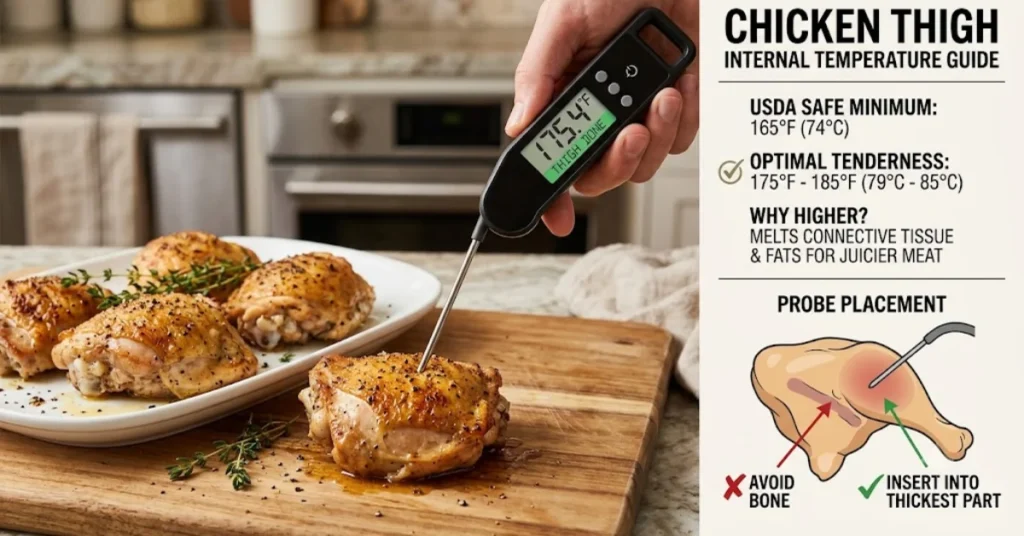
None of these numbers replace an instant-read thermometer, and that’s not a minor caveat — it’s the difference between a safe dinner and a genuine risk. Chicken is safe once it hits 165°F at the thickest part, measured away from the bone. That’s the baseline set by food safety guidelines, not a suggestion.
But safe and best aren’t the same thing. Drumsticks and thigh meat carry more connective tissue than a chicken breast, and that tissue needs a higher temperature to break down into something tender. Cooks who’ve made hundreds of trays of legs tend to pull them closer to 185°F to 195°F, well past the safety line, because that’s where the meat stops being merely done and starts falling off the bone.
There’s also carryover cooking to account for. Chicken left to rest for five to seven minutes after coming out of the oven continues climbing another 3 to 5 degrees on its own. Pulling drumsticks at exactly 165°F often means they overshoot to 168°F or higher by the time you’re ready to plate, which can tip already-lean pieces toward dry.
Getting Crispy Skin Every Time
Crispy skin comes down to moisture control more than anything else. Wet skin steams instead of browning, so patting the legs dry with paper towels before seasoning matters more than most people realize.
A wire rack set inside the baking sheet also makes a noticeable difference. It lets hot air circulate under the chicken instead of trapping steam against the pan, which is often why oven-baked legs come out soggy on the bottom even when the tops look perfect.
Convection settings help too. Anyone who has switched from a standard bake to convection roast at 375°F, about 25 to 50 degrees below the equivalent standard-bake temperature, usually notices tighter, crisper skin along with a slightly shorter cook time thanks to the circulating air.
Common Mistakes That Ruin Chicken Legs in the Oven
A few habits show up again and again in home kitchens, and each one throws off timing in a different way.
- Skipping the temper step. Chicken straight from the fridge cooks unevenly, with the surface racing ahead of the center.
- Crowding the pan. Legs touching each other steam instead of roast, which softens the skin.
- Relying on the clock alone. Oven accuracy varies more than most people expect, sometimes by 15 to 25 degrees.
- Rinsing raw chicken. This doesn’t improve safety and can spread bacteria across the sink and nearby surfaces.
- Cutting into the meat to check doneness. It lets juices escape and still doesn’t confirm the internal temperature reliably.
Fixing even two or three of these is usually enough to turn an inconsistent tray into a reliable one.
What the Research Shows
Food safety data is consistent on one point: color is not a reliable doneness indicator. Chicken can stay pink near the bone even after reaching a safe internal temperature, particularly in younger birds, and that pigment change has more to do with hemoglobin reacting to heat than with actual safety. A thermometer reading is the only measurement that actually confirms the chicken is done.
Detailed analysis of oven-roasting methods also points to a consistent pattern: pieces cooked on an elevated rack brown more evenly than those left flat on a sheet pan, because trapped moisture underneath the meat is the main reason for uneven skin texture. That single change shows up repeatedly across tested methods, regardless of which oven temperature is used.
Cooking for Different Kitchens and Needs
Not every reader is working with a standard full-size oven. Toaster ovens and countertop convection models cook hotter and faster in a smaller cavity, so drumsticks in those appliances often finish 5 to 10 minutes ahead of a full-size oven at the same temperature setting. Checking at the earlier end of the range prevents overcooking.
For anyone cooking from frozen, the safe approach is thawing in the refrigerator, in cold water, or in the microwave, never on the counter at room temperature. Frozen legs placed directly in the oven need significantly longer, and the outside can dry out before the center reaches a safe temperature, so thawing first is the more reliable route.
Meal preppers batch-cooking for the week often ask how long to cook chicken legs in oven when doubling a recipe across two trays. The answer: rotate the trays halfway through and add roughly 5 minutes total, since two pans changes how air moves through the oven even with convection running.
Conclusion
There’s no single stopwatch number that answers how long to cook chicken legs in oven for every kitchen, every oven, and every cut. What holds steady is the internal temperature target, the value of a wire rack, and the habit of checking with a thermometer instead of guessing from color. Get those three things right, and 400°F to 425°F will reliably turn out chicken legs with crisp skin and meat that pulls cleanly from the bone, in 2026 kitchens using standard ovens, convection settings, or countertop models alike.
FAQs
Is it better to bake chicken legs at 400°F or 425°F?
Both work well. 400°F gives a slightly longer, more forgiving cook, while 425°F finishes faster with a firmer, darker skin. Either way, confirm doneness with a thermometer rather than relying on the timer alone.
Why are my chicken legs still pink near the bone even though they’re done?
This is a common and generally harmless reaction between hemoglobin in young chicken and oven heat. As long as the internal temperature reads 165°F or higher at the thickest part, the meat is safe to eat.
Do chicken leg quarters take longer than drumsticks?
Yes. Leg quarters include the thigh and carry more mass and a thicker joint, so they typically need an extra 10 to 15 minutes compared to drumsticks at the same oven temperature.
Should I cover chicken legs with foil while baking?
Covering traps steam and softens the skin, so it’s better left uncovered for most of the cook. Foil can help if the skin is browning faster than the inside is cooking, tented loosely for the final stretch.
Can I cook chicken legs from frozen?
It’s safer to thaw first in the refrigerator, cold water, or the microwave. Cooking from frozen extends the time significantly and raises the risk of the outside overcooking before the center reaches a safe temperature.