
Twenty-five years after a sorority girl walked into Harvard Law School on screen, the Legally Blonde cast has become one of Hollywood’s most celebrated ensembles. But this isn’t just a story about a beloved comedy—it’s the story of how one film became a career launchpad that would define the next quarter century for actors who took a chance on Amanda Brown’s fashion-forward narrative. In 2026, with the franchise returning to theaters for anniversary screenings and Legally Blonde 3 in pre-production, it’s worth examining how each member of this ensemble shaped the industry while the industry shaped them right back.
The magic of Legally Blonde cast members lay not in their fame before 2001, but in their willingness to commit fully to characters that might have felt one-dimensional on the page. What emerged was something unexpected: proof that comedy could carry genuine depth, that stereotypes could be shattered through humor rather than preaching, and that audiences were ready to embrace stories centered on women’s agency and friendship. The ripple effect has been undeniable.
How the Legally Blonde Cast Redefined Career Trajectories in Comedy
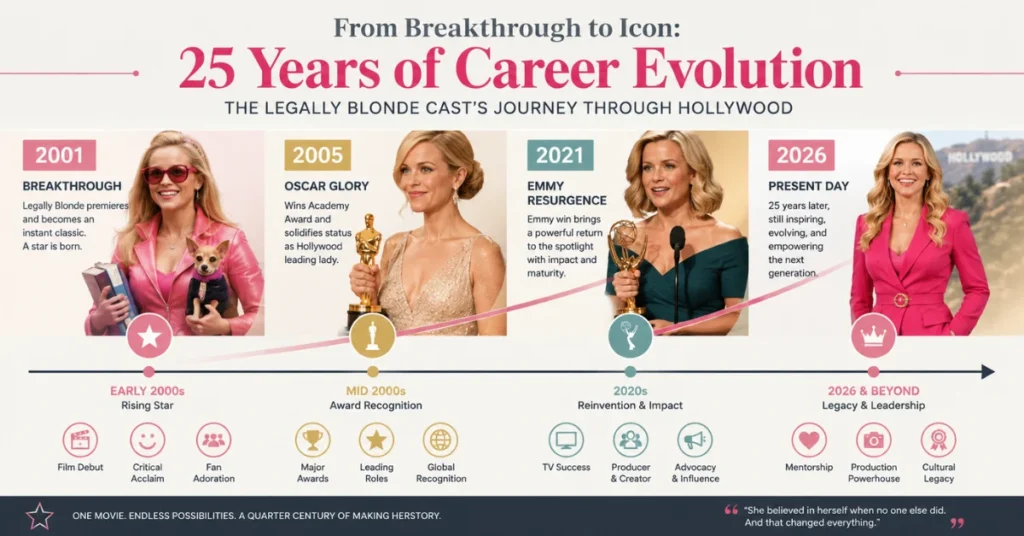
Reese Witherspoon’s path is perhaps the most documented. Before Elle Woods, Witherspoon was known for Cruel Intentions and Election—smart choices that showed range, but films that hadn’t yet positioned her as a leading bankable star. Legally Blonde changed the conversation overnight. That opening weekend gross of $20 million wasn’t just business success; it was permission. Permission for studios to greenlight female-led comedies. Permission for Witherspoon to negotiate roles differently. Permission to fail gracefully later and still bounce back.
What’s remarkable about Witherspoon’s post-Legally Blonde trajectory is the control she exercised. She didn’t chase instant blockbusters after her initial success. Instead, she balanced romantic comedies like Sweet Home Alabama with deliberately risky choices—Walk the Line (2005), which won her an Academy Award, proved she wasn’t willing to be typecast as the funny blonde. Wild (2014) earned her another Oscar nomination, placing her among Oscar’s most nominated actresses. By the 2020s, she’d shifted entirely toward production and executive power, launching Hello Sunshine into a media empire generating hundreds of millions in deals.
The Legally Blonde cast around her benefited from the same cultural permission the film granted. When audiences laughed at Paulette’s hair perm jokes and heart-centered loyalty, they weren’t laughing at her—they were laughing with her. That distinction mattered.
The Career Resurgence of Jennifer Coolidge and the Art of Reinvention
Jennifer Coolidge’s story with the Legally Blonde cast offers a different lesson: sometimes dormancy isn’t death. After Legally Blonde and American Pie established her in the culture, the 2000s and 2010s saw her work steadily but without major recognition. She appeared in sitcoms, guest spots, and films that came and went. By 2020, she was working regularly but rarely in the spotlight.
Then came The White Lotus in 2021. Playing Tanya McQuoid—a wealthy, fragile, complex woman drowning in her own privilege—Coolidge delivered a performance that earned her two Primetime Emmy Awards and reshaped how the industry saw her. Suddenly, critics and peers were reassessing her earlier work through a new lens. The comedic timing that made Paulette memorable wasn’t just funny—it was the product of an actress with real emotional intelligence. At 64 years old in 2026, Coolidge commands her choice of projects. She’s filming Girl Group with Rebel Wilson, heading back to reprise Paulette in Legally Blonde 3, and continuing to appear in major productions like Minecraft, where she joins Jason Momoa and Jack Black.
Her journey demonstrates that being part of the Legally Blonde cast created a permanent cultural footprint—one that couldn’t be erased even during decades of being overlooked. When Hollywood finally caught up to what audiences already knew, that goodwill from the 2001 film was still there, waiting to be rediscovered.
Luke Wilson, Victor Garber, and Supporting Brilliance
The supporting members of the Legally Blonde cast constructed a different kind of success. Luke Wilson’s Emmett became the face of a particular type of charming leading man—the kind you root for not because he’s conventionally powerful, but because he’s genuinely good. That archetype defined his career choices from there forward. He continued in romantic comedies, character-driven dramas, and eventually shifted toward television with projects like Veep, showing audiences a darker edge beneath that affable exterior.
Victor Garber brought gravitas to Professor Callahan, suggesting complexity and moral corruption beneath an esteemed surface. Garber’s resume reads like a master class in professionalism: Argo, Titanic (1997), Alias, Legends of Tomorrow. His presence in Legally Blonde grounded the comedy, preventing it from floating entirely into satire. That ability to anchor ensemble casts became his signature in Hollywood.
Selma Blair, Ali Larter, and the Value of Complex Female Characters
Selma Blair’s portrayal of Vivian—the initially snobbish fellow student who becomes genuine friend material—allowed for something the Legally Blonde cast executed beautifully: character arcs that felt earned within comedy. Blair went on to tackle dramatic roles in Hellboy, Brown’s Requiem, and television work that showcased her range. Similarly, Ali Larter’s Brooke Taylor Windham proved that comedic timing and intelligence don’t require physical perfection or emotional availability. She became essential casting in both comedy and action franchises, including Resident Evil and Heroes, demonstrating staying power that few actors achieve.
What the Research Shows
According to career trajectory analysis in entertainment industry, actors who break through in ensemble comedies with strong female presences experience longer careers and more diverse role options than those in male-dominated comedies. The Legally Blonde cast exemplifies this trend—each member has worked consistently for 25 years, with most achieving significant industry recognition beyond their breakthrough roles. Witherspoon’s production company alone reportedly generates revenues exceeding $900 million annually as of 2026, while Coolidge’s career renaissance mirrors broader industry patterns where female actors over 60 are increasingly being cast in complex, leading roles.
The Franchise Continues: Legally Blonde Cast Returns in 2026
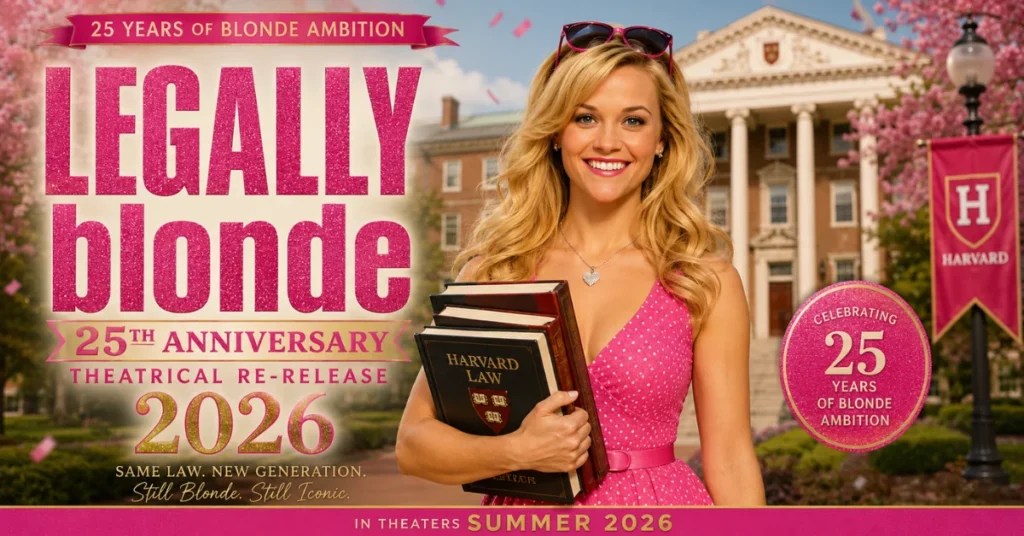
As Legally Blonde 3 enters pre-production, both Witherspoon and Coolidge have confirmed their return. The original Legally Blonde cast reunion carries weight that most sequels can’t generate—these aren’t just actors playing characters anymore; they’re returning to roles that shaped their actual identities in the culture. Witherspoon is expected to also star in the Elle prequel series launching on Prime Video in 2026, which explores Elle’s high school years with a new cast.
The 25th anniversary theatrical re-releases happening in 2026 have sparked genuine cultural conversation. Younger audiences discovering the film for the first time are surprised by how modern it feels—its feminist subtext about education, ambition, and female friendship hasn’t aged, because those themes were never trendy. They were always fundamental.
FAQs
Who plays Elle Woods in Legally Blonde?
Reese Witherspoon plays Elle Woods in the original 2001 film and its 2003 sequel. She’s set to reprise the role in Legally Blonde 3, currently in pre-production.
Is Jennifer Coolidge returning for Legally Blonde 3?
Yes, Jennifer Coolidge has confirmed she’ll return as Paulette Bonafonté in the third installment of the franchise. She won two Emmy Awards for her role in The White Lotus and continues to take on major film and television projects.
Where is the Legally Blonde cast now in 2026?
Members of the Legally Blonde cast have pursued diverse careers. Witherspoon leads Hello Sunshine media company, Coolidge recently won critical acclaim in The White Lotus, Luke Wilson works in television, Victor Garber appears in major film and TV productions, and other cast members continue working across film, television, and stage.
What happened to the Legally Blonde cast after the original films?
The Legally Blonde cast members pursued different paths—some focused on comedy, others transitioned to drama, several became producers and executives. Many took supporting roles in major films and series, while others maintained lower profiles before experiencing career resurgences later. All have maintained consistent work in Hollywood.
Is there a Legally Blonde musical and who starred in it?
Yes, a musical adaptation premiered on Broadway in 2007 with different casting. The production later toured and had international runs, including London’s West End with Sheridan Smith as Elle. The stage musical introduced new audiences to the story while the original Legally Blonde cast from the films continued their separate careers.