
There’s a particular kind of kitchen chaos that comes with frying turkey bacon on the stovetop: grease flicking onto your shirt, one strip burning while the other stays pale and floppy, and a pan you’ll be scrubbing for ten minutes afterward. Learning how to cook turkey bacon in the oven fixes all of that in one move, and once you’ve done it a couple of times, you probably won’t go back to the skillet.
The oven method works because it surrounds every strip with even, steady heat instead of one hot spot under a pan. That’s the whole trick behind why this method has become the go-to for anyone who’s tired of standing guard over a sizzling skillet.
How to Cook Turkey Bacon in the Oven (Step-by-Step)
Here’s the version that works across most standard home ovens, adjusted from what turns up consistently across professional and home-tested recipes.
What you’ll need:
- A rimmed baking sheet
- Parchment paper, foil, or a wire cooling rack
- A pack of turkey bacon (thinner cuts cook faster than thicker ones)
Steps:
- Preheat the oven to 400°F. Give it the full preheat time — a half-heated oven is the single biggest reason people end up with soggy, undercooked strips.
- Line your baking sheet. Parchment gives the cleanest release; foil sprayed lightly with oil works almost as well.
- Pat the bacon dry with a paper towel first. Turkey bacon often comes packed in a bit of liquid, and that extra moisture is what keeps it from crisping.
- Lay strips in a single layer, not touching. Crowded strips steam instead of crisp.
- Bake for 12 to 15 minutes, flipping once around the halfway mark if you’re not using a wire rack.
- Watch, don’t just time it. Ovens vary enough that the same recipe can run five minutes fast or slow from one kitchen to the next.
That’s the entire method. No oil, no splatter guard, no standing over a pan.
Best Oven Temperature and Timing Guide
Different temperatures give different results, and this is where most confusion around how to cook turkey bacon in the oven actually comes from. Here’s a quick breakdown pulled from consistent patterns across tested home methods:
| Oven Temp | Cook Time | Best For |
|---|---|---|
| 350°F | 18–20 minutes | Gentler cook, less risk of burning |
| 375°F | 14–18 minutes | Balanced crisp without drying out |
| 400°F | 12–15 minutes | The most commonly recommended sweet spot |
| 425°F | 8–13 minutes | Fastest, crispiest, needs closer watching |
Higher heat gets you crispier bacon faster, but it also narrows the margin between “done” and “burnt.” Anyone who’s pulled a tray of blackened strips out at the 425°F mark knows how quickly that window closes. If it’s your first time with a particular brand, 375°F to 400°F gives you the most forgiving results.
Why Cooking Turkey Bacon in the Oven Beats the Stovetop
Pan-frying turkey bacon has three built-in problems: uneven heat, constant flipping, and grease that ends up everywhere except the pan. The oven solves each one.
Hands-off cooking. Set the timer and prep the rest of breakfast while the oven does the work.
Even results across every strip. No more pieces that are burnt on one end and raw on the other.
Bigger batches, one tray. Feeding a family or meal-prepping for the week is far faster when you’re not frying strips two at a time.
The one tradeoff worth mentioning: the oven takes a few extra minutes total compared to a hot skillet, and it doesn’t give you quite the same rendered-fat flavor you’d get from a well-seasoned cast iron pan. For most people, the cleanup savings alone make that a fair trade.
Common Mistakes When Learning How to Cook Turkey Bacon in the Oven
A few missteps show up again and again, even among people who’ve made this dozens of times:
- Skipping the preheat. Bacon placed in a cold or half-warm oven cooks unevenly and often ends up chewy instead of crisp.
- Overlapping strips. Even a small overlap traps steam and stops that spot from browning.
- Using the exact same time for every brand. Thinner cuts, like some uncured or lower-sodium brands, cook noticeably faster than thicker national brands — sometimes by five minutes or more.
- Not patting the bacon dry. Surface moisture is the enemy of crisp texture, full stop.
- Walking away completely. This isn’t a “set it and forget it forever” recipe. Check at the low end of the time range the first time you try a new brand.
Is Turkey Bacon Actually Cooked? The Safety Side
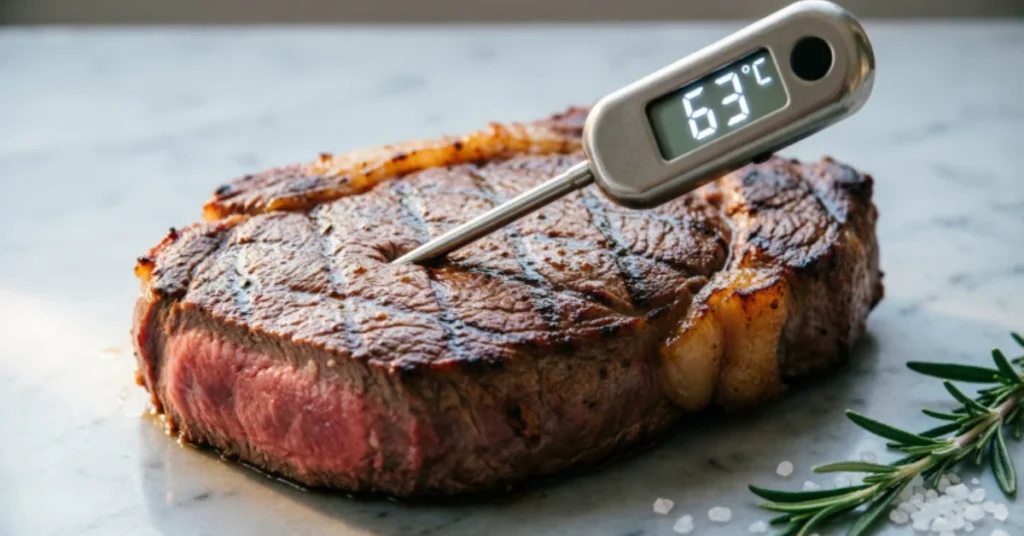
Here’s something a lot of people miss: most packaged turkey bacon is cured and smoked, not fully cooked, so it needs to be heated through before eating — unless the label specifically says “fully cooked” or “ready to eat.”
USDA guidance calls for cooking turkey bacon to well-done, at a minimum internal temperature of 165°F, as confirmed with a food thermometer. Visually, that means no pink or translucent spots and a consistent golden-brown color across the strip. If you’re checking with a thermometer for the first time, insert it into the thickest part of a strip rather than the thin, curled edges, which read hotter than the center.
What Home Cooks and Recipe Testers Notice
Detailed testing across dozens of home ovens shows the same pattern again and again: temperature consistency matters more than the exact number on the dial. Two ovens both set to 400°F can still finish bacon three or four minutes apart, simply because home ovens rarely calibrate perfectly.
Recipe testers who’ve run this method repeatedly also flag brand differences as the biggest variable. Thinner, leaner cuts crisp up fast and can go from perfect to overdone in under two minutes. Thicker cuts hold moisture longer and tend to need the higher end of any given time range.
The pattern that shows up consistently: cooks who use a wire rack over the baking sheet get more even crisping, since air can move underneath the strip instead of just around the top.
Different Ovens, Different Results
Not every kitchen has the same setup, and this method flexes for most of them.
Toaster ovens work fine for smaller batches — just shave two to three minutes off the low end of your time range, since compact ovens run hotter relative to their dial setting.
Convection ovens circulate air more aggressively, so bacon crisps faster. Start checking at the low end of whatever time range you’re using.
Standard electric or gas ovens are what most of the times above are based on, so no adjustment needed there.
Storing and Reheating Leftovers
Cooked turkey bacon holds up well for meal prep. Once it’s cooled to room temperature, an airtight container keeps it fresh in the fridge for three to five days. For longer storage, cooled strips freeze well in a sealed freezer bag for up to two months.
Reheating is quick — a minute or two in a dry skillet, or a short stint in the oven at 350°F, brings the crisp back without drying the strips out. Anyone who’s meal-prepped a week of breakfast sandwiches knows how much easier this makes weekday mornings.
Conclusion
Once you know how to cook turkey bacon in the oven, the stovetop starts feeling like the harder option. It’s less mess, more even results, and it frees up a burner for eggs or hash browns while the bacon takes care of itself. Stick to 375°F–400°F for your first attempt, watch the clock instead of trusting it blindly, and check for that golden-brown finish before pulling the tray. For 2026 and beyond, this is the method worth keeping in regular rotation.
FAQs
Is turkey bacon healthier than regular bacon?
It generally has less fat and fewer calories per strip than pork bacon, though it’s still a processed, higher-sodium food, so it fits better as part of a balanced diet than as a health food on its own.
What temperature should turkey bacon reach to be safe?
USDA guidance calls for a minimum internal temperature of 165°F, checked with a food thermometer, with no pink or translucent areas remaining.
Can I cook turkey bacon in the oven without flipping it?
Yes, if you use a wire rack set over the baking sheet — air circulates underneath the strips, so flipping becomes optional rather than necessary.
Why did my turkey bacon turn out chewy instead of crispy?
Usually it’s leftover surface moisture, an oven that wasn’t fully preheated, or strips that were overlapping on the tray.
How long does cooked turkey bacon last in the fridge?
Stored in an airtight container, it stays fresh for three to five days, and it can be frozen for up to two months if you want to prep further ahead.