
You’re staring at the clock at 5:47 AM, baby babbling happily in the crib, and wondering if this is normal. How much sleep does a 9 month old need, really? Not the internet-average version. The actual range pediatricians and sleep researchers point to.
The short answer: most 9 month olds need somewhere between 12 and 16 hours of sleep across a full day, split between nighttime sleep and two daytime naps. But that range hides a lot of nuance, and the number that matters most isn’t a chart — it’s how your own baby is functioning.
This piece breaks down the real numbers, where they come from, and what to do when your baby doesn’t match them.
How Much Sleep Does a 9 Month Old Need Each Day?
According to the American Academy of Sleep Medicine’s pediatric consensus guidelines, infants aged four to 12 months should get 12 to 16 hours of sleep per 24 hours, including naps, on a regular basis to support optimal health. That range is the benchmark most US pediatric sources, including the American Academy of Pediatrics, work from.
Guidance from the UK differs slightly in framing. A patient sleep resource published by an NHS Foundation Trust states that babies between 9 and 12 months may sleep up to 13 to 14 hours in a 24 hour period, including at least one nap during the day, and it remains common for babies this age to still wake for night feeds.
Put those two together and you get a workable middle ground: aim for roughly 13 to 14 hours as a target, treat 12 hours as a reasonable floor, and don’t panic if your baby occasionally reaches 15 or 16. Individual variation is wide at this age, and how much sleep does a 9 month old need really does shift from baby to baby depending on temperament, feeding pattern, and daytime activity level.
Nighttime Sleep: What’s Typical at 9 Months
Nighttime is where most of that total gets banked. Babies at this stage typically sleep somewhere in the 10 to 12 hour range overnight, sometimes with a brief waking that resolves without full intervention.
A few things shape how much nighttime sleep actually happens:
- Whether the baby still needs an overnight feed
- How consistent the bedtime routine is
- Whether daytime naps are long enough to prevent overtiredness
- Developmental leaps like crawling, pulling to stand, or babbling milestones
That last point catches a lot of parents off guard. A baby who was sleeping through the night at 7 months can suddenly start waking again at 9 months — not because something’s wrong, but because there’s a lot happening developmentally. Separation anxiety tends to intensify around this age too, and it can make settling back to sleep harder even when the baby isn’t hungry.
Anyone who has gone through this stage with a baby knows the frustration of a previously solid sleeper suddenly fighting bedtime. It’s common, it’s temporary, and it usually resolves within a few weeks if the routine stays consistent.
Daytime Naps at 9 Months: How Many and How Long
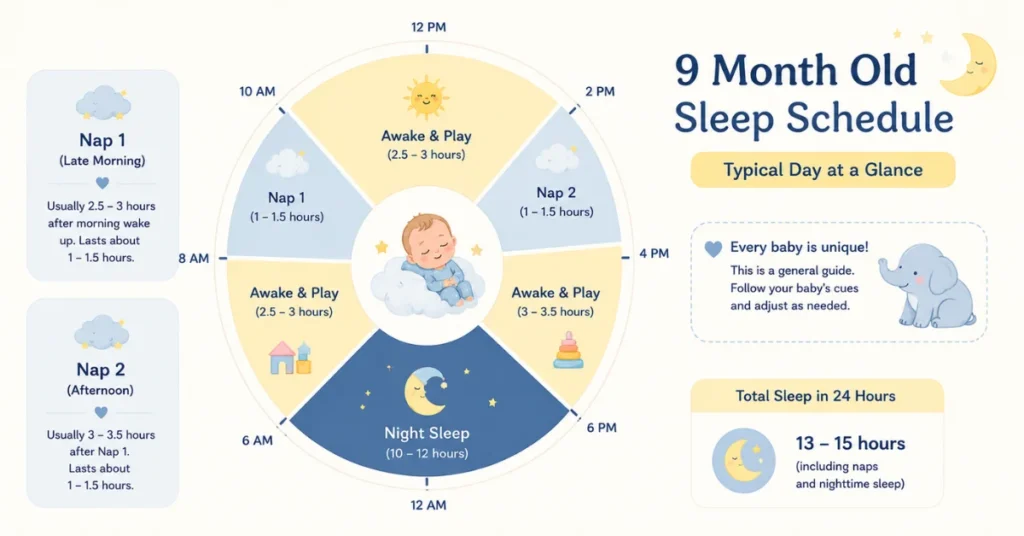
By 9 months, most babies have transitioned — or are transitioning — from three naps down to two. A typical daytime nap total lands around 2 to 3 hours, usually split into a morning nap and an early afternoon nap.
Some babies hang onto a short third catnap for a few more weeks, and that’s within the normal range too. What matters more than the exact nap count is whether the baby is getting enough total daytime rest to avoid becoming overtired by evening, since overtiredness tends to backfire into worse nighttime sleep, not better.
Wake windows — the stretches of time between sleep periods — typically run from about 2.5 to 3.5 hours at this age, with the longest stretch usually falling right before bedtime. A baby kept awake much longer than that often ends up fussier and harder to settle, not more tired in a useful way.
Why Sleep Needs Vary So Much Between Babies
Two 9 month olds can have wildly different sleep patterns and both be perfectly healthy. Some babies are naturally lower-sleep-need children who function well on 12 hours total. Others need closer to 15 or 16 to seem rested and content.
Pediatric sleep researchers generally point to mood, alertness, and feeding behavior as better indicators than the clock alone. A baby who wakes cheerful, feeds well, and hits developmental milestones on schedule is probably getting what they need — even if the total falls slightly outside the textbook range.
Growth spurts and minor illnesses also shift things temporarily. It isn’t unusual for a baby to need extra sleep during a growth spurt week, then settle back to their usual pattern once it passes.
What the Research Shows
Detailed analysis of pediatric sleep consensus data shows a consistent pattern across major health bodies: the recommended range for infants this age clusters tightly around 12 to 16 hours, with most healthy babies landing closer to the middle of that band rather than the extremes.
Research into infant sleep regression also points to a fairly predictable window. Sleep disruptions tied to developmental leaps, teething, and separation anxiety cluster heavily around the 8 to 10 month mark, which lines up with when many parents report a noticeable, temporary dip in how much a 9 month old is actually sleeping compared to a few weeks earlier.
When examining this closely, the common thread isn’t a fixed number of hours — it’s consistency of routine. Babies with a stable, repeated bedtime and nap schedule tend to self-regulate closer to their natural sleep need, even through regressions, more reliably than babies on an inconsistent schedule.
Signs Your 9 Month Old Is Getting Enough Sleep
Rather than chasing an exact hour count, watch for these signals:
- Wakes up in a generally good mood, not immediately crying or clingy
- Stays alert and engaged during wake windows without excessive fussiness
- Falls asleep at naps and bedtime within a reasonable window, not fighting sleep for 45+ minutes
- Feeds well and hits expected developmental milestones
- Doesn’t need to be woken from naps constantly to protect bedtime
If most of these hold true, the exact number matters less than parents often assume.
When to Talk to a Pediatrician
Occasional rough nights are normal at this age. But a few patterns are worth flagging to a doctor rather than waiting out:
- Consistent difficulty breathing during sleep, snoring, or gasping
- Sleep that’s disrupted for weeks with no improvement despite a consistent routine
- Signs of pain during sleep unrelated to typical teething discomfort
- Noticeable regression in developmental milestones alongside the sleep changes
This article is for informational purposes only. Always consult a qualified pediatrician or healthcare provider for concerns specific to your baby’s sleep or development.
Building a Sleep-Friendly Routine at 9 Months
A predictable bedtime routine does more heavy lifting than most parents expect. A simple sequence — bath, a short book, a final feed, then into the crib drowsy but still awake — helps the baby’s brain associate those steps with sleep rather than needing to be rocked or nursed fully to sleep each time.
Keeping the room dark, cool, and consistent also helps, especially once separation anxiety kicks in and a baby becomes more sensitive to environmental changes. A nightlight can help some babies who’ve started showing new fear of the dark, though it works against sleep for others who find it stimulating.
Conclusion

So, how much sleep does a 9 month old need? The evidence-backed range sits between 12 and 16 hours across 24 hours, with most babies settling around 13 to 14 hours split between nighttime sleep and two daytime naps. The exact number will always vary by baby, and mood and development matter more than hitting a specific figure on a chart. Watch your baby, not just the clock, and loop in a pediatrician if something feels consistently off rather than just temporarily rough.
This article is for informational purposes only. Always consult a qualified pediatrician or healthcare provider for concerns specific to your baby’s sleep or development.
FAQs
Is it normal for a 9 month old to wake up at night?
Yes. Many babies this age still wake occasionally, sometimes for a feed and sometimes due to developmental leaps or separation anxiety. It’s common and usually temporary.
How many naps should a 9 month old take?
Most babies are on two naps by this point, though some still take a short third nap for a few more weeks before dropping it.
What if my baby sleeps less than 12 hours total?
Occasional shorter days aren’t automatically a problem if mood, feeding, and development look normal. Persistent shortfalls are worth discussing with a pediatrician.
Why did my baby’s sleep suddenly get worse at 9 months?
This is often linked to the 9 month sleep regression, tied to teething, new physical milestones, and separation anxiety. It typically resolves within a few weeks.
Should I wake my baby from a long nap to protect their schedule?
If naps regularly stretch past 2 hours and start pushing bedtime too late, gently waking the baby can help keep the overall schedule on track.