
Nine months in, and you’re still doing the 2 a.m. bounce-and-shush routine. You’re not alone, and there’s a good reason so many parents start googling how to sleep train a 9 month old right around this age. By nine months, most babies are physically capable of sleeping through longer stretches, but plenty haven’t learned how yet.
That gap between can and has learned to is exactly what sleep training addresses. This guide walks through the real methods pediatric sleep experts recommend, what to expect night by night, and how to keep things safe while you do it.
Why Nine Months Is a Common Turning Point
Anyone who has parented an infant through the fourth-month regression and come out the other side knows sleep rarely stays predictable for long. Around nine months, though, something shifts. Babies are typically past the newborn feeding schedule, more physically mobile, and better able to self-soothe than they were even two months earlier.
Pediatric sleep specialists note that graduated approaches — like the Ferber method — are commonly used well into this age range and beyond, since the underlying skill being taught (falling asleep without help) doesn’t really have an expiration date. Parents who wait until nine months often find the process moves faster, simply because their baby has better motor control and a longer attention span for routine.
That said, this is also the age of separation anxiety spikes, teething, and possibly a new milestone like crawling or pulling to stand — all of which can complicate how to sleep train a 9 month old. Timing still matters, even at this stage.
The Main Methods Parents Actually Use
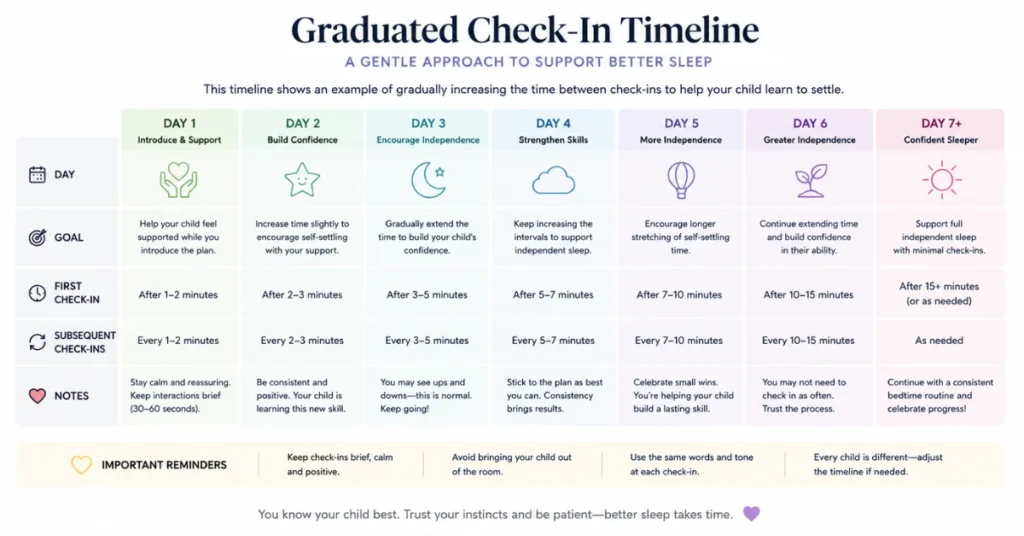
There isn’t one single “right” way to do this. Different families land on different approaches depending on temperament, tolerance for crying, and how much time they have to commit.
Ferber Method (Graduated Extinction). You put your baby down awake, leave the room, and return at timed intervals that lengthen each night. Each check-in involves brief verbal reassurance, not picking the baby up. Research reviewed by outlets like Sleep Foundation and Cleveland Clinic has found no evidence of long-term negative effects on attachment or mental health from this approach when used with healthy, typically developing babies.
Chair Method. You sit in a chair near the crib the first few nights, then gradually move it toward the door over the following week or two. It’s slower, but some parents prefer being physically present even without intervening.
Pick Up, Put Down. You pick your baby up when they cry, soothe them briefly, then put them back down awake — repeating as many times as needed. This tends to work better for younger babies, and by nine months, some kids find the repeated handling more stimulating than calming.
Full Extinction (Cry It Out). You follow the bedtime routine, say goodnight, and don’t return until morning regardless of crying. It’s the fastest method for most families, though it’s also the one that generates the most hesitation among parents.
Fading / Gentle Sleep Training. No crying-it-out at all. You gradually reduce your involvement — less rocking, less holding — over one to two weeks. It takes longer, but it’s the softest option for parents who aren’t ready for structured crying.
A comparison worth remembering: choosing between Ferber and full extinction is a bit like choosing between a staged workout program and jumping straight into a marathon. Both get you to the same finish line, but one has more built-in checkpoints.
What to Expect Night by Night
Anyone who has actually gone through this with a real baby knows the first three nights are usually the hardest, regardless of which method you pick. Crying often peaks on night two, not night one — a pattern sleep consultants call the “extinction burst.” It can feel like things are getting worse before they get better, but that dip is typically part of the normal curve, not a sign of failure.
By night four or five, most families using a graduated method start seeing shorter settling times. By the end of week one, many babies are falling asleep independently within 10–15 minutes. A minority take closer to two weeks, particularly with gentler methods, and that’s still within a normal range.
Consistency matters more than which specific method you choose. Switching approaches mid-week, or caving on night three after holding firm on nights one and two, tends to reset the clock rather than speed things up.
Safety Comes First — Every Single Night
Whatever method you choose, safe sleep guidelines don’t change. The American Academy of Pediatrics recommends placing infants on their backs, on a firm mattress, with no pillows, blankets, bumpers, or stuffed animals in the crib. Room-sharing without bed-sharing is still recommended for at least the first six months, and continuing it longer is fine if it works for your family.
If your 9 month old is a strong crawler or is pulling up to stand in the crib, childproof the room fully — anchor furniture, cover outlets, and secure blind cords — since check-ins may now involve a baby who stands up the moment the door opens.
What the Research Shows
Long-term studies on graduated extinction methods, including a well-cited Australian trial published in Pediatrics, followed families for up to five years and found no measurable difference in child mental health, attachment security, or parent-child closeness between sleep-trained kids and those who weren’t. The same research found mothers in the sleep-trained group reported meaningfully lower rates of depression at the two-year mark.
That’s a useful data point for parents worried that responding less at night somehow damages trust. The research so far doesn’t support that fear for healthy, typically developing infants.
Common Mistakes That Slow Things Down
Skipping the bedtime routine is one of the biggest ones. A consistent 15–20 minute wind-down — bath, book, dim lights — cues the brain that sleep is coming, and cutting it short undercuts everything else.
Starting sleep training during a regression, illness, or right after a schedule change (daylight saving, travel, new daycare) rarely goes well. Waiting for a stable week pays off.
Changing the plan mid-process is another common trip-up. If night one uses five-minute check-ins and night three suddenly uses one-minute check-ins because the crying got hard to hear, the baby doesn’t get a consistent signal to learn from.

Final Thoughts
Learning how to sleep train a 9 month old comes down to picking a method that matches your family’s tolerance for crying, sticking with it consistently, and keeping safe sleep basics non-negotiable throughout. There’s no perfect approach — just the one you can follow through on for two full weeks without wavering.
If your baby has any underlying health condition, feeding difficulties, or you’re simply unsure where to start, a conversation with your pediatrician before you begin is worth having.
This article is for informational purposes only. Always consult a qualified pediatrician before starting any sleep training approach, especially if your baby has health concerns, feeding issues, or a history of reflux.
FAQs
Is 9 months too late to sleep train?
No. Many pediatric sleep specialists consider 4 months through the toddler years all workable windows, and nine months is a common and effective time to start.
How long does it usually take?
Most families using a graduated method see real improvement within 3–7 nights, with full independent sleep skills typically in place within two weeks.
Will sleep training hurt my baby’s trust in me?
Long-term research following children up to five years later hasn’t found evidence of lasting harm to attachment or emotional development from graduated methods used appropriately.
What if my baby is still waking to feed at 9 months?
That’s common and not necessarily linked to sleep training readiness. Talk to your pediatrician about whether night feeds are still developmentally needed before dropping them.
Can I switch methods partway through if it’s not working?
It’s better to give one method a full week before switching. Frequent changes tend to confuse the learning process rather than speed it up.