
Can you freeze milk? Yes, and it’s a genuinely useful move when a gallon is about to expire and you’re not going to finish it. But the milk that comes out won’t behave the same as the milk that went in, and understanding why saves you from tossing a perfectly usable carton in the trash.
Here’s something most people don’t realize until they’ve stared at a lumpy, yellowish jug pulled out of the freezer: milk doesn’t stay milk once it’s frozen. It separates. It turns grainy. And no, that doesn’t mean it’s spoiled.
What Freezing Actually Does to Milk
Milk is what food scientists call an emulsion — fat, water, protein, and sugar all suspended together in a smooth, uniform mixture. Store-bought milk goes through homogenization specifically to keep that fat evenly distributed instead of rising to the top.
Freezing undoes some of that work. As the water in milk turns to ice, it forms crystals that push the fat molecules out of their neat arrangement. When the milk thaws, those components don’t automatically snap back together. What you get instead is a batch that looks watery with small clumps or a slightly gritty texture floating through it.
None of this makes the milk unsafe. It’s purely cosmetic and textural — a structural shakeup, not a spoilage sign.
Real Examples: What Frozen Milk Looks Like in Practice
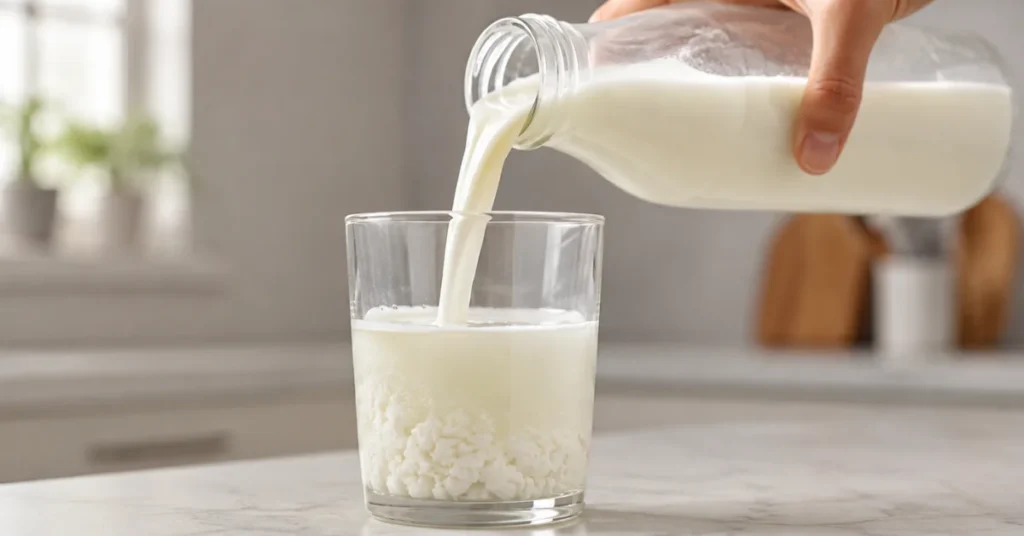
Picture a half-gallon of whole milk left in the freezer for six weeks. Pull it out, thaw it in the fridge, and you’ll likely see a thin layer of pale yellow fat sitting near the top with the rest looking thinner and more watery underneath. Give it a hard shake or run it through a blender for ten seconds, and most of that visual separation disappears.
Now compare that to skim milk treated the same way. Because there’s barely any fat to separate in the first place, skim milk usually thaws looking far closer to normal — a little thinner, maybe, but rarely grainy in any noticeable way.
Parents freezing extra milk for a toddler’s sippy cup, home bakers stockpiling milk before a holiday baking weekend, and anyone trying to stretch a bulk grocery run all run into the same pattern: the higher the fat content, the more obvious the separation once it thaws.
Can You Freeze Milk and Still Use It the Same Way?
Not exactly — and that’s the trade-off worth knowing before you commit a whole gallon to the freezer.
For drinking straight out of a glass, frozen and thawed milk is a mixed bag. Some people don’t mind the slightly altered mouthfeel after a good shake. Others notice it right away, especially with whole or 2% milk.
For cooking and baking, though, frozen milk performs almost identically to fresh. Pancake batter, muffins, mac and cheese, mashed potatoes, oatmeal, and cream-based soups all turn out fine, because the milk gets blended, heated, or mixed with other ingredients that mask any leftover texture. Smoothies are another easy win, since the blender handles the graininess automatically.
Where it struggles is anywhere smoothness has to stand entirely on its own: steamed milk for a latte, a delicate custard, or whipped cream made from previously frozen cream.
Pros and Cons of Freezing Milk
Pros:
- Cuts food waste when a carton is close to its date
- Safe indefinitely at 0°F, well past the usual one-week fridge window
- Works well pre-portioned for smoothies, coffee, or baking
- Nutrition — protein, calcium, fat — stays essentially unchanged
Cons:
- Texture separates, especially in higher-fat milk
- Not ideal for drinking straight without a shake or blend
- Takes up freezer space and needs time to thaw
- Quality drops after about a month, even though it stays safe for months longer
What Professionals in Food Storage Say
Dairy industry guidance treats freezing milk as a legitimate, if imperfect, preservation method rather than something to avoid. Professionals who work with bulk dairy storage routinely point out that the un-homogenized look of thawed milk unsettles people far more than it should, given that it poses no actual food safety issue.
The consistent advice across food safety experts comes down to three things: freeze it before the use-by date rather than after, thaw it gradually in the refrigerator rather than on the counter, and give it a vigorous shake or a quick blend before use. Skipping any one of those steps is usually what turns “slightly grainy” into “genuinely unappetizing.”
How to Freeze Milk the Right Way
A few habits make a real difference in how the thawed milk turns out.
- Pour out about an inch or two of milk from a full container before freezing — milk expands as it freezes, and a full jug can crack or burst.
- Use a freezer-safe container or bag, and label it with the date.
- Freeze in smaller portions if you only need small amounts at a time, rather than committing a whole gallon at once.
- Store at a steady 0°F for the best results.
- Use within one month for the best texture, even though it stays technically safe well beyond that at a constant freezer temperature.
Thawing Milk Safely
Move frozen milk to the refrigerator and give it 24 hours or more, depending on the size of the container. Room-temperature thawing on the counter isn’t recommended, since the outer layer can sit in the bacterial danger zone between 40°F and 140°F while the center is still frozen solid.
Once thawed, shake the container hard or whisk the milk before drinking or cooking with it. If separation is still visible, a quick blend fixes most of what shaking alone can’t. Use thawed milk within a few days, the same as any fresh opened carton, and never refreeze milk once it’s fully thawed — each cycle makes the separation worse.
The Bottom Line
Can you freeze milk? Yes, and for anyone trying to cut down on wasted groceries, it’s a small habit that pays off. Expect separation, plan to shake or blend it before use, and lean on it for cooking and baking rather than a straight glass, and frozen milk earns its place in the freezer without much fuss.
FAQs
Is it safe to drink milk after freezing it?
Yes. Freezing stops bacterial growth completely, so as long as the milk was fresh when frozen and thawed properly in the fridge, it’s safe to drink.
Does freezing ruin the nutritional value of milk?
No. Protein, calcium, and fat levels stay essentially the same. The changes freezing causes are textural, not nutritional.
Can you freeze milk in its original plastic jug?
It’s better to pour a small amount out first to leave room for expansion, then freeze it in the same jug or transfer it to a freezer-safe container.
How long can you freeze milk before it goes bad?
Milk stays safe for several months at a steady 0°F, but texture and taste hold up best if it’s used within about a month.
Does non-dairy milk freeze the same way as regular milk?
Mostly yes — almond, oat, and soy milk all separate and turn grainy after freezing, just like dairy milk, and respond the same way to a good shake or blend.