
A birthday Zoom call turns into a nightmare, and by the final minute, you’re left staring at a black screen wondering who actually survived. This don’t log off ending explained guide walks through the twist, the villain’s motive, and why the film refuses to give you a clean finish.
If you just watched it and felt a little robbed of closure, you’re not alone. That ambiguity is intentional, and once you trace the story back to its opening minutes, the pieces click into place in a way that feels less like a cheat and more like a choice.
What Happens Before The Final Twist
The setup is simple enough. Sam’s friends throw her a surprise birthday party over video call during the early weeks of the 2020 lockdown, and everything starts with drinks, jokes, and bad Wi-Fi complaints.
Then Sam steps away to answer the door for a delivery. Her camera keeps rolling. She doesn’t come back.
What follows is a slow unraveling. Katy, Becca, Jacob, Brian, and Adam start digging through calls, texts, and social media, trying to figure out where Sam went. One by one, whoever leaves the call to check her apartment in person stops responding too.
Anyone who has sat through a group chat spiraling into panic knows how fast reassurance turns into dread. That’s the engine driving the middle of the film, and it works because the friend group feels genuinely close, not scripted.
The Reveal Behind Don’t Log Off Ending Explained
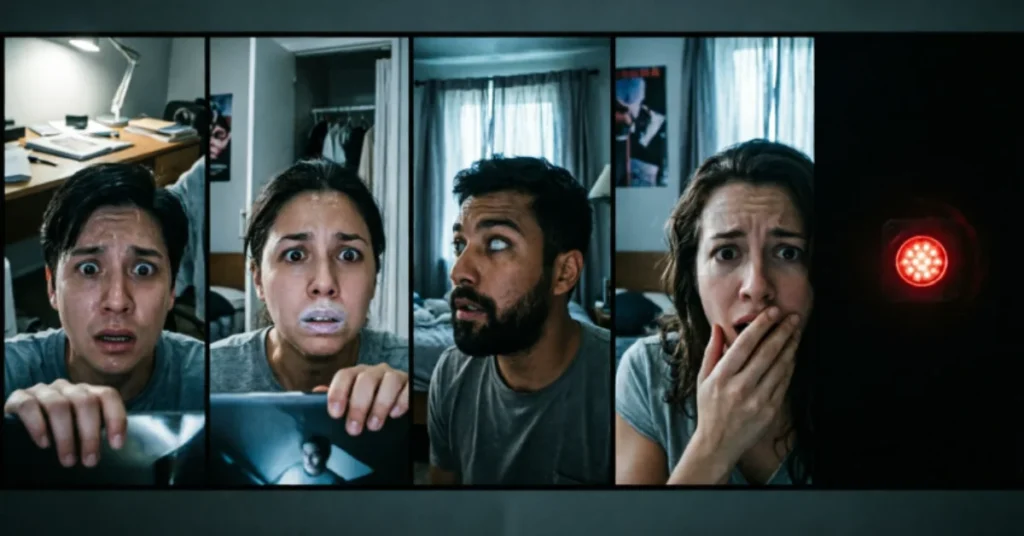
Here’s the part everyone searches for. The person behind the disappearances isn’t a stranger. It’s Evan, someone from Sam’s past who orchestrated the entire abduction as a revenge scheme.
That detail matters. This isn’t a random killer picking off victims for sport — it’s personal, calculated, and built around making Sam watch her friends suffer one at a time.
Every attempt at heroism plays into his hands. Whoever tries to save the day walks straight into a setup, which is part of why the third act feels so relentless once it gets going.
By the time only Katy remains, the tension tightens considerably. She confronts Evan directly, accuses him of killing an earlier victim named Jessica after luring her through a dating app, and tries to talk him down. He doesn’t deny it.
The confrontation turns physical. Katy grabs a knife from the kitchen just as her laptop battery dies, cutting the call and the screen at the same time.
Why The Screen Cuts To Black
This is where the don’t log off ending explained conversation gets interesting, because the film deliberately withholds confirmation. We see Katy log back into her laptop later, reading worried messages from friends who heard about her ordeal. That’s the closest thing to proof that she survived.
But the fates of Becca, Jacob, Brian, and Adam are never fully spelled out. Sirens wail somewhere off-screen just as the tension peaks, and then it’s over — no rescue footage, no arrest, no tidy wrap-up.
Some viewers find that satisfying. Others feel like they earned a clearer payoff after ninety minutes of dread. Reviews on Rotten Tomatoes reflect that exact split, with several praising the tension-filled final stretch while others wished for at least a glimpse of police arriving on scene.
The Meaning Behind The Ambiguity
Screenlife horror lives and dies on format, and this one leans into the idea that the audience is essentially another silent participant on the call. We’re watching everything unfold in real time, unable to intervene, which mirrors exactly what Sam’s friends experience.
That’s arguably the smartest trick the film pulls. The video call, meant to bring isolated friends together during lockdown, becomes the exact mechanism used to trap and terrify them. Connection itself turns into the threat.
Evan’s motive is hinted at rather than explained in full. Revenge, obsession, and control all bleed into each other, and the film never hands you a tidy monologue laying it all out. That restraint makes him scarier precisely because he isn’t supernatural. He’s just human enough to feel plausible.
How This Compares To Other Screenlife Horror
Anyone who has watched films like Host or Unfriended: Dark Web will recognize the DNA here. The format forces every scare to happen through a webcam, a shared screen, or a dropped connection, and Don’t Log Off leans hard into that limitation rather than fighting it.
Where it differs is pacing. The first half moves slowly, almost too slowly for some viewers, before the last twenty minutes pick up considerably. That structure means patience gets rewarded here more than in faster-paced entries in the genre.
The cast, including Ariel Winter, Kara Royster, and Jack Griffo, brings a natural chemistry that carries the slower stretches. It’s the kind of camaraderie that makes the eventual panic land harder, because you’ve spent enough time with these characters to actually care when they start vanishing.
What The Research Shows
Screenlife horror has grown into a recognizable subgenre since Unfriended launched it back in 2014, and pandemic-era entries like this one form a small but distinct wave within it. Industry analysts covering horror trends have noted that lockdown-set thrillers found a natural audience precisely because viewers had lived through the isolation being depicted on screen.
Detailed analysis of audience reactions across review platforms shows a consistent pattern: viewers either fully buy into the found-footage restraint or find the lack of resolution frustrating. That divide shows up clearly in this film’s reception, and it’s part of why the don’t log off ending explained search remains active among horror fans months after release.
Who Should Watch This Film
If you’re a fan of slow-burn tension and don’t need every loose end tied up, this is worth the watch. Patient horror fans who enjoyed Host or Searching will likely appreciate the format here.
If you need clean resolution and hate ambiguous endings, you might find the final stretch frustrating rather than satisfying. That’s a fair trade-off to know going in.
Final Thoughts
The don’t log off ending explained mystery ultimately comes down to restraint. The filmmakers chose atmosphere and implication over a wrapped-up conclusion, and whether that lands depends entirely on what you want from a horror finale.
What’s clear is that Evan’s reveal recontextualizes everything that came before it, turning a lockdown birthday party into a carefully staged trap. And that’s the thing — sometimes the scariest part isn’t the villain. It’s realizing how easily connection can be turned against you.
This is a full spoiler breakdown of Don’t Log Off, including its ending and key plot twists. The analysis and interpretations offered here reflect one viewing of the film and are intended for discussion, not as the filmmakers’ official statement of intent.
FAQs
Is Don’t Log Off based on a true story?
No. It’s a fictional screenlife thriller written and directed by Brandon and Garrett Baer, though it draws heavily on the real atmosphere of 2020 lockdown life.
Who is the villain in Don’t Log Off?
Evan, a figure from Sam’s past, orchestrates the entire abduction as an act of revenge tied to a previous relationship.
Does Katy survive at the end?
The film strongly implies she does. A later scene shows her logging back into her laptop and reading concerned messages from friends.
Why does the movie end without showing the police arrive?
The filmmakers chose an abrupt cutoff instead of a resolved rescue scene, leaving the outcome for several characters intentionally unconfirmed.
Is Don’t Log Off worth watching if I’ve seen Host or Unfriended?
Yes, particularly if you enjoy patient pacing. The final act is considerably stronger than the slower opening stretch.