
Ask ten people what time is first thing in the morning and you’ll get ten different answers. Some say 5 a.m. Others swear it doesn’t count until after coffee. That gap is the whole story here, and it’s more interesting than it sounds.
This phrase gets searched constantly, usually right before someone books an appointment, sets an alarm, or promises a boss they’ll “get to it first thing.” Yet nobody has ever agreed on an exact hour. What time is first thing in the morning depends on who’s talking, what job they work, and honestly, what kind of sleeper they are.
What Time Is First Thing In The Morning For Different People
There’s no clock stamp on this phrase. It’s a habit-based expression, not a scheduling term, and that’s exactly why it causes so much confusion in emails and text messages.
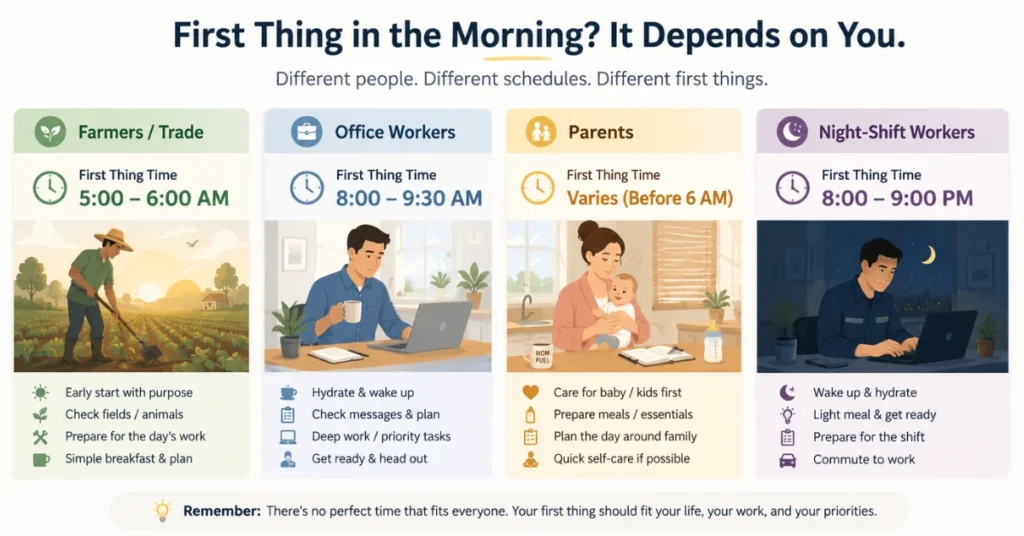
For most office workers, first thing in the morning lands somewhere between 8:00 and 9:30 a.m. — right when the workday officially opens. Anyone who has managed a team knows this is the window where “I’ll send it first thing” actually means: before the 9 a.m. standup, not before sunrise.
For early risers and farmers, the phrase means something closer to 5:00 or 6:00 a.m., often before the sun’s fully up. People who work agricultural or trade jobs describe their day as already half done by the time a desk worker’s “first thing” even starts.
For night-shift workers, the whole concept flips. Their first thing in the morning might technically happen at 9 p.m., because that’s when their personal day begins. Their body clock runs on a schedule most people never see.
Then there’s the parent category. Anyone raising small children knows first thing in the morning isn’t chosen. It’s whatever hour a toddler decides to wake up, which is rarely convenient and never negotiable.
So when someone asks what time is first thing in the morning, the honest answer is: it’s the first hour of your particular routine, not a fixed point on a 24-hour clock.
The Science Behind Why Mornings Feel So Different
Circadian rhythm research explains a lot of this variation. The body’s internal clock, regulated by light exposure and a hormone called melatonin, determines when a person naturally feels alert versus groggy. Some people are wired to peak early. Others don’t fully wake up until midday, no matter how many alarms go off.
Sleep researchers often separate people into chronotypes — early “larks” and late “owls” — and this single trait shapes what each group considers the start of their day. A lark’s first thing might genuinely be 5:30 a.m. An owl’s first thing might not arrive until 10 a.m., even with a full night’s sleep behind them.
The Sleep Foundation notes that chronotype is influenced by genetics as much as habit, which means two people can follow identical schedules and still experience “morning” completely differently.
Common Situations Where the Phrase Actually Gets Used
Here’s where this gets practical. The phrase shows up constantly in daily conversation, and each context nudges its meaning slightly.
- Workplace emails: “I’ll have it done first thing” almost always means before 9 or 10 a.m. the next business day.
- Doctor’s appointments: Clinics that offer “first thing” slots usually mean the very first booking of the day, often 7:30 or 8 a.m.
- Deliveries and services: Companies promising “first thing in the morning” arrival windows typically mean between 7 and 9 a.m.
- Personal habits: For a lot of people, first thing simply means before checking a phone, eating, or speaking to anyone else.
- Fitness routines: Gym-goers who train “first thing” are usually referring to a session before 7 a.m., squeezed in before work.
Anyone who has coordinated a delivery window or a work deadline knows the phrase carries real weight, even without a printed time attached to it.
What Early Risers and Night Owls Actually Report
People who track their own habits closely tend to describe the same pattern year after year. Those who wake before dawn talk about a quiet stretch of time nobody else is using yet — no messages, no noise, just a head start. Meanwhile, people wired for later mornings describe forcing an early first thing as one of the hardest habits to sustain, no matter how much they want it to stick.
That divide isn’t laziness. It’s biology layered on top of lifestyle, and it explains why so many “wake up at 5 a.m.” routines work for some people and fail for others within a week.
The Sleep Foundation
| Group | Typical “First Thing” Time | Why |
|---|---|---|
| Office workers | 8:00–9:30 a.m. | Aligned with business hours |
| Farmers/trade workers | 5:00–6:00 a.m. | Daylight-dependent tasks |
| Night-shift workers | 8:00–9:00 p.m. | Reversed body clock |
| Parents of young kids | Varies (often before 6 a.m.) | Set by the child, not the clock |
| Gym-goers (“early birds”) | 5:30–7:00 a.m. | Fits training before work |
| Self-employed/remote workers | 7:00–10:00 a.m. | Flexible, chronotype-driven |
How to Figure Out Your Own “First Thing”
If someone’s trying to pin this down for their own routine rather than someone else’s, a few steps help.
- Track natural wake times for a week without an alarm, if possible.
- Notice when energy actually peaks, not just when the day starts on paper.
- Match commitments — work, appointments, workouts — to that natural window instead of fighting it.
- Communicate clearly. If a deadline says “first thing,” ask for an actual hour when it matters.
That last step avoids more missed deadlines than people realize. A vague phrase plus two different assumptions about time equals a missed handoff, and it happens in workplaces every single day.
What the Research Shows
Sleep and productivity researchers have spent years studying when people feel most alert, and one point comes up again and again: matching tasks to a person’s natural rhythm improves performance more than simply waking up earlier for its own sake. The NHS points out that consistent sleep and wake times matter more for alertness than the specific hour chosen.
Professionals who study workplace habits also note that “first thing” language causes more scheduling friction than almost any other common phrase, precisely because it sounds specific while meaning something different to everyone using it. That single observation explains a lot of the confusion around what time is first thing in the morning in the first place.
Why This Still Matters in 2026
Remote work and flexible schedules have only made the phrase blurrier. With more people choosing their own hours, “first thing in the morning” no longer maps to a single, shared 9-to-5 rhythm the way it once did. As of 2026, workplace surveys and scheduling tools increasingly ask people to specify an actual hour rather than rely on the phrase alone, precisely because it means something different depending on who’s reading it.
Conclusion
There’s no universal stamp on what time is first thing in the morning. It shifts with someone’s job, their sleep pattern, and even whether they have kids waking them up before sunrise. For most people with a standard schedule, it lands somewhere around 7 to 9 a.m. For everyone else, it’s simply whatever hour kicks off their day. The safest move, especially in writing or work settings, is to swap the phrase for an actual time whenever precision counts.

FAQs
Q1: Is there an official time that counts as “first thing in the morning”?
No. It’s a habit-based phrase, not a fixed hour. It changes based on someone’s schedule and natural wake time.
Q2: What time do most workplaces mean by “first thing”?
Usually between 8:00 and 9:30 a.m., right around when the business day starts.
Q3: Does chronotype really affect what counts as morning for someone?
Yes. Genetics and habit shape whether a person naturally feels alert at 5 a.m. or closer to 10 a.m.
Q4: Should I use an exact time instead of the phrase in emails?
For anything deadline-related, yes. Swapping the vague phrase for an actual hour avoids mixed-up expectations.
Q5: Does “first thing” mean the same thing for night-shift workers?
No. Their day often starts in the evening, so their “first thing” might land at 8 or 9 p.m.