
Rain jackets on, snacks packed, and someone’s already asking “are we there yet” before the car leaves the driveway. That’s the honest starting point for most family trips here, and it’s exactly why what to do in Seattle with kids is one of the most searched travel questions for Pacific Northwest visits. The good news? This city was practically built for short attention spans and big curiosity.
Seattle sits between Puget Sound and Lake Washington, with the Cascades rising in the distance, so nature is never more than a short drive away. But the real trick to a good family trip isn’t just picking the biggest attractions. It’s knowing which ones actually hold a kid’s attention past the first twenty minutes.
What to Do in Seattle With Kids at Seattle Center First
Seattle Center was built for the 1962 World’s Fair, and it still functions as the city’s family hub today. The 74-acre campus puts several kid-magnet attractions within walking distance of each other, which matters more than people expect when you’re managing nap schedules and stroller logistics.
The Space Needle anchors the campus, and daring kids can stand on the glass floor and look straight down at the city below. It’s not cheap, and it’s not for kids who hate heights, but the view genuinely delivers. Right nearby, the Pacific Science Center runs laser shows, planetarium screenings, and a tropical butterfly house where kids walk among hundreds of free-flying butterflies. Live science demonstrations here explain things like optical illusions and air pressure in a way that clicks with younger minds far better than a textbook ever could.
Younger kids, especially toddlers and preschoolers, tend to gravitate toward the Seattle Children’s Museum instead. It’s a play-based space built around building, role-playing, and hands-on art, and it’s forgiving of short attention spans in a way some of the bigger museums aren’t.
Between stops, the International Fountain gives kids somewhere to burn off energy by running through the water jets, and the open lawns are perfect for a packed lunch break. If your visit falls during the colder months, check the Seattle Theatre Group’s family lineup. The Paramount Theatre and Neptune Theatre run family-oriented shows through the year, including science-themed programming aimed squarely at curious kids.
Waterfront Wins: Aquarium, Otters, and the New Ocean Pavilion
Any real answer to what to do in Seattle with kids has to include the waterfront, and the Seattle Aquarium on Pier 59 is the centerpiece. Walking through the dim, glowing tunnels surrounded by marine life tends to quiet down even the most wound-up toddler.
The aquarium recently expanded with the Ocean Pavilion, a roughly 500,000-gallon tropical reef exhibit on the redeveloped Elliott Bay waterfront. It houses Indo-Pacific leopard sharks, eagle rays, and dozens of Indonesian reef species, and kids can walk right up to the glass for a close look. It pairs naturally with a stroll along the new Seattle Waterfront Park, which opened on Alaska Way and includes a large playground and a pedestrian path connecting straight through to Pike Place Market.
Speaking of which, Pike Place Market deserves its own hour, minimum. Kids love watching the fish-throwing vendors do their thing, and there’s an odd but undeniable thrill in showing them the market’s famous Gum Wall. Grab a treat from one of the market’s cheese shops on the way through. It’s messy, it’s loud, and it’s exactly the kind of sensory chaos that makes a market visit memorable for a six-year-old.
Woodland Park Zoo and the Great Outdoors
For families who’d rather spend the day outside than indoors, Woodland Park Zoo is consistently rated as one of the better-laid-out zoos for little ones, with wide paths that work well for strollers and slower walkers. A brand-new Forest Trailhead exhibit opened as part of the zoo’s ongoing habitat expansion, featuring an immersive wooded landscape and a treetop walking path, with close-up viewing for crowd favorites like red pandas.
Seattle’s relationship with water goes beyond the aquarium, too. On extra-low-tide days, several of the city’s beaches turn into open-air classrooms. Trained beach naturalists run seasonal programs at multiple beaches stretching from Shoreline down to Des Moines, helping kids gently handle and identify tide-pool creatures that are normally hidden underwater. These sessions run free, seasonally, and they’re one of the few genuinely educational activities that kids don’t have to be bribed into enjoying.
For a quieter outdoor moment, Kerry Park on Queen Anne Hill gives families a postcard view of the skyline. It’s small, it’s free, and it’s a good five-minute stop on the way to somewhere else.
Ballard Locks and Bainbridge Island: What to Do in Seattle With Kids Beyond the Basics
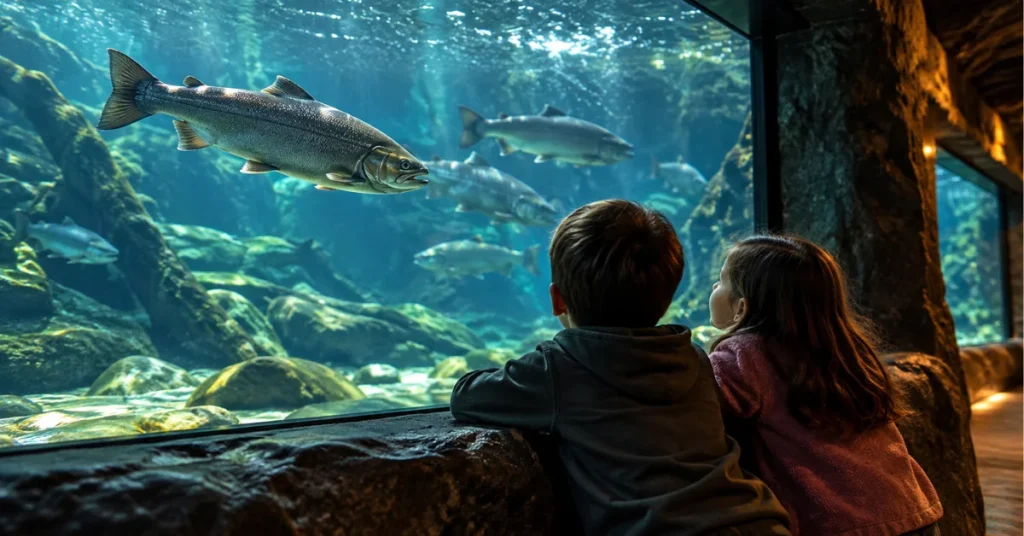
Most first-time visitors never make it to the Hiram M. Chittenden Locks, better known as the Ballard Locks, and that’s a genuine miss. Kids get to watch boats rise and drop like a water elevator as they pass between Puget Sound and Lake Washington, with fishing boats, yachts, and the occasional dinghy with a pirate flag all lining up for a turn.
The real draw for most families is the indoor fish ladder viewing area, where glass windows let kids watch salmon swim upstream at eye level, close enough that the same fish often swims past two or three times while everyone waits. The migration runs by species: sockeye peak in July, chinook peak in late August, and coho peak in late September, so a summer visit gives the best odds of a good show. Entry is free, and guided tours run daily in the afternoon during the visitor center’s open season.
Pair a locks visit with a short walk to Commodore Park, or extend the day with a Washington State Ferry crossing to Bainbridge Island. The ride runs about 35 minutes each way from downtown Seattle and delivers skyline and Mount Rainier views that a car trip simply can’t match. On the other side, the Bainbridge Waterfront Trail and small-town shops give kids room to stretch their legs before the ride back.
Families who want more open space afterward can add Discovery Park to the same day, since it sits within easy reach of the locks and gives kids beach access, forest trails, and enough room to run off the energy a ferry ride tends to store up.
Save Money: Is the Seattle CityPASS Worth It for Families Asking What to Do in Seattle With Kids?
Once a family has three or more paid attractions on the list, cost adds up fast, and this is where most itineraries quietly fall apart. The Seattle CityPASS bundles admission to five attractions, with the Space Needle and Seattle Aquarium as the two mandatory picks, plus a choice of three more from Chihuly Garden and Glass, the Argosy Cruises Harbor Tour, the Museum of Pop Culture, Woodland Park Zoo, and the Pacific Science Center.
Pricing runs $139 per adult and $119 per child, ages five through twelve, and the pass stays valid across nine consecutive days once it’s activated, so a family doesn’t have to cram everything into one exhausting day. Buying individually instead can mean paying close to full price at every single stop, and the combined savings on the full five-attraction bundle can run well over one hundred dollars for a family of four.
Families planning a shorter trip, or one that leans toward attractions outside the standard bundle, might prefer the Seattle C3 option instead. It allows any three attractions chosen from a wider list of ten, including the Museum of Flight and the Seattle Art Museum, without the two mandatory picks the full CityPASS requires. Either pass is worth pricing out before buying tickets one at a time, since the math tends to favor the bundle the moment a third attraction joins the plan.
Rainy Day Backup Plan (You’ll Need One)
Seattle earns its rainy reputation, so a family itinerary without an indoor backup plan is asking for trouble. The Museum of Pop Culture, known as MoPOP, gives older kids and tweens an interactive, music-and-culture-heavy alternative to the science-focused options. The Amazon Spheres downtown are another underrated pick. These glass domes house a lush indoor rainforest and are free to enter, though they require advance reservations, and they’re a surprisingly good fit for plant-curious kids on a wet afternoon.
For something less structured, look up neighborhood community centers, which regularly host free or low-cost indoor programming for kids during the wetter months. This isn’t glamorous, but it’s often the difference between a meltdown and a manageable afternoon three hours into a rainstorm. Any solid plan for what to do in Seattle with kids during the wetter months needs at least one of these indoor options on standby.
Why Families Flock to Seattle Between May and September
The pattern emerging from family travel data in 2026 shows Pacific Northwest destinations gaining ground with parents specifically because of accessible, walkable attraction clusters like Seattle Center, where several major activities sit within a five-minute walk of each other. That clustering matters more for families than it does for solo travelers, since it cuts down on the transit time that tends to wreck a toddler’s nap schedule.
Seasonal programming also tells its own story. Free events, from beach naturalist walks to outdoor summer movie nights in neighborhood parks, run nearly continuously from spring through the end of summer, which lines up with what most family travel planners already suspect: Seattle’s peak family season runs May through September, when both the weather and the events calendar cooperate. It’s one more reason the search for what to do in Seattle with kids spikes so heavily in those months.
Different Ages, Different Seattle: What to Do in Seattle With Kids by Age Group
A trip built around a three-year-old looks nothing like one built around a twelve-year-old, and Seattle bends well in both directions.
- Toddlers and preschoolers do best at the Seattle Children’s Museum, the International Fountain, and short zoo loops that don’t demand long stretches of walking.
- Elementary-age kids tend to light up at the Pacific Science Center, the Aquarium’s Ocean Pavilion, and the tide-pool beach programs.
- Tweens and teens usually get more out of MoPOP, the Space Needle’s glass floor, the Ballard Locks fish ladder, and a full Pike Place Market wander with actual spending money.
Families visiting with a mix of ages tend to do best splitting the day: mornings for the shared big attractions, afternoons split into smaller groups so each age range gets something built for them.
Budget-Friendly and Free Options
Not every good answer to what to do in Seattle with kids costs money. Kerry Park, the Amazon Spheres, the International Fountain, the Ballard Locks, beach naturalist programs, and most neighborhood park playgrounds cost nothing. Several museums also run free or discounted admission days throughout the month, so it’s worth checking individual attraction calendars before locking in a full-price itinerary. Packing lunches for park days instead of eating out at every stop is the single easiest way to keep a multi-day family trip from blowing the budget, and skipping the CityPASS entirely makes sense for families sticking mostly to these free stops.
Practical Tips Before You Go

A few logistics make a real difference on the ground. Locker storage is available free for a couple of hours at major attractions like the Space Needle, which helps when you’re carrying stroller gear you don’t want to haul around all day. Advance reservations are required for some free attractions, including the Amazon Spheres, so that’s not a same-day walk-up option. Weekday mornings consistently run lighter on crowds than weekends, which matters a lot when you’re navigating a museum with a double stroller.
Public transit, including the Link light rail and the monorail connecting downtown to Seattle Center, is stroller-friendly and cuts down on parking headaches, which tend to be one of the bigger stressors of a city family trip. Anyone weighing the CityPASS against individual tickets should decide early in the trip, since some attractions inside the bundle require the same advance-reservation planning as the free ones.
Conclusion
There’s no single perfect itinerary for what to do in Seattle with kids, because the right day depends entirely on your kids’ ages, energy levels, and tolerance for rain. What does hold true across every age group is that Seattle rewards families who mix indoor and outdoor stops, lean on the free stuff between the big-ticket attractions, and build in slack time for the inevitable meltdown or nap. Between the aquarium’s new Ocean Pavilion, Woodland Park Zoo’s fresh trail exhibit, the Ballard Locks fish ladder, and the same tide-pool beaches locals have been visiting for generations, this city gives families more genuinely different ways to spend a day than its reputation for rain and coffee usually gets credit for.
FAQs
How many days do you need in Seattle with kids?
Three to four days covers the major attractions comfortably, including a full day at Seattle Center, a waterfront and market day, and one day built around the zoo, the Ballard Locks, or an outdoor beach visit, with a rainy-day backup in reserve.
Is the Space Needle worth it for young kids?
It depends on the child. Kids who enjoy heights and views tend to love it, especially the glass floor, but toddlers who spook easily may find it overwhelming. The Pacific Science Center next door is a gentler alternative.
Is the Seattle CityPASS worth it for a family?
Usually yes, once a family plans on visiting three or more paid attractions. The combined savings on the five-attraction bundle typically outweigh buying individual tickets, though families sticking to two attractions or fewer may come out ahead paying separately.
What’s the best free thing to do in Seattle with kids?
The Ballard Locks and the tide-pool beach naturalist programs are hard to beat. Both are free, hands-on, and genuinely educational without feeling like a lecture.
What should families do in Seattle on a rainy day?
MoPOP, the Pacific Science Center, the Seattle Children’s Museum, and the Amazon Spheres (with advance reservation) all work well as indoor backups when the weather turns.