
It’s 2 a.m., you’re standing over the crib again, and the same question keeps circling: why is my 9 month old not sleeping when they used to go down without a fuss? You’re not imagining it. Somewhere between eight and ten months, a huge number of babies who were sleeping fine suddenly start fighting bedtime, waking every couple of hours, or refusing naps altogether.
This isn’t a parenting failure. It’s a predictable, well-documented stage tied to how fast babies develop at this age. Once you understand what’s actually happening in that little brain and body, the wake-ups start to make a lot more sense, and so do the fixes.
Why Is My 9 Month Old Not Sleeping? The Real Causes
Parents searching why is my 9 month old not sleeping are usually dealing with one thing: the widely recognized 9-month sleep regression. It typically hits somewhere between eight and ten months and tends to stick around for two to six weeks before easing off on its own.
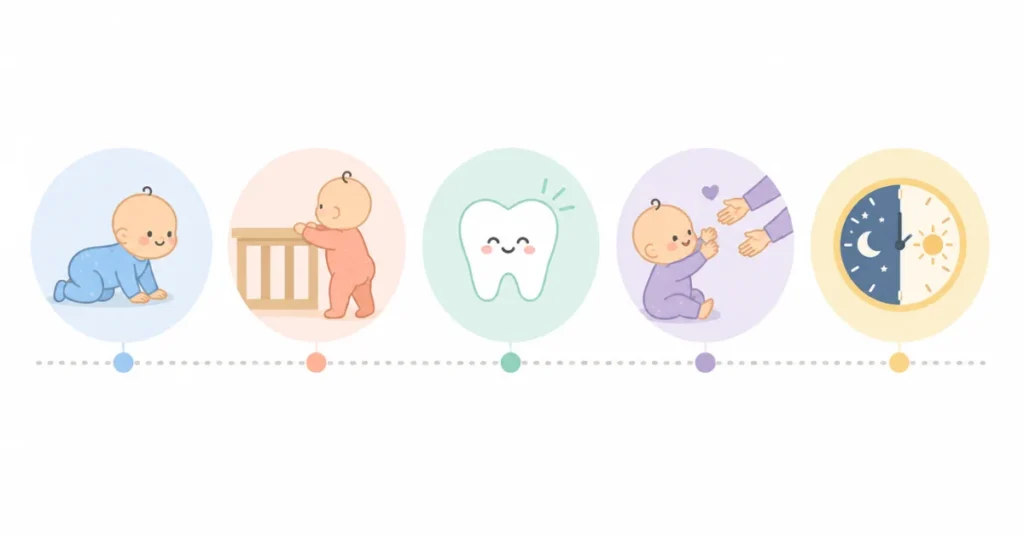
Several things converge at once during this window. Babies are often crawling, pulling up to stand, or even cruising along furniture, and a body that’s busy learning to move doesn’t want to lie still and drift off. Separation anxiety also tends to peak here, since object permanence has just clicked. Your baby now understands you exist even when you’re out of the room, which can turn a simple bedtime goodnight into a genuine protest.
Add in a possible nap transition from three naps down to two, plus teething discomfort, and you’ve got a perfect storm. None of these factors alone is usually the full story. It’s the pile-up that disrupts the sleep your baby had finally figured out.
Breastfed babies tend to wake more often at this age than formula-fed babies, simply because breast milk digests faster. That’s not a problem to fix. It’s just useful context so you’re not comparing your baby’s wakings to a formula-fed friend’s baby and assuming something’s wrong.
Teething, Growth Spurts, and Other Medical Causes
Anyone who has raised a baby through this stretch knows teething doesn’t announce itself politely. Swollen gums, extra drool, and a sore mouth can wake a baby who was otherwise sleeping soundly. Growth spurts work the same way. A baby who suddenly needs more calories may start waking hungry again, even after weeks of sleeping through.
Reflux, ear infections, and mild allergies can also disrupt sleep at this age, and they’re often mistaken for a regression simply because the timing overlaps. If wakings feel unusually painful rather than just restless, it’s worth ruling these out.
Signs This Is a Regression, Not Something Else
A true regression tends to look consistent: night wakings that weren’t there before, shorter or skipped naps, extra clinginess at bedtime, and a baby who fights sleep even when clearly tired. If these signs line up with the eight-to-ten-month window and nothing else has changed, it’s very likely developmental rather than medical.
Illness looks different. Fever, a stuffy nose, a cough, or a rash alongside the sleep disruption points toward something a pediatrician should check, not a regression to wait out.
| Possible Cause | Typical Signs | What Usually Helps |
|---|---|---|
| Developmental regression | New wakings, short naps, clinginess | Consistent routine, patience, 2–6 weeks |
| Teething | Drooling, swollen gums, chewing everything | Cool teething rings, gentle gum relief |
| Nap transition (3→2) | Fighting the third nap, early morning wakes | Shift to 2 longer naps over 1–2 weeks |
| Separation anxiety | Crying at drop-off, wanting to be held | Short practice separations, calm goodnights |
| Reflux or ear infection | Painful crying, arching back, tugging ear | Pediatrician visit |
| Illness | Fever, congestion, fussiness all day | Contact your pediatrician |
| Overtiredness | Fighting sleep, wired at bedtime | Earlier bedtime, watch sleepy cues |
How Much Sleep a 9 Month Old Actually Needs
It helps to know what “normal” even looks like at this stage. Babies between 4 and 12 months old typically need 12 to 16 hours of sleep across a 24-hour period, including naps, according to official UK pediatric health guidance. Most 9-month-olds land around 13 to 14 hours total, usually split between 11 to 12 hours overnight and two naps during the day.
Wake windows matter more than most parents realize. At this age, babies generally do best staying awake for 2.75 to 3.5 hours between sleep periods. Push past that window and overtiredness sets in fast, which paradoxically makes falling asleep harder, not easier.
It’s also worth knowing that night waking at this age isn’t automatically a problem. Some official pediatric sleep guidance notes it’s completely normal for babies to begin waking more frequently again around 8 to 9 months, and many continue waking through the night for at least the first year of life. That single fact tends to bring a lot of relief to exhausted parents who assume they’re doing something wrong.
Families who room-share, which health guidance recommends for at least the first six months, often notice wakings feel more frequent simply because they’re within earshot of every stir. That doesn’t mean the baby is waking more than a baby sleeping in their own room; it just means you’re hearing more of it.
What the Research Shows
Pediatric sleep experts consistently link this stage to brain development rather than poor habits. Detailed analysis of infant sleep patterns shows that regressions cluster around known developmental leaps: rolling, crawling, standing, and object permanence, rather than random bad luck. Most regressions last between two and six weeks, and not every baby experiences a noticeable one. Some skip it entirely while others go through only mild disruption.
When examining sleep-training research closely, a pattern shows up again and again: babies who have a predictable bedtime sequence tend to resettle faster during regressions than those without one. That’s not a guarantee, but it’s a consistent finding across pediatric sleep guidance.
Practical Fixes That Actually Help Tonight
Fixing a 9 month old not sleeping well rarely means overhauling everything. Small, consistent adjustments tend to work better than dramatic changes.
- Keep bedtime and nap times within the same 30-minute window daily
- Watch for sleepy cues (eye rubbing, staring off, fussiness) before your baby gets overtired, and aim for that 2.75 to 3.5 hour wake window
- If dropping the third nap, do it gradually over one to two weeks rather than all at once, and shift bedtime 30 minutes earlier during the transition
- Cap the last nap so it doesn’t push bedtime too late
- Build a short, predictable wind-down: bath, book, feed, lights out
- Follow safe sleep basics: baby on their back, firm flat mattress, no loose blankets or pillows in the crib
- Respond to night wakings with a brief, calm check rather than immediately picking baby up or turning on lights; give a short pause first to see if they resettle on their own
None of these solve the regression outright. They just make it easier for your baby to find their way back to sleep on their own.
For Parents Considering Sleep Training
Anyone who has looked into gentle sleep coaching knows there’s no single “right” method. Some families lean on gradual check-ins, others prefer full self-settling approaches. What matters more than the method is consistency; switching strategies every few nights confuses a baby who’s already unsettled.
One thing worth knowing before you start: sleep often gets briefly worse for two to three nights when you introduce a new routine or method, before it improves. Parents who don’t expect this dip often quit right before it would have worked.
For Working Parents, Solo Parents, and Multiples
Not every household runs on the same clock. Parents dropping their baby at daycare often deal with an extra layer: schedule changes, new caregivers, and separation anxiety hitting twice a day instead of once at bedtime. Coordinating nap times between home and daycare, even loosely, tends to reduce the overtired-overnight cycle that makes wake-ups worse.
Solo parents managing every night wake-up alone should focus on the lowest-effort resettling method that still works, since there’s no partner to split shifts with. Parents of twins or multiples often find staggering bedtimes by ten to fifteen minutes prevents one baby’s crying from waking the other. And if you’re traveling during this stretch, keeping the same nap and bedtime sequence, even in an unfamiliar room, matters more than the actual clock time.
When to Call the Pediatrician
Most sleep disruption at this age resolves on its own. But contact a doctor if wakings come with fever, persistent crying that doesn’t respond to comfort, breathing changes, a rash, or a sudden drop in appetite. Snoring paired with pauses in breathing during sleep is also worth mentioning at the next check-up, since it can point to airway issues unrelated to a typical regression.
The Bottom Line

A 9 month old not sleeping through the night is frustrating, exhausting, and, in the vast majority of cases, completely normal. Development doesn’t pause for anyone’s sleep schedule, and this particular stretch tends to pass once crawling, standing, and separation anxiety settle into the background. Keep the routine steady, watch for illness versus regression, and remember: most babies come out the other side sleeping just fine.
This article is for informational purposes only. Always consult a qualified pediatrician or healthcare professional about your baby’s specific sleep and health concerns.
FAQs
Is it normal for a 9 month old to suddenly stop sleeping through the night?
Yes. Waking more often around 8 to 9 months is common and usually tied to development rather than a health problem.
How long does the 9-month sleep regression last?
Most last between two and six weeks, though duration varies by baby.
Should I start sleep training during a regression?
Some parents wait until the regression settles, while others use it as a starting point for gentle sleep coaching. Either approach can work; consistency matters more than timing.
Could teething be the real reason my baby isn’t sleeping?
Yes, teething often overlaps with this age and can worsen night wakings independently of the regression itself.
When should I worry instead of waiting it out?
If wakings come with fever, rash, breathing changes, or ongoing appetite loss, it’s time to check in with a pediatrician rather than assume it’s a phase.