
The first time a baby lifts a chubby little hand and flaps it at grandma, something clicks in every adult in the room. It’s one of those moments parents replay for years. So when do babies learn to wave, and what’s actually happening in that tiny brain when they do it?
The short answer: most babies start experimenting with a wave-like motion somewhere between 6 and 9 months, and by their first birthday, waving “bye-bye” is one of the milestones pediatricians expect to see. But there’s more nuance to it than a single number, and that’s what this guide breaks down.
When Do Babies Learn to Wave? The Age Breakdown
There isn’t one magic day when waving switches on. It happens in layers, and the timeline looks a little different for every baby.
Early flapping or hand-opening movements can show up as early as 6 to 7 months. This isn’t a true social wave yet — it’s more of a reflexive or exploratory hand motion that just happens to look like one.
By 9 to 11 months, many babies start connecting that hand motion with a social moment. They’ll wiggle their fingers when someone says “hi” or leaves the room, even if the timing is a bit off.
The Centers for Disease Control and Prevention lists waving “bye-bye” among the developmental milestones most babies reach by 12 months, right alongside playing pat-a-cake and responding to their own name. That’s the benchmark pediatricians actually track.
Some babies wave earlier, some later, and both can be perfectly normal. Anyone who has raised more than one child knows the second baby rarely follows the same script as the first.
What Happens Before the First Wave
Waving looks simple, but it’s actually a small miracle of coordination. Three things need to line up first.
Gross and fine motor control has to develop enough for a baby to open and close their hand on purpose, rather than by accident. Hand-eye coordination has to mature so the movement connects to what they’re seeing — a face leaving the room, a familiar voice saying goodbye. And social awareness has to kick in, so the baby understands a wave means something to another person.
That third piece is the one parents notice most. Babies who watch faces closely, track people moving around a room, and respond to peekaboo are usually building the exact social wiring that waving depends on.
Waving Compared to Other Early Gestures
Waving rarely shows up alone. It tends to arrive in a cluster with a few other “party trick” gestures, and comparing the timeline helps put it in context.
- Banging objects together: often begins around 9 months
- Clapping: starts around 9 months, becomes purposeful (used to show excitement) closer to 15 months
- Pointing: typically emerges between 8 and 12 months
- Waving: early attempts around 6 to 9 months, a deliberate “bye-bye” wave usually by 12 months
Think of these gestures the way you’d think of learning scales before playing a song on the piano. The individual finger movements come first, and only later does the baby string them into something with real meaning.
What the Research Shows
Pediatric researchers describe developmental milestones as skills that roughly 75% or more of children reach by a certain age, according to the CDC’s own definition of the term. Waving “bye-bye” earns its place on the 12-month checklist because that’s where the data lands for most infants.
Detailed analysis of infant communication also shows a pattern worth knowing: babies who use more gestures — waving, pointing, reaching — before they can talk tend to build spoken vocabulary faster once words do arrive. Gesturing isn’t a substitute for language. It’s practice for it.
Pediatricians who track this closely will tell you the wave itself matters less than the intention behind it. A baby flapping their hand at nothing isn’t the same milestone as a baby who waves specifically when someone walks out the door.
How to Encourage Your Baby’s First Wave
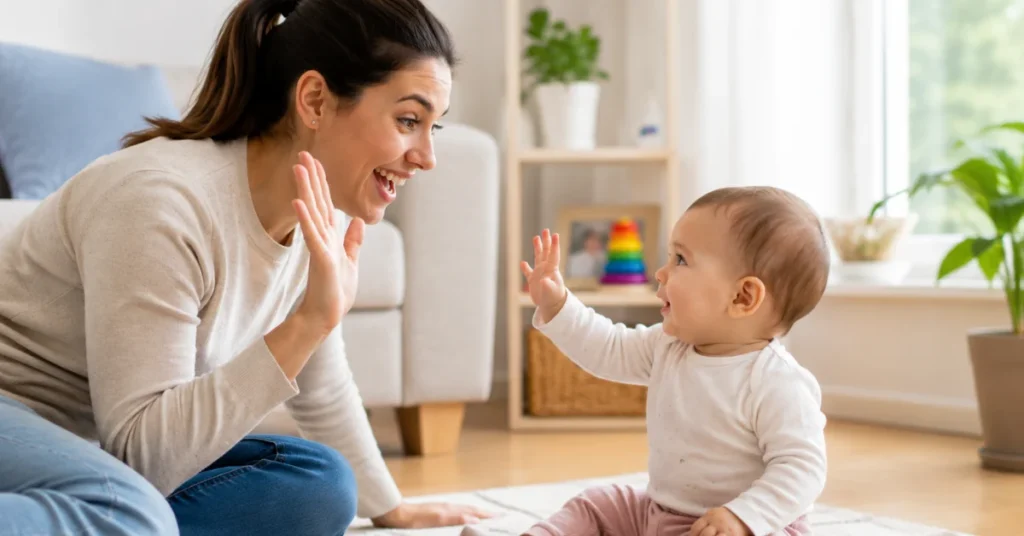
Babies pick up waving mostly through imitation, so the fastest way to help is simply to model it constantly and consistently.
Wave every time you say hello or goodbye, and pair it with the actual words — “bye-bye,” “hi.” Repetition matters more than intensity here. Gently guide your baby’s hand through the motion during greetings if they seem interested but stuck. And keep a mirror handy during playtime; watching their own hand movements helps babies connect motion with meaning.
Reacting with genuine delight when your baby attempts even a clumsy version goes a long way, too. Babies are natural people-pleasers, and a big smile from a parent is often the best reinforcement there is.
When to Talk to Your Pediatrician
One missed milestone rarely means anything on its own. Development isn’t a straight line, and babies frequently nail one skill early while lagging on another.
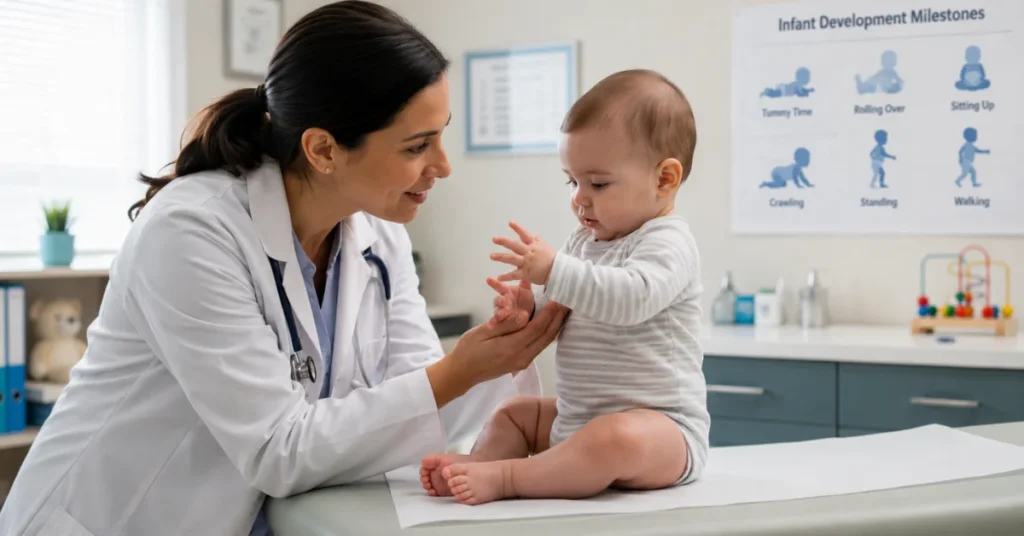
That said, the American Academy of Pediatrics recommends developmental screening at 9, 18, and 30 months, and pediatricians use exactly these kinds of gesture-based milestones as part of that check. If a baby isn’t waving, pointing, or using any gestures by 12 months, or if they’ve lost a skill they once had, it’s worth flagging at the next visit.
So, When Do Babies Learn to Wave for the First Time? A Quick Recap
Pulling it all together: early hand movements can appear around 6 months, a more deliberate attempt shows up between 9 and 11 months, and a true social “bye-bye” wave is expected by the first birthday. That’s the window parents can reasonably expect, even though every baby’s path there looks a little different.
As of 2026, pediatric guidance on this milestone hasn’t shifted much — it remains one of the more reliable early markers of social and motor development that doctors watch for at well-child visits.
Conclusion
Knowing when do babies learn to wave gives parents a realistic window to watch for, without turning every quiet week into a source of worry. Somewhere between the first curious hand-flap around 6 months and a confident “bye-bye” wave by 12 months, a baby is quietly building the foundation for real communication. Keep modeling the gesture, celebrate the clumsy first attempts, and bring any real concerns to your pediatrician rather than the internet. That wave is coming — probably sooner than you think.
This article is for informational purposes only and isn’t a substitute for professional medical evaluation. Always consult a qualified pediatrician about your child’s individual development.
FAQs
Is it normal if my 10-month-old still hasn’t waved?
Yes, in most cases. The 12-month mark is the benchmark pediatricians use, so a 10-month-old still has time. Watch for other social cues like eye contact and response to their name.
Can a baby wave too early?
Not really — early hand-flapping around 6 to 7 months is usually just exploratory movement rather than a true social wave, and that’s completely typical.
Does waving mean my baby is advanced?
Not necessarily. Early waving is a nice sign of coordination and social interest, but it doesn’t predict overall intelligence or later milestones on its own.
What if my baby waves but doesn’t make eye contact?
Occasional lack of eye contact isn’t automatically a concern, but if it happens consistently alongside missed gestures, mention it to your pediatrician at the next visit.
Should I worry if my baby never wiggles their fingers, only opens and closes their whole hand?
No — the exact form of the wave varies a lot between babies. What pediatricians care about is whether the gesture happens in a social context, not its precise shape.