
A quiet children’s book author. A loving husband. A newborn daughter on the way. None of it is enough to stop what happens by the final scene, and that’s exactly the point. If you just finished the film and typed “a mouthful of air ending explained” into a search bar, you’re probably sitting with the same knot in your chest that thousands of other viewers have described. This isn’t a twist ending built for shock value. It’s a portrait of depression that refuses to hand you a tidy resolution, and that refusal is precisely why people can’t stop talking about it in 2026.
Amy Koppelman wrote the 2003 novel this film is based on, then directed the 2021 adaptation herself, casting Amanda Seyfried as Julie Davis. Anyone who has watched this film knows the ending doesn’t creep up quietly. It lands like a gut punch you somehow saw coming the whole time.
What Actually Happens In The Final Scene
Julie survives a suicide attempt near the start of the story, on the eve of her son Teddy’s first birthday. She spends the rest of the film trying to look grateful, trying to convince Ethan and her mother that she’s fine, all while a second pregnancy reopens wounds tied to her father.
The closing sequence shows Julie in the backyard with her two children. Her baby daughter starts crying, and Julie’s biggest fear, the fear of leaving Teddy unattended, gets triggered instantly. Ethan calms things down for a moment. Then, while a voiceover plays of Julie reading her handwritten story to Ethan, she quietly gathers her paintings into a bundle, places her daughter in the crib, and walks outside with a box cutter.
The film cuts away before showing the act itself. What follows is an older Ethan handing Julie’s handmade book to their now-grown daughter, which confirms Julie did not survive.
Why The A Mouthful Of Air Ending Explained So Much About Depression Itself
Here’s the deal. Most films about mental illness build toward a lesson. This one refuses to. Julie is surrounded by people who love her, and it still isn’t enough, and that’s uncomfortable to sit with.
Koppelman based the story partly on her own experience with clinical depression, and she pushed back hard when a studio once asked her to soften the book’s ending into a survival story. She refused, and that refusal is the reason the a mouthful of air ending explained here still feels honest rather than manipulative.
The film never uses the clinical term postpartum depression on screen, yet everything about Julie’s spiraling thoughts, her guilt, her conviction that her family would be better off without her, points directly at it. According to the NHS, perinatal depression affects roughly one in eight women at some point during pregnancy or the first year after childbirth, a condition that often hides behind a mask of competence exactly like Julie’s.
The Father Subplot Nobody Fully Explains
Julie’s strained relationship with her father runs through the entire film in fragmented flashbacks. He was cruel to her as a child, and his attempt to reconcile late in the story, including helping paint the nursery, never quite lands the way he hopes.
Julie stays distant. She lets him try. Neither of them says the thing that actually needs saying. The film deliberately never spells out exactly what he did or whether he struggled with his own undiagnosed mental illness, and that ambiguity is intentional rather than lazy writing.
Anyone who has lived alongside a parent’s unresolved anger recognizes this pattern instantly: the damage doesn’t announce itself with a single dramatic incident. It accumulates in small moments, the kind that are easy to explain away and impossible to fully forget.
Julie’s Children’s Books Aren’t Just A Career Detail
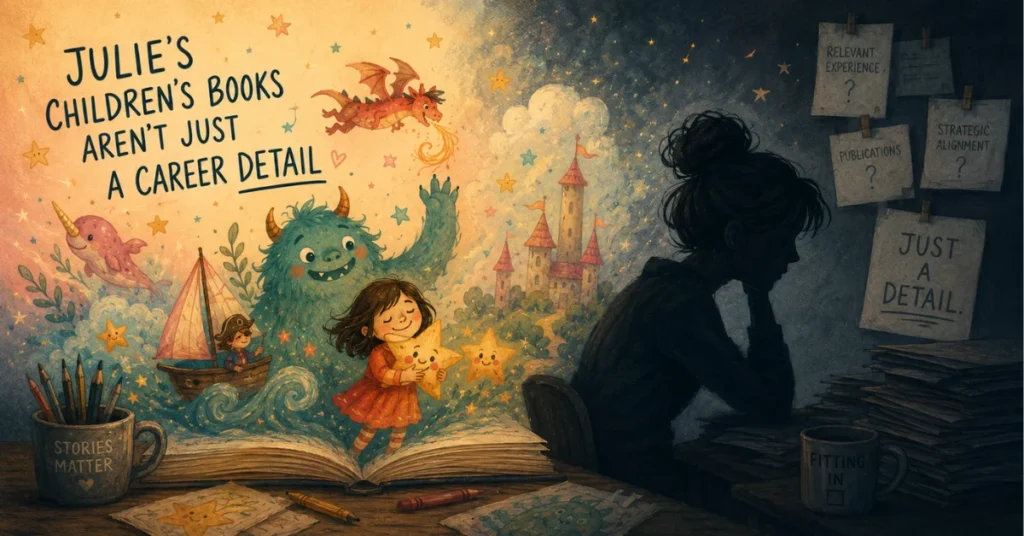
Julie writes and illustrates stories about children finding courage against monsters that eat stars and steal happiness. The irony sits right there on the surface: a woman teaching bravery to millions of kids while unable to summon it for herself.
This detail does real narrative work. It shows how skilled Julie is at performing wellness for an audience, whether that audience is her readers, her husband, or her own mother hovering outside the bathroom door. The gap between the person she presents and the person underneath is the entire engine of the story.
What The Research Shows
Detailed analysis of postpartum mental health data backs up what the film dramatizes. A large-scale JAMA Network Open study tracking more than 440,000 births found postpartum depression diagnoses in the United States climbed from 9.4% in 2010 to 19.0% in 2021, and researchers connect part of that rise to better screening rather than the condition becoming more common. Separately, up to half of people experiencing postpartum depression are never formally diagnosed, which lines up almost exactly with how long Julie hides her condition from the people closest to her.
Mental health professionals who work with new mothers consistently note that outward appearances, a stable marriage, financial comfort, a successful career, offer no protection against this illness. Julie has all three, and none of it saves her.
A Mouthful Of Air Ending Explained Through Its Title
The title itself carries weight once you reach the end. A mouthful of air is barely anything, an invisible, fleeting resource that most people never think twice about, yet it’s also the very thing that keeps you alive. Julie spends the film gasping for that small, sustaining thing and never quite catching enough of it.
One film critic described the story as needing “more room to breathe that mouthful of air,” which, intentionally or not, captures the central metaphor the whole narrative is built around.
Critical Reception And Why Audiences Still Search The Ending
The film holds a 68% approval rating on Rotten Tomatoes based on 31 critic reviews, alongside a more mixed 52 out of 100 on Metacritic. Critics were split. Some found Seyfried’s performance devastating and precise. Others, including reviewers at major outlets, felt the film shortcut its way through Julie’s backstory and left too many threads unresolved.
That split is exactly why so many viewers finish the movie confused and go searching for answers immediately afterward. The ambiguity that frustrated some critics is the same quality that makes the film linger in a viewer’s mind for days.
Who Should Watch This Film, And Who Might Want To Wait
- Viewers processing their own experience with postpartum depression may find validation here, but should approach it with support nearby
- Partners and family members of someone with depression can gain real insight into how invisible the illness can be, even inside a loving household
- Anyone currently in a fragile mental state, or triggered by depictions of suicide, may want to skip this one or watch with a trusted person present
Final Thoughts

There’s no version of the a mouthful of air ending explained that makes it easier to watch. That’s not a flaw in the storytelling. It’s the whole argument the film is making about how depression actually works, quietly, persistently, and often invisibly to everyone standing right beside the person suffering. Julie’s legacy becomes the handmade book she leaves behind, and the film asks its audience to sit with the discomfort of a story that offers no rescue, only remembrance.
This article discusses depression and suicide from an educational and cultural analysis perspective. If you or someone you know is struggling with thoughts of suicide or postpartum depression, please reach out to a mental health professional or a crisis line in your country for support.
FAQs
Does Julie die at the end of A Mouthful of Air?
Yes. The film implies she dies by suicide in the final scene, confirmed by a later scene of an older Ethan giving their daughter Julie’s handmade book.
Is A Mouthful of Air based on a true story?
It’s fiction, but author and director Amy Koppelman has said the 2003 novel draws on her own experience with clinical depression.
Why doesn’t the film use the term postpartum depression?
Koppelman deliberately avoids the clinical label so viewers experience Julie’s spiral the way those around her do, as confusing, unexplained distress rather than a diagnosis.
What does the title A Mouthful of Air mean?
It reflects how small and fragile the things keeping Julie alive feel to her, a thin, uncertain supply of air she can never quite get enough of.
Is there a sequel planned?
No. The story concludes with Julie’s death, and Koppelman hasn’t written a follow-up novel or announced a sequel film.